
Pioneer in Kazakhstan: protecting a unique center for autistic children
Near Almaty, Pioneer Mountain Resort is a rare inclusive ecosystem, combining adapted skiing, altitude, natural hypoxia, family support, research, training, and a non-defectological approach to autism; today, an expropriation procedure threatens to deprive this center of its essential land, its autonomy, and what gives it value for autistic children, families, and Kazakhstan.
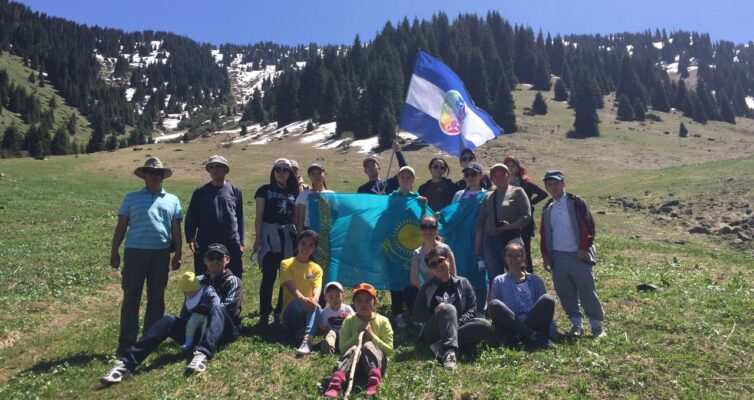
Important update – May 14, 2026.
After a meeting at the Senate of Kazakhstan, senators asked the Akimat of Almaty not to take Pioneer away from its founders. According to Zhanat Karatay, the Akimat promised to cancel the expropriation order within fifteen days.
This announcement is encouraging, but it still needs to be confirmed by an official written act. The central problem also remains: Pioneer must be recognized as a partner of the Almaty Mountain Cluster, with a written agreement protecting its team, its method, its autonomy, its inclusive programs, and its mission for autistic children, children with Down syndrome, and other disabled children.
This rare convergence is now threatened by an expropriation procedure initiated as part of the development of the Almaty mountain cluster and new cable car infrastructure.
The problem is not the modernization of the mountain. Kazakhstan can legitimately want to develop its infrastructure, improve safety, strengthen access to resorts, and structure a major tourism project around Almaty.
The problem is different: modernization should not weaken, dispossess, or empty of its substance a place that has already created exceptional human, social, scientific, and inclusive value.
Pioneer is not only a resort. It is a place built over eleven years by a family, from a previously abandoned site, to respond to needs that very few structures knew how to understand: those of autistic children, children with Down syndrome, children with specific needs, and their families.
1. A family project that became a social model
Pioneer was created by Murat and Zhanat Karatay after the purchase, in 2015, of the former Skitau tourist base, which at that time was abandoned and badly deteriorated.
The Karatay family restored the basic infrastructure and transformed this place into a family resort, with an inclusive orientation directly linked to the experience of their son Alibek, who is autistic, and to the role of sport in his development.
Forbes Kazakhstan describes Pioneer as a project based on inclusion, trust, achievement accessible to everyone, and the idea that the mountain can serve human development, including for children with specific needs. Source: Forbes Kazakhstan
Pioneer was not built by the State. It was built by a family who sold what they had because their autistic son had no suitable place to go.
What exists today is the result of private resources, personal sacrifices, and eleven years of daily work with children for whom appropriate responses were almost nonexistent.
This origin is essential. Pioneer is a family response that became a social model.
In many countries, autism is still approached through deficits, behaviors to be corrected, separation, or medicalization. Pioneer developed another path: offering a natural, sporting, social, and human environment where autistic children can try, participate, learn, self-regulate, and gain confidence.
2. Adapted skiing, altitude, hypoxia, method, and research
Pioneer works with very concrete elements: adapted skiing, physical activity, stays at altitude, natural environment, individualized support, and instructor training.
The altitude of more than 2,000 meters creates natural conditions of moderate hypoxia. Forbes Kazakhstan explains that Zhanat Karatay very early perceived the potential of this environment for children with specific needs. The same article presents Pioneer around hypoxia, skiing, and a method developed by the Karatay family for these children. It also mentions a patent concerning a non-medicinal method aimed at increasing the functional capacities of autistic children under conditions of natural hypoxia. Source: Forbes Kazakhstan
This method is not based on a defectological view of autism. It does not consider autism as an illness or a deficiency to be corrected. It seeks to create favorable conditions to reduce the difficulties produced by unsuitable environments, and to allow autistic children to participate more, with greater confidence, stability, and autonomy.
Pioneer has also gone beyond the stage of local experience. Kazakh media indicate that thousands of children have gone through the resort’s programs, that more than 100 instructors have been trained, and that scientific research on the methods used at Pioneer was conducted with the support of the World Bank. Source: Total.kz
Informburo.kz had already documented a World Bank-supported project amounting to 126 million tenge, carried out on the basis of Ski Park Pioneer, with scientific support from the Institute of Human and Animal Physiology. This project included, in particular, laboratory analyses, rehabilitation, physical exercises, mountain hikes, individual adapted skiing lessons, food, and accommodation for the children. It also aimed to develop an inclusive tourism product ready to be scaled up, with scientific methodological recommendations. Source: Informburo.kz
Pioneer therefore represents a model that can inspire other regions of Kazakhstan, and even other countries.
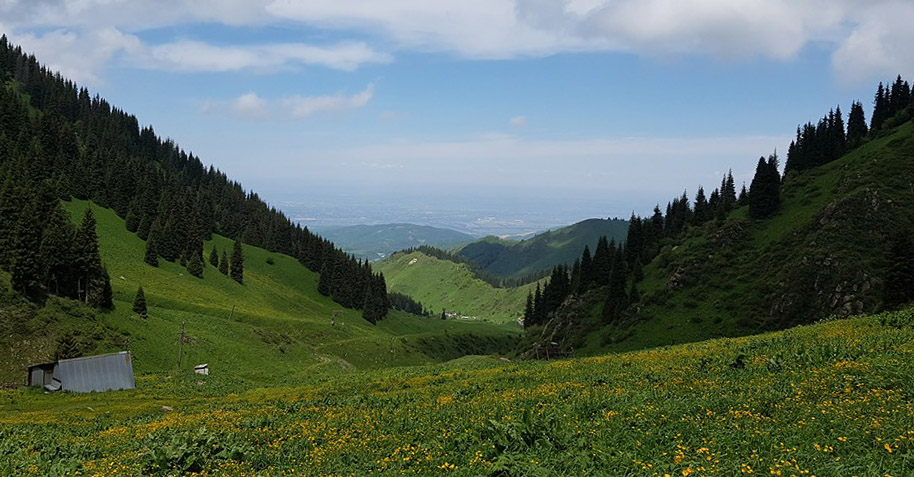
2 bis. What the available articles, publications, and videos confirm
The documents transmitted by Zhanat Karatay and the already published articles should not simply be added as links. Their content reinforces several essential points: Pioneer is a family project that became a recognized inclusive center, a place of applied research, a rehabilitation system through adapted physical activity, a space of inclusion for disabled children, and a concrete example of what Kazakhstan can preserve within the Almaty Mountain Cluster.
The scientific publication entitled Influence of Midlands as a Means of Strengthening Immunity in Children with Autism Spectrum Disorders, published in 2020 in the journal Autism and Developmental Disorders, includes U.N. Kapysheva, Zhanat K. Karatay, S.K. Bakhtiyarova, and B.I. Zhaksymov. Zhanat Karatay is affiliated with TOO “Ski Park Pioneer”, while the other authors are linked to the Institute of Human and Animal Physiology in Almaty. Read the scientific publication in PDF; ResearchGate page.
This publication does not present Pioneer as a simple ski station. It describes a model combining the natural environment of mid-mountain areas, moderate hypoxia, dosed physical activities, adapted exercises, movement in the mountains, learning to ski, and work with specially prepared instructors. The study concerns 50 children diagnosed with ASD, aged 6 to 16, who followed four seasonal ten-day courses at Ski Park Pioneer, located at an altitude of 1800 meters in the Alatau mountains near Almaty.
The authors indicate that these courses were associated with positive changes in certain immune indicators, as well as parental feedback mentioning improvements in psycho-emotional state, communication, and socialization. These elements must be presented with scientific caution, but they confirm that Pioneer has already been a field of study, experimentation, and methodological development, and not a mere leisure space.
The Forbes Kazakhstan article confirms another dimension: Pioneer was born from the transformation of an abandoned former tourist base, Skitau, purchased in 2015 by Murat and Zhanat Karatay. The article shows that the family chose not to turn this land into a closed real estate project, but into a family, social, and inclusive space. It also emphasizes the role of altitude, hypoxia, the Karatay family’s method, adapted skiing, and work with autistic children, children with ADHD, children with Down syndrome, and other children with neurological or developmental particularities. Read the Forbes Kazakhstan article.
The same article also underlines that Pioneer functions as a sustainable project, reinvesting its resources in the development of the place, improvement of slopes, purchase of equipment, instructor training, and structuring of its programs. It mentions a 140-place capacity, a perspective of expansion, major family investments, a local team, and a clientele that extends beyond Kazakhstan, with visitors from several countries. This presentation reinforces the idea that Pioneer is not a marginal structure, but an already built social, economic, tourist, and human asset.
An article published by Liter.kz on May 24, 2025 is particularly important because it publicly records support for this direction at the level of the Government of Kazakhstan. The article states that the Prime Minister of Kazakhstan, Olzhas Bektenov, supported Murat Karatay’s initiative to create a network of resorts for children with specific needs in the country. This point is essential in the current situation: Pioneer is not an isolated private object suddenly appearing in a land dispute, but a project already presented at government level as a model that could be developed on a larger scale. Read the Liter.kz article.
Public position of the Prime Minister of Kazakhstan.
« В рамках развития Алматинского горного кластера надо обязательно предусмотреть инфраструктуру для детского туризма, в том числе и для особенных детей », — подчеркнул Олжас Бектенов.
English translation: “As part of the development of the Almaty Mountain Cluster, infrastructure for children’s tourism, including for children with specific needs, must necessarily be provided,” emphasized Olzhas Bektenov.
This quotation is important because it directly links the development of the Almaty Mountain Cluster with the need to provide infrastructure for children’s tourism and for children with specific needs. The current threat to Pioneer’s essential land therefore appears particularly contradictory: a place that already fulfills precisely this mission should be protected and integrated as a partner, not weakened.
The Liter.kz article also recalls that Zhanat and Murat Karatay became experts in inclusive education after the birth of their son Alibek, diagnosed autistic in childhood. It describes how, nearly thirty years ago, the family had to seek for itself paths for the child’s development and integration into society, and then created, on that basis, a non-medicinal approach combining mountains, sport, and inclusive pedagogy.
The article indicates that in 2015, the Karatay spouses created the first inclusive family resort Pioneer in the Medeu district of Almaty, on the basis of one of the oldest ski slopes in Kazakhstan. According to the article, more than six thousand children have gone through the resort’s programs, more than one hundred instructors have been trained, and scientific research on the methods used was carried out with the support of the World Bank.
Liter.kz also emphasizes that behind these numbers are real children who began to speak, walk, and communicate, as well as parents in whom hope appeared for a more autonomous future for their children, with the possibility of working and earning income. This formulation is particularly important because it shows the human meaning of Pioneer: it is not only tourism, but the restoration of a life perspective for children and families.
Finally, the article presents Pioneer as a model already ready to be developed at State level: a competence center for inclusive tourism, a school for preparing specialists, infrastructure corresponding to international standards, and a platform for the development of children’s, family, and health tourism. This reinforces the central argument of this article: if the Government has already recognized the need for such infrastructures, Pioneer should be protected as the existing Kazakh base of this direction, and not endangered by expropriation.
An interview published by TravelPress.kz with Lyudmila Kuznetsova, a specialist in integrated territorial development, international expert in sustainable tourism development, and general director of TOO “GeoData Plus”, provides important insight. She explains that the situation of Pioneer should not be understood as a simple land dispute: the risk is to lose much more than a territory. Read the TravelPress.kz interview with Lyudmila Kuznetsova.
Lyudmila Kuznetsova emphasizes that opposing tourism development to rehabilitation for children with specific needs is a false alternative. In the best international practices, inclusion does not oppose resort development; on the contrary, it represents a higher level of service and an important element of a country’s international image. According to her, the situation in Almaty looks like a serious systemic dysfunction: the Pioneer project is first recognized and supported at a high level, and then a local expropriation decision threatens the very basis of this project.
The interview also explains that removing part of the territory would not only affect the patrimonial interests of the center, but also the safety of the children and the rehabilitation method itself. According to the expert, the project could create a dangerous crossing between skier flows and the zones used by beginners and children with specific needs. For autistic children, calm, predictability, and a sensory-safe environment are essential; the arrival of noisy commercial infrastructure at the heart of such a zone could destroy the therapeutic atmosphere for which Pioneer was created.
Lyudmila Kuznetsova also recalls that TOO “GeoData Plus” had worked concretely with Pioneer on a cable car project, and that this project had received a positive opinion from the Госэкспертиза. This means that the possibility of developing Pioneer’s infrastructure cautiously, while respecting its inclusive orientation, had already been technically studied and officially validated. For this reason, she considers it more logical and economically more reasonable to integrate the existing inclusive resort into the overall network than to break an already built social ecosystem.
The interview also compares this situation with international practice: in the United States, France, and Canada, inclusive mountain centers are considered strategic resources, benefit from long-term guarantees, public support, and become elements of the country’s international image. In this sense, weakening or destroying Pioneer would be not only a social mistake, but also a reputational risk for Almaty and Kazakhstan.
This interview therefore reinforces the central conclusion of this article: Pioneer should not be treated as an obstacle to the Almaty Mountain Cluster, but as an already existing inclusive asset that must be protected, integrated, and developed through a loyal partnership, and not through expropriation or a break in the method built over eleven years.
The 24KZ article on the meeting of the Council for Inclusion at the Senate of Kazakhstan gives a broader institutional framework. It reports that the Chairman of the Senate, Maulen Ashimbayev, presented support for inclusion as an integral part of building a “Just Kazakhstan”, with emphasis on education, sport, and the social sphere. It also mentions the development of inclusive sport in the country, with specialized clubs, sports schools, and thousands of disabled athletes, as well as the preparation of legislative changes aimed at strengthening support for children with specific needs. Read the 24KZ article.
This context is important: protecting Pioneer would be a very concrete way of transforming national inclusion principles into observable reality. It is not only about affirming that inclusion is important, but about preserving a place where inclusion already exists, with children, families, instructors, a method, experience, and results.
The Shanger article devoted to Zhanat Karatay presents her journey from mother to expert in the field of autism. This type of story shows that Pioneer did not appear as an abstract project, but as a progressive response to a real family experience, concrete difficulties, the absence of adapted responses, and then the desire to help other children and other families. Read the Shanger article in English.
The Burger King Kazakhstan episode, also mentioned by Zhanat Karatay, shows another aspect of her action: the fight against attitudinal barriers, discrimination, and humiliating behavior toward autistic people. Media reported that her son Alibek, an autistic employee at Burger King Kazakhstan, was allegedly pushed to leave his job in a context of harassment or pressure, which triggered a public reaction and the intervention of labor authorities. This element should not distract the article from its main subject, Pioneer, but it shows that Zhanat Karatay’s work goes beyond managing a resort: it is part of a concrete defense of the dignity and social participation of autistic people. Read the Orda.kz article in English.
Finally, Zhanat Karatay transmitted a video in Russian showing the scale of the development of Pioneer and adapted skiing. Even without replacing written data, this type of video has particular strength: it allows one to see that the project is not reduced to declarations, but that it exists concretely, with children, families, instructors, activities, organization, collective energy, and continuity. According to Zhanat Karatay, more than 1000 children participate in the programs each year. This video can therefore visually show what the texts describe: Pioneer is a living, active, already structured center.
Documentary video transmitted by Zhanat Karatay.
This video in Russian shows the scale reached by Pioneer and its adapted skiing programs. It illustrates the work accomplished with children, families, instructors, and adapted physical activity in the mountains.
2 ter. The presentation at the Senate of Kazakhstan on May 12, 2026
The presentation prepared for the Senate of Kazakhstan on May 12, 2026 strongly reinforces Pioneer’s institutional credibility. It does not present Pioneer as a simple ski station, but as the first inclusive family resort in Kazakhstan, carrying proposals for financing and public partnership with the Akimat of Almaty.
From its first page, the presentation highlights three structuring data points: more than 10,000 children already reached by the programs, 11 years of experience, and more than 100 trained instructors. These figures show that Pioneer is already an organized, experienced, and useful reality, and not a theoretical or marginal project.
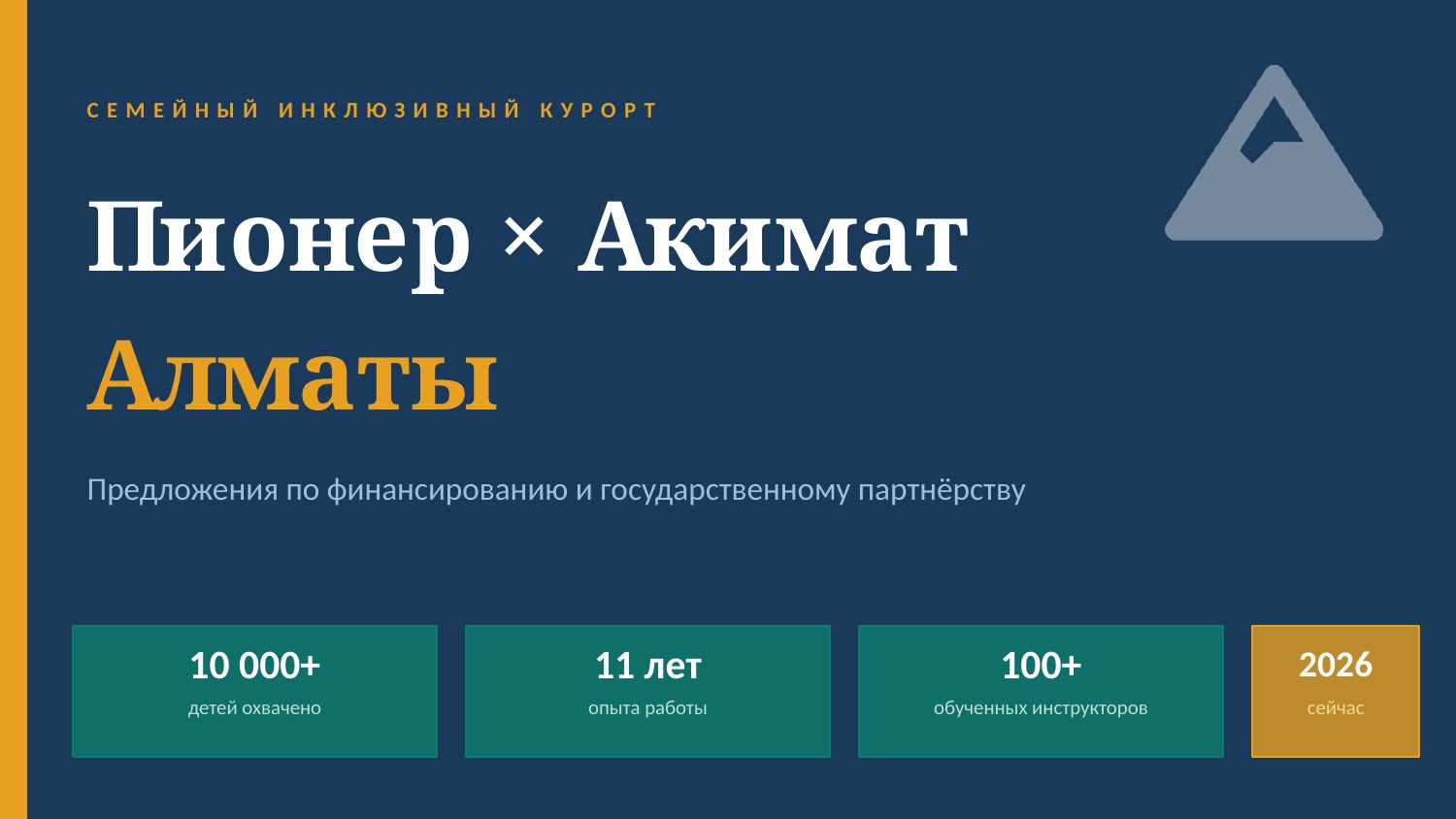
The presentation also recalls the family origin of the project: the birth of Alibek Karatay, who is autistic, 27 years ago, the absence of sufficient responses at the time, and then his parents’ search for a path based on mountains, sport, and inclusive pedagogy. It explains that in 2015, Murat and Zhanat Karatay founded Pioneer on the basis of a former ski slope in the Medeu district, and that this experience became a proposal for a national model.
The document insists on the scale of the need: more than 300,000 children with special educational needs in Kazakhstan, according to the official data cited in the presentation. It also indicates that five of Pioneer’s six programs are not funded by the State, and that only the adapted skiing activity was carried out with the support of the sports administration between 2018 and 2026.
This information is very important for understanding the current situation: Pioneer is not asking for a privilege, but for the recognition and stabilization of work already accomplished, even though most of its programs have been carried by the company and the family, without regular public funding.
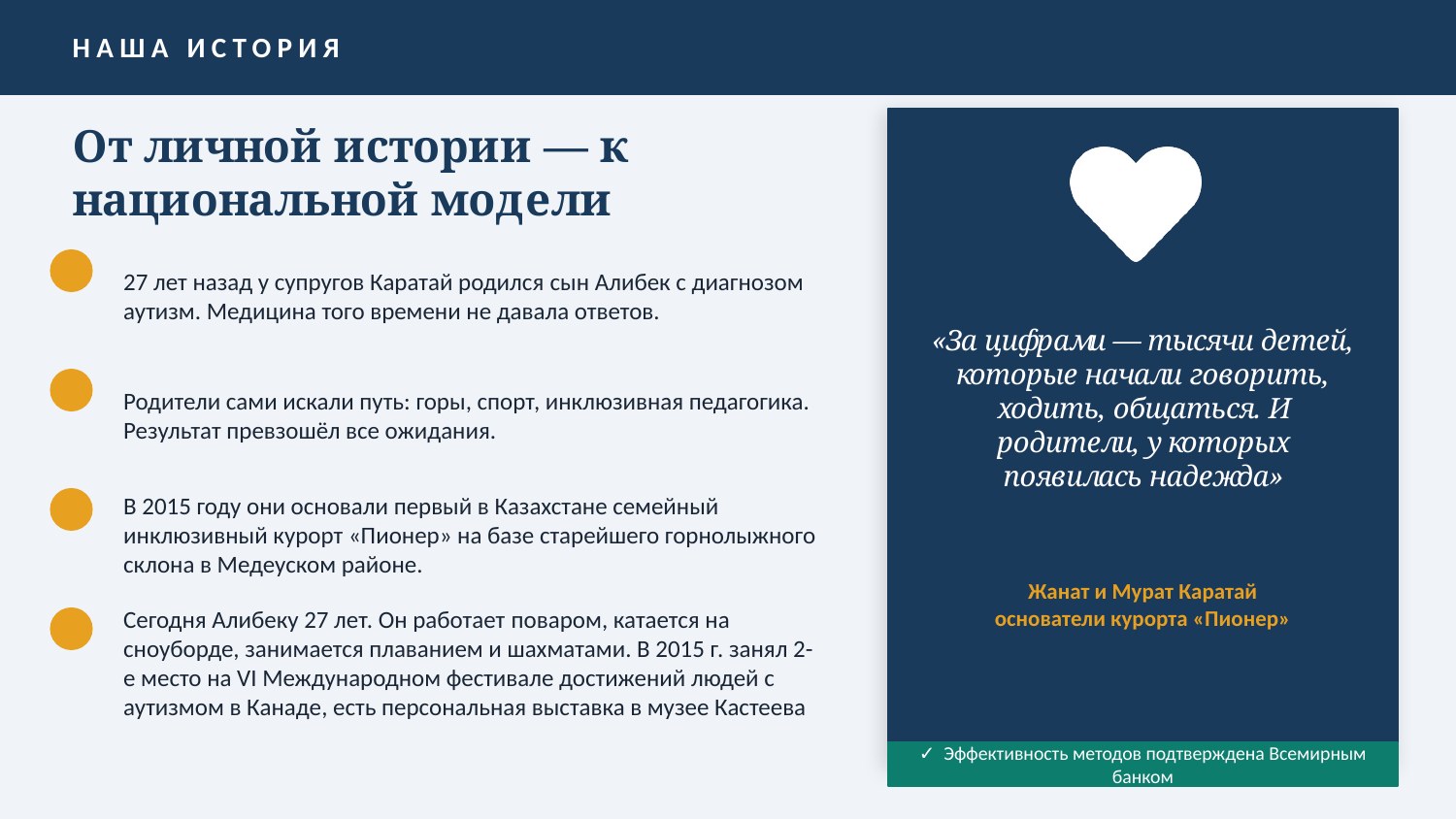
The presentation lists six programs: adapted skiing, the summer mountain program, the inclusive children’s camp, the school of instructors, family weekends, and health tourism. It thus shows that Pioneer is not only linked to winter skiing, but forms a complete structure of inclusion, rehabilitation, training, family support, and social tourism.
The document proposes three concrete mechanisms for partnership with the Akimat: financing through public social procurement via education or social protection; infrastructure support through tourism and the mountain cluster; and grants or targeted financing through youth policy or social protection. These proposals are important because they show that Pioneer does not limit itself to denouncing a threat: it also proposes concrete administrative and financial solutions.
The presentation finally details a first operational step: the return of the inclusive summer mountain program. This program would target, in particular, children with ASD, cerebral palsy, Down syndrome, and other particularities. It would combine mountain therapy, adapted sport, and inclusive pedagogy, with an announced capacity of 50 to 100 children simultaneously and 500 to 1000 children per season.
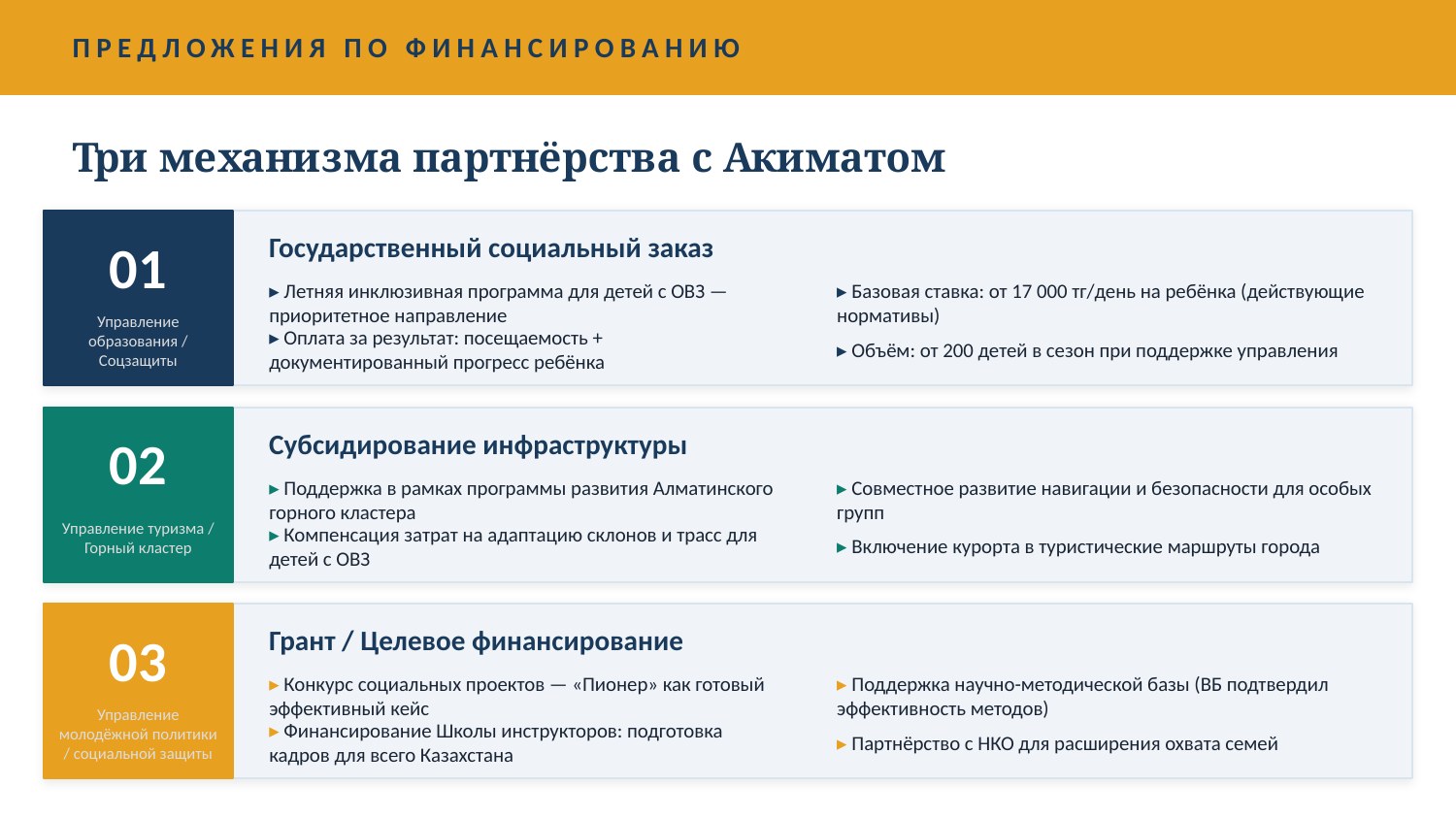
The roadmap proposed for 2026 provides for a protocol of intent with the Akimat, a financial decision in May, the launch of the summer program in June, and then an assessment in September with negotiations on the financing of all six programs for 2026–2027.
This institutional document therefore reinforces the central argument of this article: Pioneer should be treated as a useful public partner, already experienced and capable of carrying a concrete part of Kazakhstan’s inclusion policy. In this context, expropriation or integration into the Almaty Mountain Cluster without a written agreement, without guarantees, and without protection of the method developed by Zhanat Karatay and her team would be contradictory to the very objectives of inclusion, adapted sport, family support, and social development.
Important institutional document.
Presentation prepared for the Senate of Kazakhstan, May 12, 2026: “Pioneer × Akimat Almaty — proposals for financing and public partnership”.
Consult the full presentation in PDF format
 Loading...

 Reload document
  Open in new tab
 3. An inclusive ecosystem, not just a ski station
Pioneer is not limited to the mountain resort and adapted skiing. Over the years, a broader ecosystem has been built around this place.
This ecosystem includes the Pioneer mountain center, inclusive camps, the training of instructors, teachers, coaches and support workers, parent education, urban programs such as Campus Pioneer, inclusion experiments in complementary education, and the development of digital tools intended to better support families and professionals.
Parent education is part of this architecture. Pioneer developed an online school to help families better understand autism without a defectological vision, reduce stress, and better take into account sensory particularities, rhythm, food, communication, and the family’s emotional balance.
The ecosystem also includes the experience of the Inclusive House of Schoolchildren No. 7, which made it possible to work on inclusion in the complementary education system. The idea is not to isolate children with different needs, but to adapt the environment so that they can participate in circles, programs, and forms of social life.
Campus Pioneer extends this work in the urban environment, with activities related to socialization, skills development, preparation for autonomy, vocational orientation, and support for families in daily life.
A next step also consists of developing an assistant based on artificial intelligence. Its role would not be to replace parents, teachers, coaches, or specialists, but to help them better understand the child, their rhythm, language, cultural context, sensory needs, communication, educational goals, and the evolution of their path.
The mountain center is the practical nucleus around which parent education, professional training, urban programs, inclusive camps, adolescent socialization, and future digital support tools have developed.
Expropriation would therefore not only threaten a resort. It would threaten the heart of a much broader inclusive architecture, built for years around concrete experience with children and families.
4. A yearly mountain camp, alive and sought after
An essential part of Pioneer is its mountain camp for children, which over the years has become one of the project’s most recognized and most requested programs.
It is not only a winter camp or a program limited to skiing. Pioneer operates all year round, adapting its activities to each season.
In winter and spring, the heart of the program is based on alpine skiing and adapted skiing. In summer and autumn, the activities shift toward mountain hikes, rollerblading, cycling, outdoor sports, collective programs, cohesion activities, and active development experiences in the open air.
Across all seasons, the same natural factor remains central: the effect of moderate natural hypoxia produced by the mountain environment.
According to the experience reported by Pioneer, this environment positively influences not only autistic children and children with other developmental particularities, but also children with typical development.
Families frequently report that children become physically stronger, emotionally calmer, more confident, more independent, and more able to adapt to challenges and collective environments.
These effects do not come from nature alone. They are reinforced by the methodology developed by Pioneer, which combines physical activity, movement, structured daily rhythm, social interaction, emotional safety, progressive overcoming of difficulties, immersion in nature, reduction of urban stress, and reduction of digital overload.
According to figures communicated by Zhanat Karatay, more than 10,000 children with special educational needs have participated in Pioneer’s adapted skiing programs, and more than 15,000 children have participated in Pioneer camps overall.
The winter ski camp has become particularly well known. Places are often booked almost immediately after registration opens. Children come not only from Kazakhstan, but also from other countries.
A loyal family summarized its experience with this phrase: “Pioneer is better than Artek.” This comparison shows that many families do not see Pioneer as a simple tourism product, but as a living environment of freedom, growth, friendship, sport, and authentic mountain experience.
One of the important characteristics of the camp is its intensive but safety-centered teaching system. In one week, a child who has never skied can begin descending mountain slopes with confidence and safety.
Pioneer has developed its own model of instructor training and safety, designed around the needs of children. The resort voluntarily chose a “ski only” concept, without snowboard, in order to reduce collision risks and create a more predictable, more controlled, and safer environment, particularly important with a large number of children and participants in inclusive programs.
For many children, the Pioneer camp becomes a first experience of independence, collective life, deep contact with nature, overcoming fear, and building self-confidence.
For autistic children and children with other developmental particularities, it can become one of the first environments where they participate in common activities alongside other children, without segregation or stigma.
5. An economically viable and humanly different initiative
Pioneer is not only a social or inclusive initiative. Over the years, it has also become an economically viable model, with a loyal public, a clear identity, and a particular atmosphere.
From the first years, Pioneer attracted a specific community: families, nature lovers, mountain tourists, and skiers seeking calm, safety, respect for children, and an atmosphere centered on the human being.
At first, many people could hardly imagine that intensive work with autistic children or children with other developmental particularities could coexist with a sustainable recreational environment appreciated by the public.
Over time, visitors saw the results: children who previously had difficulties entering into relationship with the outside world began to ski, participate in camps, go to school, and interact alongside other children.
Pioneer was never designed as a luxury resort. Its concept is based on simplicity, functionality, proximity to nature, and a direct relationship with the mountain.
For many visitors, this experience is worth more than a noisy, overloaded, or excessively commercialized tourist environment.
Pioneer has thus demonstrated that an inclusive model can be compatible with long-term economic viability. Its human atmosphere, its environment based on trust, and its original philosophy have become elements of its popularity and durability.
Pioneer has also been developed as a boutique resort, on a human scale, with a limited size and a personalized approach.
This dimension is one of its strengths. Because it is not a very large standardized complex, Pioneer can adapt more quickly to the needs of families, test new services, work with specific audiences, and implement innovative practices without the usual heaviness of large structures.
In this sense, Pioneer functions as a living laboratory of family and inclusive tourism: a place where ideas can be developed, tested under real conditions, improved through practice, and then possibly integrated into broader tourism systems.
Pioneer should therefore not be seen as a competitor or an obstacle to the major mountain cluster. On the contrary, it can become an innovative and inclusive partner inside this broader whole, bringing experience, methods, and know-how that are difficult to create in massive tourism structures.
6. 2016: the meeting between Pioneer and Autistan
In February 2016, the Diplomatic Organization of Autistan met Zhanat Karatay in Almaty. This meeting was decisive, because it revealed a rare convergence: Pioneer and Autistan shared a non-defectological understanding of autism, while this approach was almost absent from the institutional and social environment of the time.
The “Almaty Autism Speech” conference was organized by Zhanat Karatay and Pioneer for the Diplomatic Organization of Autistan. It made it possible to publicly present an understanding of autism based not on deficiency, but on understanding autistic needs, adapting the environment, and reducing social, sensory, and mental obstacles. Source: Autistan.kz
This moment was very avant-garde. It was probably one of the first public presentations in Kazakhstan of such a clearly non-defectological approach to autism.
Zhanat Karatay’s role was decisive. Thanks to her intuition, trust, and understanding, what had been explained in February 2016 did not remain at the level of a conference. She wanted to make it concrete in her own center, with the first inclusive summer camps at Pioneer.
Pioneer then invited the founder of the Diplomatic Organization of Autistan to participate as an autistic counselor.
This collaboration made it possible to observe, in real situations, what happens when the environment stops treating the autistic child as a problem and begins to create the conditions for their participation.
The article on Autistan.kz presents this participation in the inclusive summer camp, with a detailed report, videos, observations, and concrete examples. Source: Autistan.kz
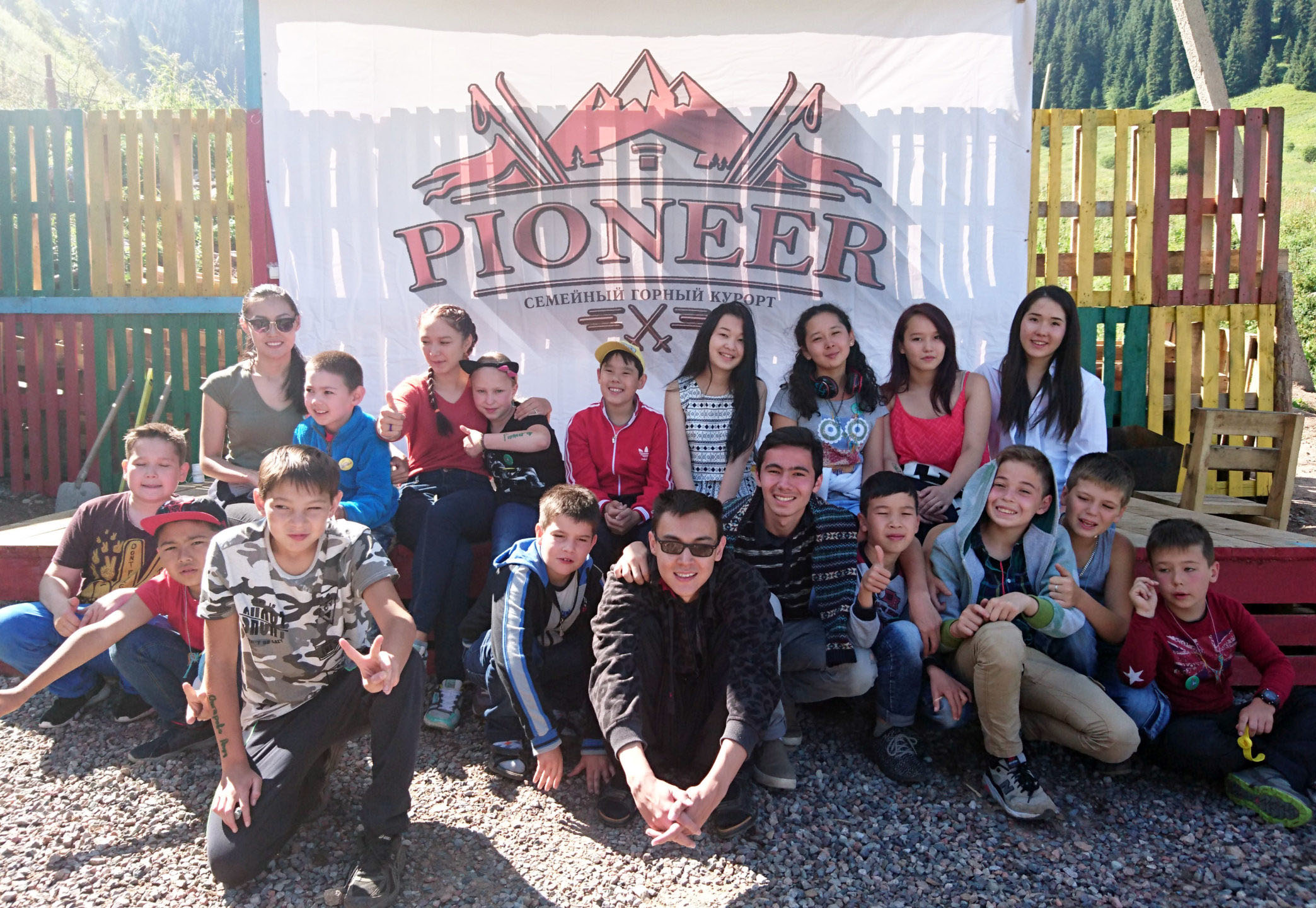
The cases of Mansur, Tima, and Adiyar are documented there. They show that the natural, patient, inclusive, and non-defectological approach can produce rapid and visible progress when adults, other children, the material framework, and the social framework are correctly prepared.
This collaboration worked because Pioneer and Autistan confirmed one another.
Pioneer brought the place, the team, the family experience, the children, the mountain, and the will to do things differently.
Autistan brought autistic analysis, a reading of situations, field advice, and an explanation of what happens when the environment becomes truly accessible to autistics.
For the Diplomatic Organization of Autistan, Pioneer is a place of proof. It still makes it possible today to show public authorities that the non-defectological approach to autism can produce concrete results when applied in an adapted environment.
7. The material birthplace of the Diplomatic Organization of Autistan
Pioneer also has direct importance in the history of Autistan.
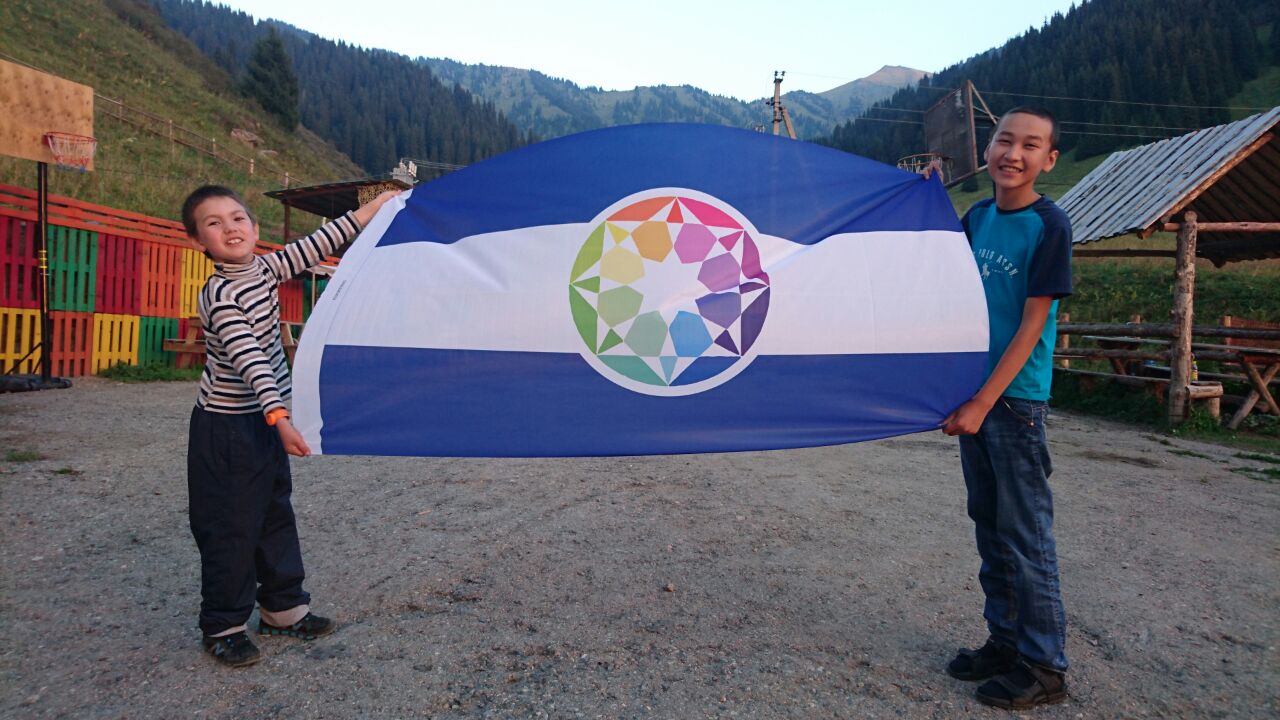
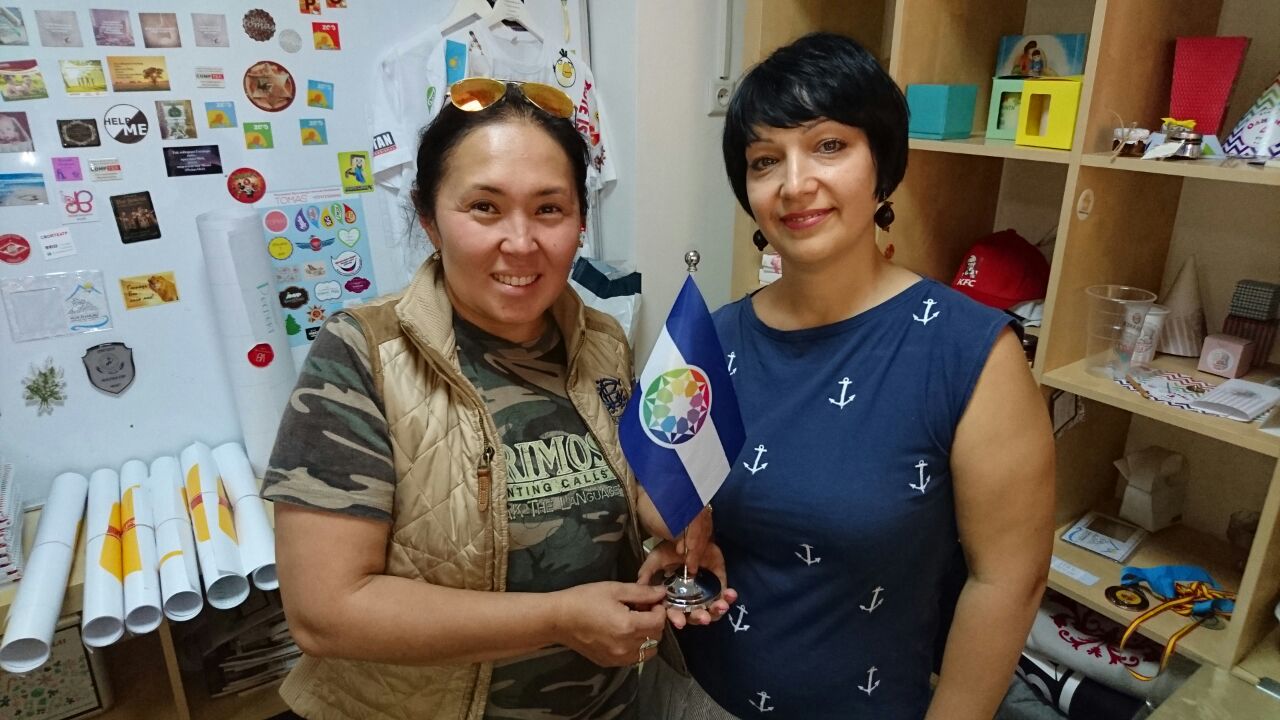
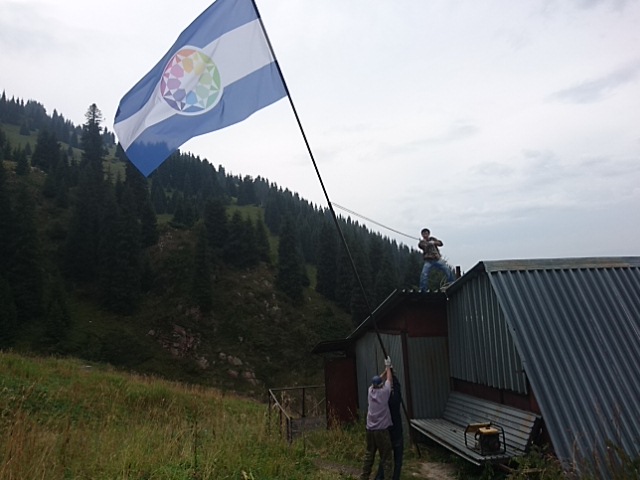
It was at Pioneer, in 2016, that the current flag of Autistan was inspired and designed, in its graphic design and its first material form.
The Autistan.kz article about the birth of the flag indicates that the flag of Autistan was designed in July 2016 at Pioneer Mountain Resort, then printed in Almaty on August 4, 2016. The first material version was presented by Zhanat Karatay, director and owner of Pioneer. Source: Autistan.kz
It was also at Pioneer that the first project of a physical embassy of Autistan in the material world took shape, with a small mountain house provided by Pioneer Mountain Resort as the embassy’s mountain residence.
The Autistan.kz article specifies that this installation had an essentially symbolic value, but that it represented the first passage of the Diplomatic Organization of Autistan from the virtual world toward a material reality. Source: Autistan.kz
Pioneer is also linked to the appointment of Adiyar as the first ambassador of Autistan in the world, in the context of the experiments conducted with him at Pioneer in 2016. The article on the summer camp devotes a part to Adiyar as a volunteer and then as ambassador of Autistan. Source: Autistan.kz
Pioneer is the material birthplace of the Diplomatic Organization of Autistan: the place where its approach found concrete confirmation, where its current flag was born, where its first physical flag existed, where the idea of a physical embassy began to take shape, and where the first ambassador of Autistan was appointed.
Today, the Diplomatic Organization of Autistan has a real physical embassy in Brasília, in the heart of Brazil’s political capital. An essential part of this history began in the mountains of Kazakhstan.
8. An expropriation procedure that raises major concern
The decree of the Akimat of Almaty of April 27, 2026, No. 2/195-562, launches the forced expropriation of land for the needs of the Almaty Mountain Cluster and the construction of cable car stations. Source: prg.kz
According to Kazinform, these lands concern, in particular, TOO “Ski Park Pioneer”, for a total area exceeding two hectares, with transfer planned to the city’s tourism department after the procedure. Source: Kazinform
According to Zhanat Karatay, the targeted plots constitute the basis of Pioneer’s functioning: the base area, the infrastructure, and the spaces where autistic children and other children with specific needs have their sessions every day.
If these plots are taken away from the center, Pioneer could continue to exist formally, but lose its real capacity to function as an inclusive ecosystem.
The issue therefore goes beyond the question of land compensation. It concerns the very continuity of the inclusive project built over eleven years.
The deepest risk is the loss of control, identity, and purpose. If Pioneer is absorbed into a tourist cluster managed by others, without concrete guarantees for its inclusive programs, its instructors, its method, and its autonomy, eleven years of work may disappear behind a simple mountain infrastructure.
9. The Akimat’s response: important recognition, insufficient guarantees
The Akimat of Almaty publicly responded that the information circulating on social networks about a supposed planned closure of Pioneer did not correspond to reality.
In the same response, the municipal administration recognizes that the Pioneer zone is part of the priority and promising territories for the development of the Almaty mountain cluster.
This response also recognizes the site’s natural advantages: gentle and safe slopes, suitable for learning to ski, for beginners, and for inclusive programs.
It gives particular importance to the rehabilitation of children with specific needs, including autistic children, and presents the relief, moderate slopes, and natural environment as favorable conditions for adapted sport, social adaptation, physical rehabilitation, and the development of autonomy. Source: Kazinform
This recognition is important. It confirms, from the municipal administration itself, that Pioneer is not an ordinary mountain site.
However, this response does not provide sufficient guarantees on the essential points: real maintenance of the team, the method, the programs, the autonomy, the founders, the working environment with the children, and the inclusive mission.
The Akimat also states that the current infrastructure is morally and physically outdated and does not meet modern safety requirements, particularly regarding protection and monitoring against avalanches.
Improving safety, engineering networks, roads, tracks, lifts, avalanche monitoring, and accessibility can be legitimate.
But these objectives should not lead to erasing or weakening the very initiative that gave this place its inclusive value.
A truly inclusive modernization should be built with Pioneer, through a clear, written, and loyal partnership, and not through a procedure that would risk preserving the name while withdrawing from the center what makes its substance.
10. A contradiction between national recognition and local expropriation
The situation is all the more worrying because Pioneer is not an unknown or informal project.
The official website of the Prime Minister of Kazakhstan indicates that the second phase of the development of the Almaty Mountain Cluster, starting in 2027, includes the Pioneer and Oi-Qaragai resorts, with their connection by cable car. Source: primeminister.kz
In April 2025, Murat Karatay presented to the Kazakh government the idea of developing a network of inclusive camps and resorts in the country. Kazakh media reported that Prime Minister Olzhas Bektenov then declared that the government would support this direction and that, in the Almaty mountain cluster, infrastructure should be provided for children’s tourism, including children with specific needs. Source: 24.kz
The question therefore becomes very simple: should the development of the cluster strengthen Pioneer as an existing inclusive center, or does it risk replacing Pioneer with a tourist structure that might preserve the name, but not the real mission?
This is where the most worrying contradiction lies.
At the national level, Pioneer appears as an element of the cluster’s development. At the local level, the expropriation of essential land can weaken the center that precisely built this inclusive value.
11. Pioneer does not oppose the development of the cluster
Pioneer is not asking for the Almaty mountain cluster to be stopped.
The development of the cluster can be positive for Kazakhstan. It can improve infrastructure, attract visitors, create jobs, and strengthen Almaty’s tourism image.
But Pioneer can bring something much rarer: an inclusive, social, and human dimension already tested, with methods, trained instructors, a relationship of trust with families, and thousands of children supported.
According to Zhanat Karatay, no real partnership has been proposed in a written, clear, and binding form.
Yet this is the essential point: if Pioneer is to be integrated into the cluster, this integration should be done with its founders, its team, its method, its autonomy, and its mission.
Pioneer can become the inclusive heart of the Almaty mountain cluster. But this requires strengthening it, not dispossessing it of what gives it value.
12. More than 300,000 children concerned in Kazakhstan
Zhanat Karatay recalls that there may be more than 300,000 children with special educational needs in Kazakhstan.
For these children and their families, Pioneer is not a comfort option. According to her, it is the only place in Kazakhstan, and even in Central Asia, where they can access mountain-based rehabilitation.
If Pioneer is destroyed as a real center, these children will not simply be redirected to an equivalent alternative. They will lose access that no one else today seems able to offer them.
This reality should be at the center of every public decision.
Kazakhstan ratified in 2015 the United Nations Convention on the Rights of Persons with Disabilities, which commits States to promoting the participation of persons with disabilities in society, on the basis of equality and without discrimination.
Pioneer gives this commitment a concrete form: a place where autistic children, children with Down syndrome, or children with other specific needs can participate in the mountain, sport, collective life, and personal development. Source: UNDP Kazakhstan
13. “Save Pioneer Together”: forty families came to defend a living place
On May 9, 2026, a community day entitled “Save Pioneer Together” took place at Pioneer.
About forty families came to the center, with children of all ages presenting different diagnoses or particularities: autism, Down syndrome, ADHD, cerebral palsy, and other situations of disability or specific needs.
It was not a political demonstration. It was not an aggressive protest. They were real families, parents and children, who came on a holiday morning all the way to the mountain because this place matters concretely in their lives.
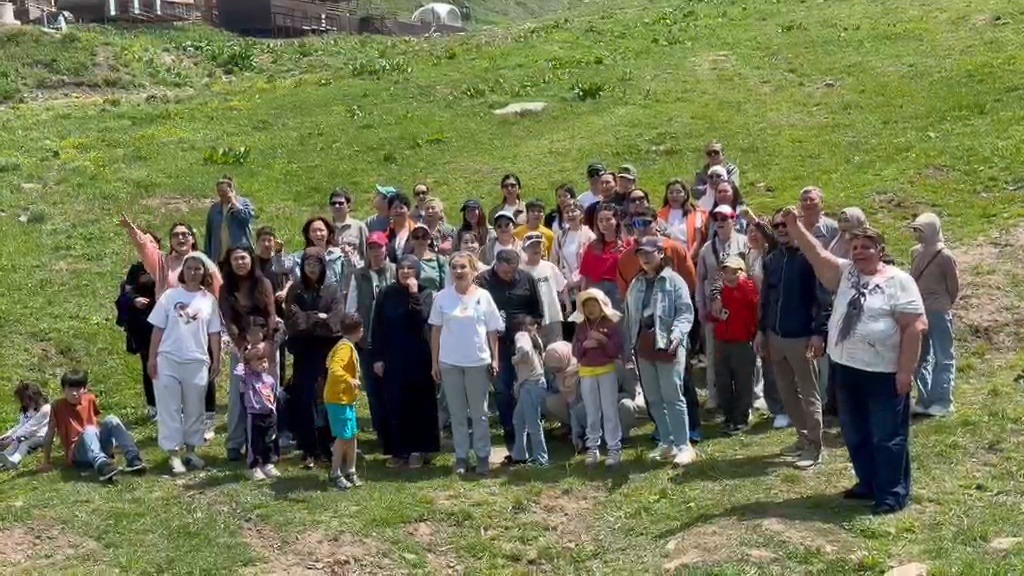
Each family recorded a personal video testimony. The common message was clear: adapted skiing at Pioneer, under the direction of Zhanat Karatay, truly helps children.
Parents explained what their children could not do before Pioneer, and what they can do today thanks to the work accomplished in this center.
Video testimony of a family who came to Pioneer for the “Save Pioneer Together” community day.
A collective video was also recorded on the slope, with the families gathered in the very place that the expropriation procedure threatens to deprive of its essential land.
Collective video recorded on the Pioneer slope with the families present.
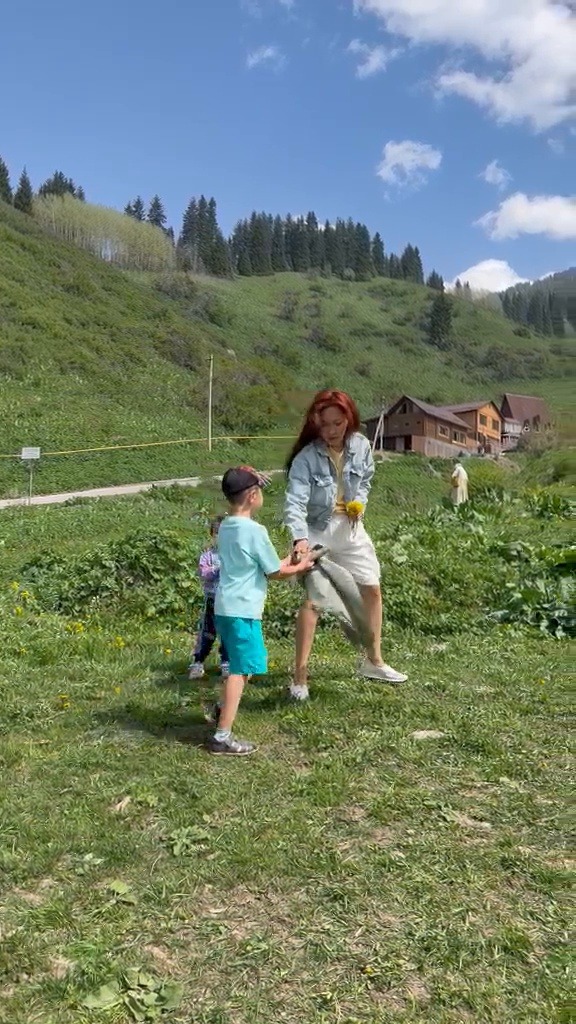
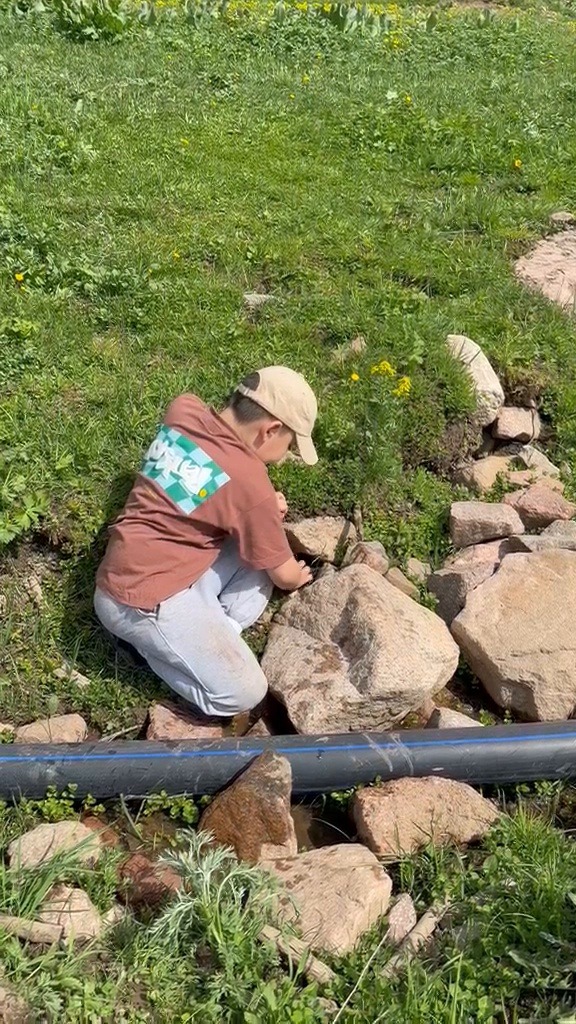
This day shows what administrative texts do not always say: Pioneer is not an abstract piece of land, nor a simple tourist infrastructure. It is a living, loved, used, useful, and irreplaceable place for many families.
A ski station can be modernized. A road can be repaired. A cable car can be installed. But a relationship of trust built with autistic children, children with other specific needs, families, instructors, and a human method cannot be replaced by decree.
This day brings direct human proof: Pioneer is not an abstract plot in an administrative file, but a place where children have progressed, where families have found support, and where an inclusive method has produced concrete effects in real life.
14. The paradox to avoid
The Almaty Superski project and the Almaty mountain cluster can bring Kazakhstan modern infrastructure, jobs, tourism, and better international visibility.
But Pioneer should not be penalized for the value it itself helped create.
Murat and Zhanat Karatay transformed an abandoned base into a living, inclusive, recognized center, frequented by thousands of children, supported by scientific experience, cited in government discussions, and carrying a model for other regions.
The result of this work should not be an expropriation that weakens the family and the team that created this value.
The development of the cluster should strengthen Pioneer, not dispossess it of its role.
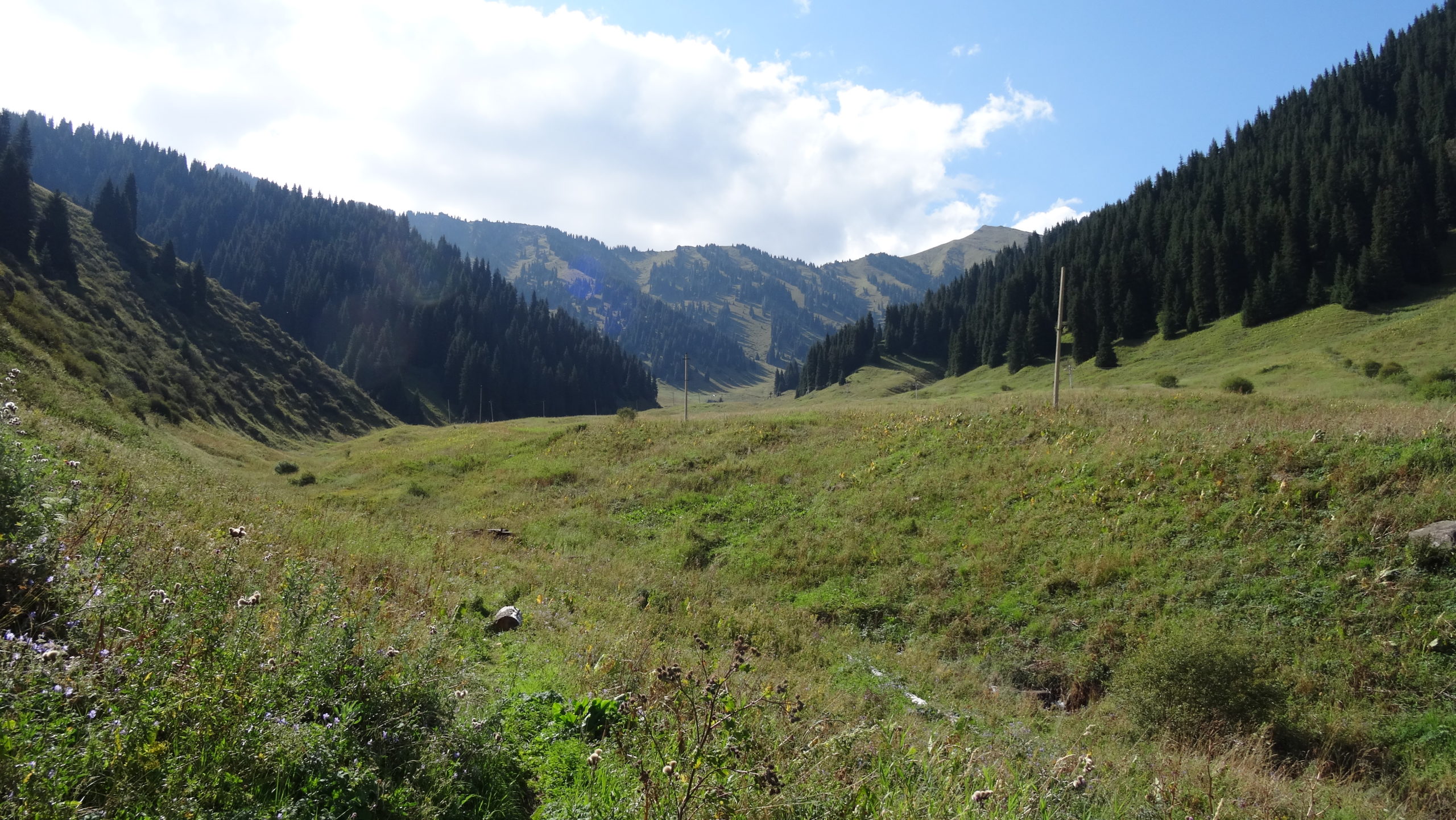
15. An opportunity for Kazakhstan
Kazakhstan has a rare opportunity here.
By protecting Pioneer, it can show that a national mountain project is not limited to equipment, gondolas, tourist flows, and investments.
It can show that a modern country knows how to recognize and protect human initiatives that already exist, especially when they concern autistic children, children with Down syndrome, and disabled people.
This orientation is consistent with the public statements of the Senate of Kazakhstan. During a meeting of the Council for Inclusion, the Chairman of the Senate, Maulen Ashimbayev, presented support for inclusion as an integral part of building a “Just Kazakhstan”, emphasizing the importance of inclusion in education, sport, and the social sphere, as well as the need to strengthen support for children with specific needs. Source: 24KZ
Protecting Pioneer would therefore make it possible to transform these principles into concrete reality: not only talking about inclusion, but preserving a place where this inclusion already exists, with children, families, instructors, a method, results, and experience accumulated over eleven years.
Pioneer can become an international symbol for Kazakhstan: that of a country capable of developing its mountains without crushing those made most vulnerable by the absence of adapted environments; that of a country capable of associating sport, nature, inclusion, research, family tourism, digital innovation, and a non-defectological approach to autism; that of a country that does not let a local administrative mechanism damage a social jewel built over eleven years.
Gondolas and slopes exist in many countries.
A mountain center combining adapted skiing, natural hypoxia, training, research, autistic inclusion, support for children with Down syndrome, family experience, parent support, urban programs, and future digital assistance tools is much rarer.
Pioneer is an opportunity for children.
Pioneer is an opportunity for families.
Pioneer is an opportunity for Kazakhstan.
16. What should be guaranteed
The Diplomatic Organization of Autistan does not oppose the development of the Almaty mountain cluster.
It asks that Pioneer not be treated as a simple land issue.
The development of the cluster should guarantee Pioneer’s real continuity: its founders, its team, its method, its autonomy, its inclusive programs, its working spaces with the children, and its mission.
Preserving Pioneer is not slowing down progress.
It is preventing a modernization project from losing what could make it exemplary in human terms.
Kazakhstan can choose to protect Pioneer, recognize it, strengthen it, and make it one of the most advanced symbols of the Almaty mountain cluster.
This choice would not be useful only for Pioneer.
It would be useful for autistics, for families, for inclusion, for Kazakhstan’s international image, and for all those who believe that a modern country is also measured by the way it protects its most human initiatives.
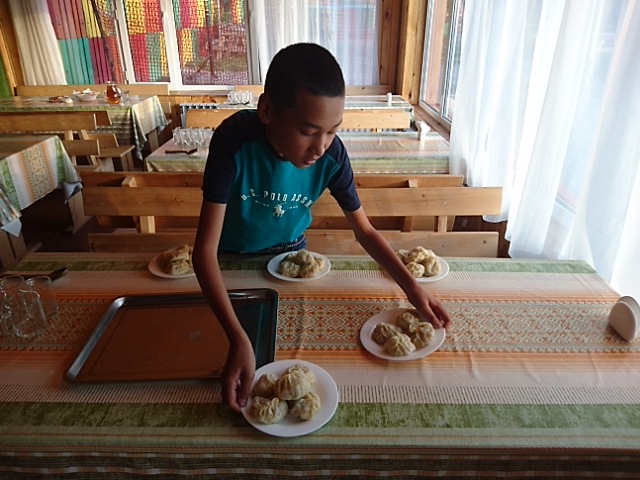
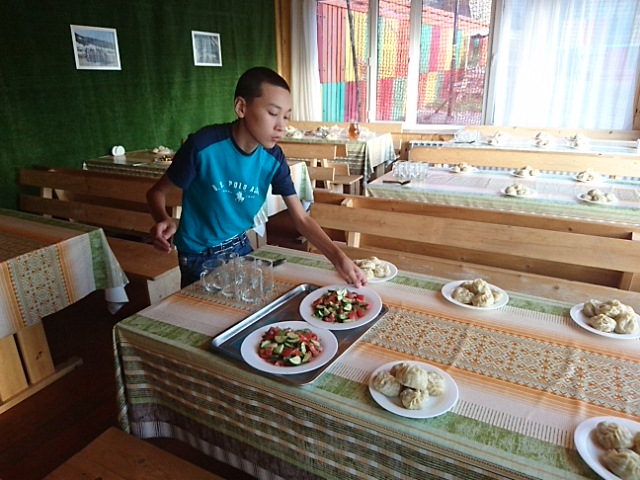
17. Complementary gallery: visual proof of the experience conducted at Pioneer in 2016
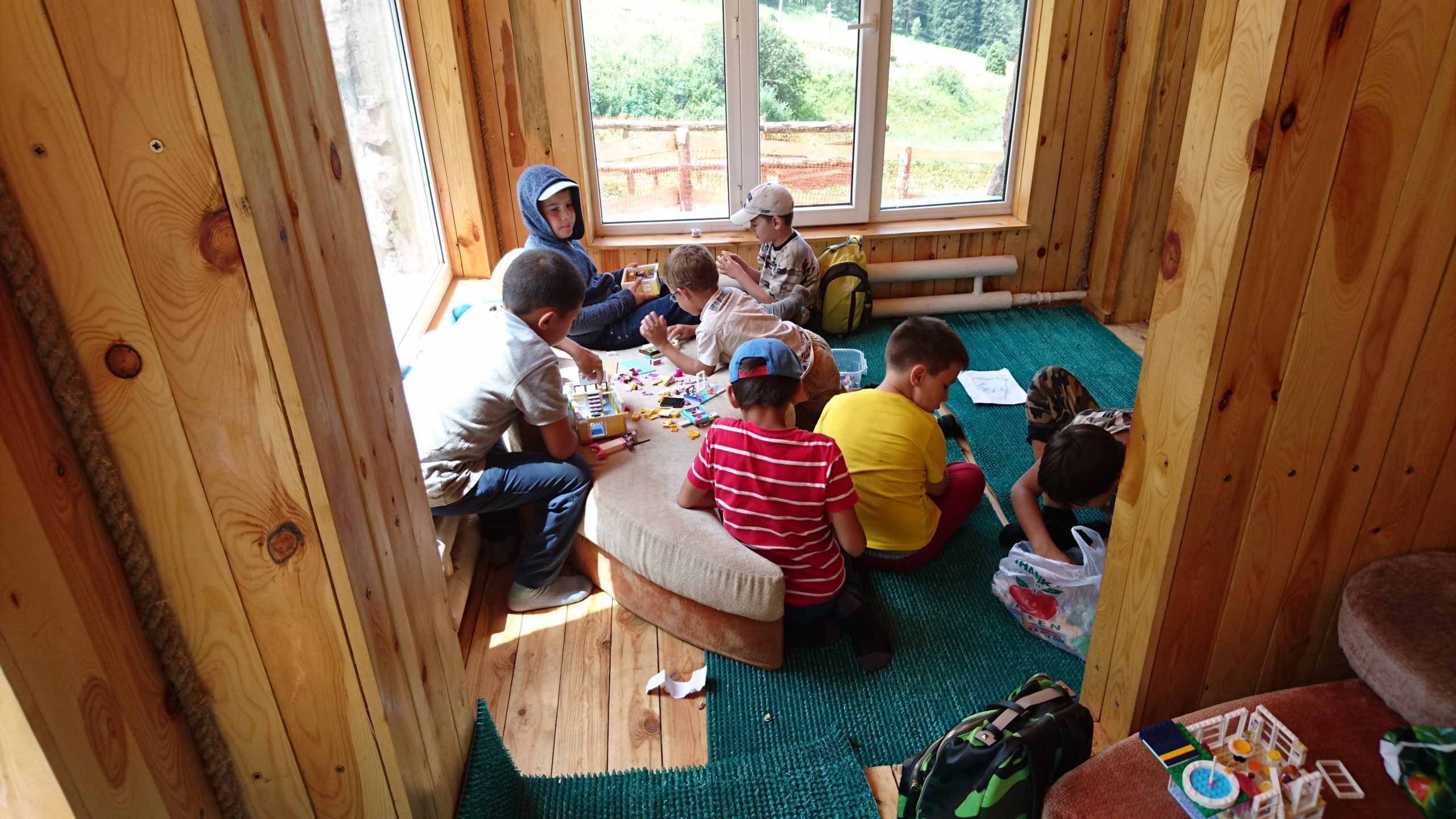
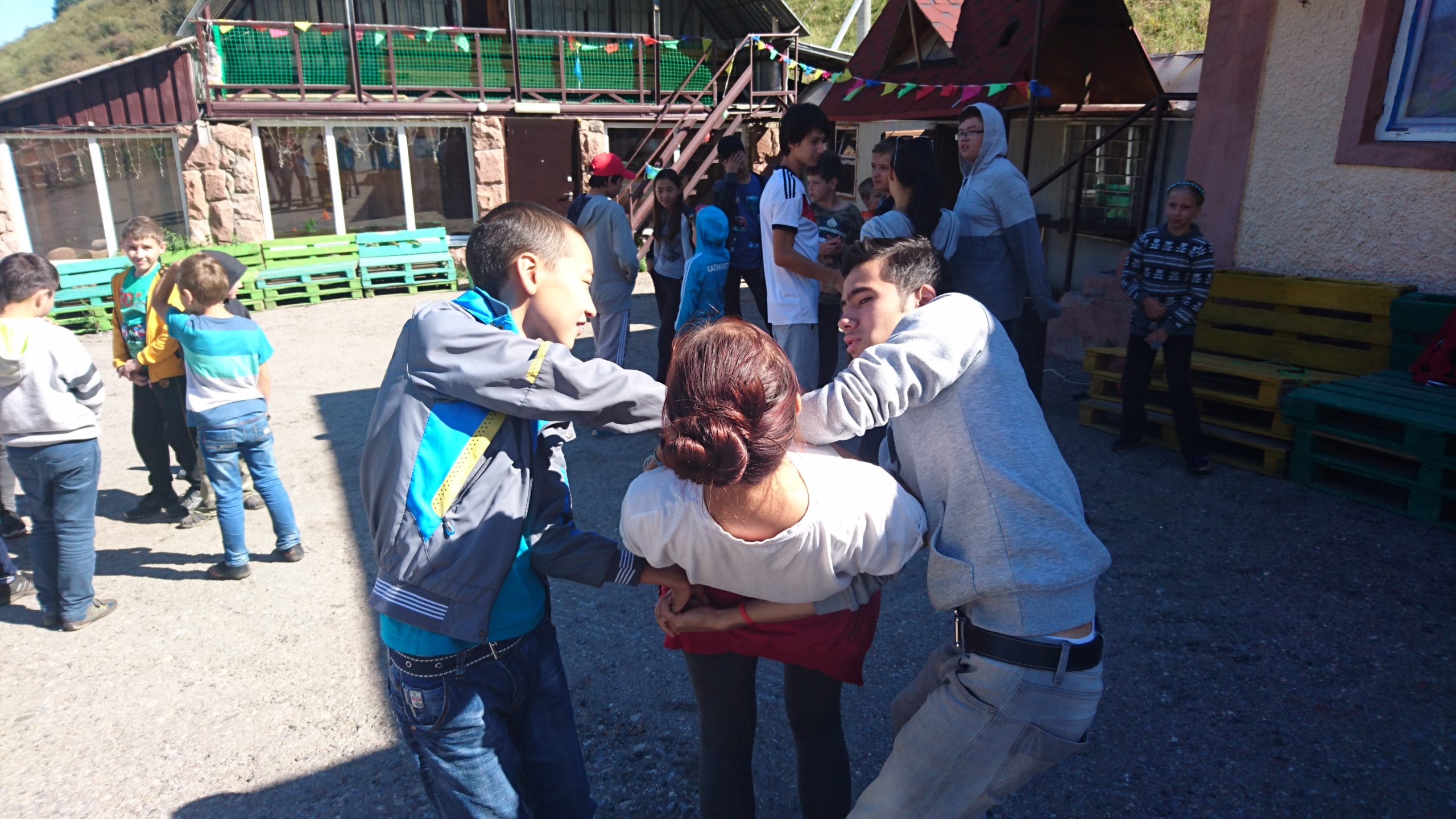
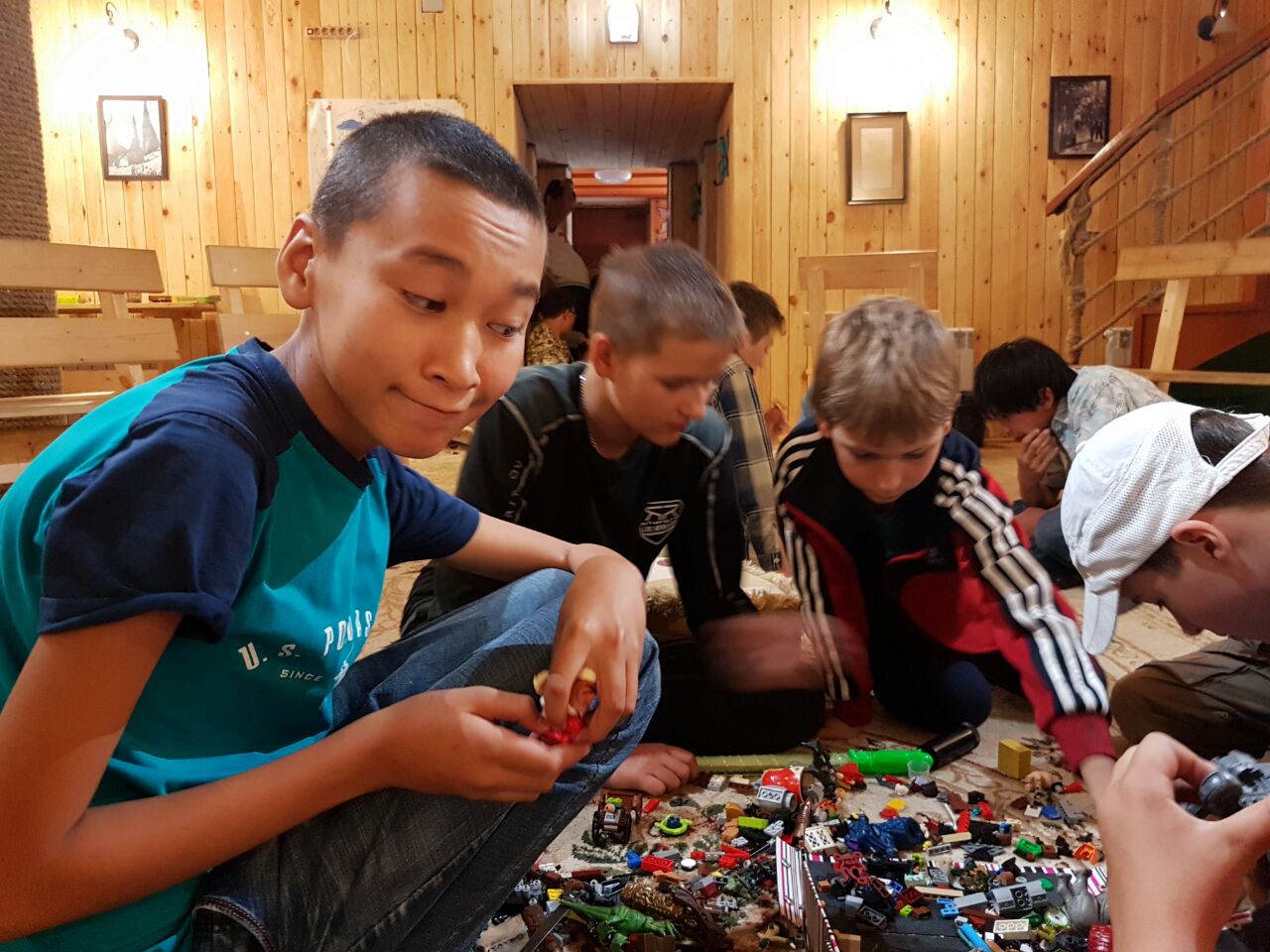
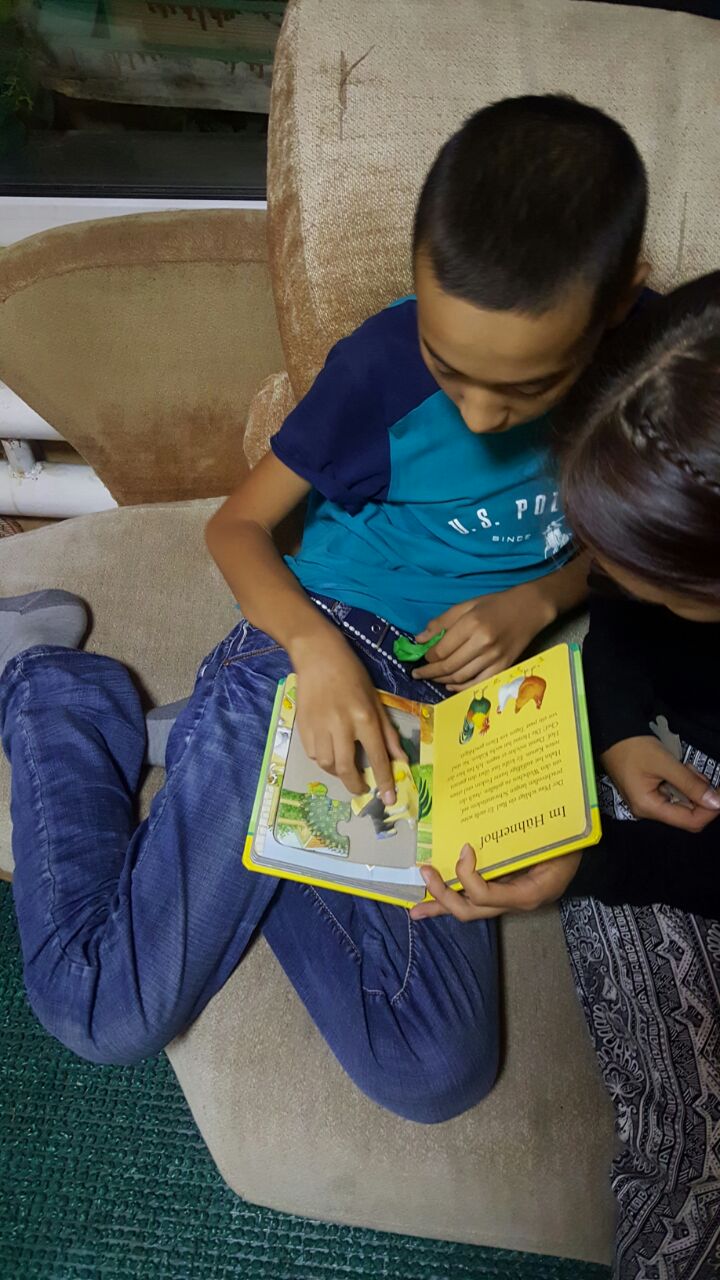
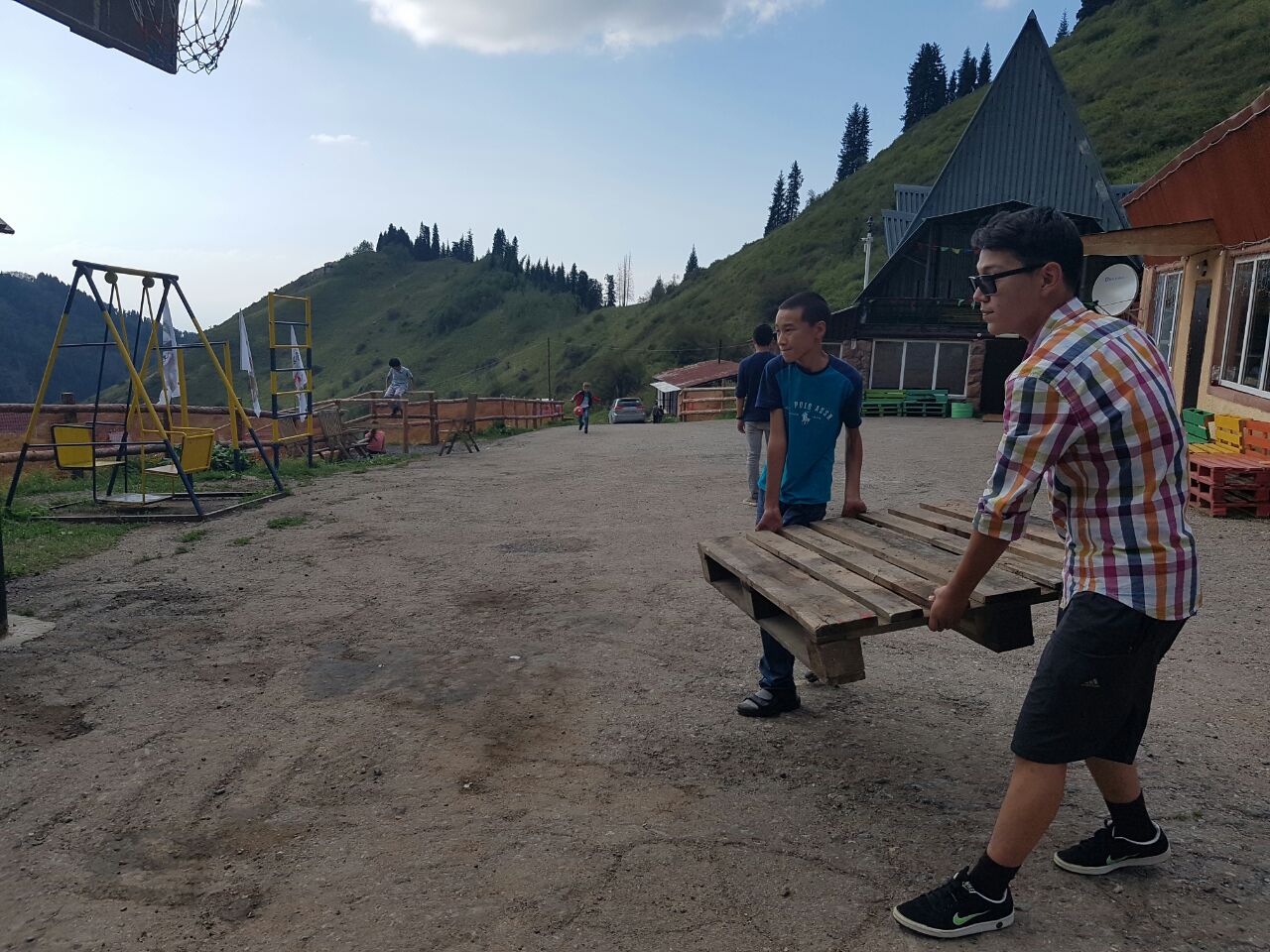
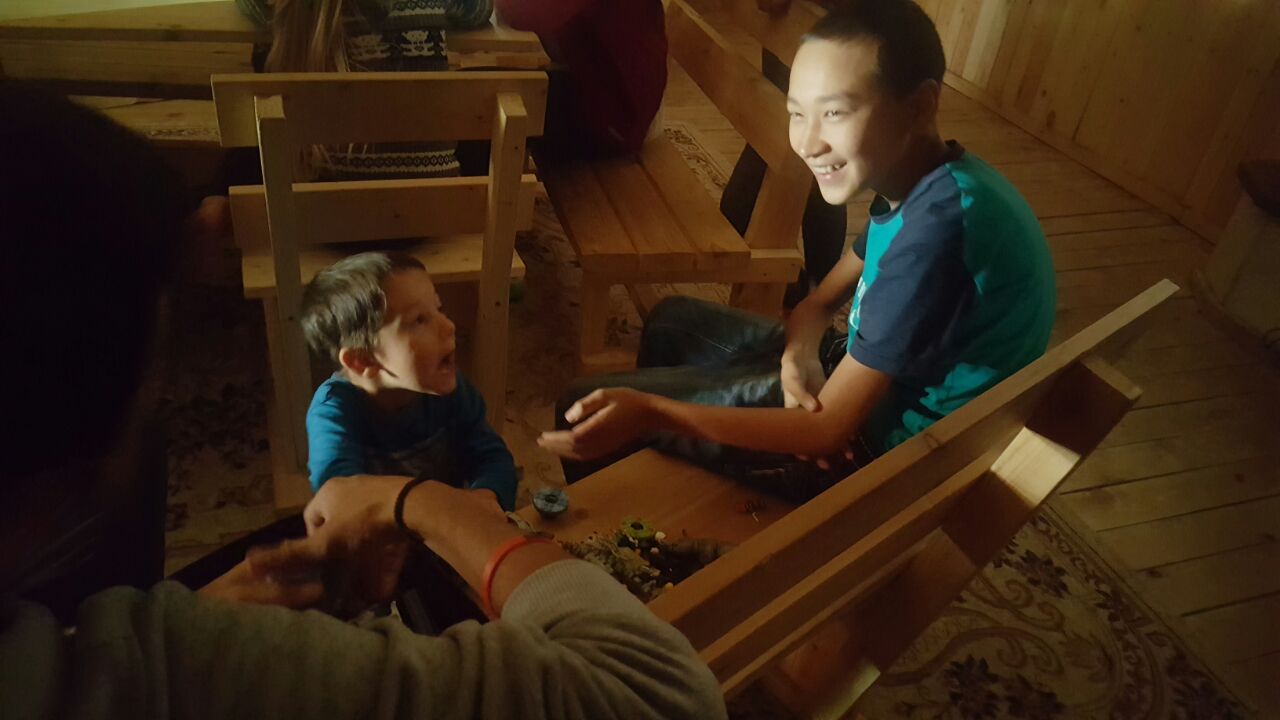
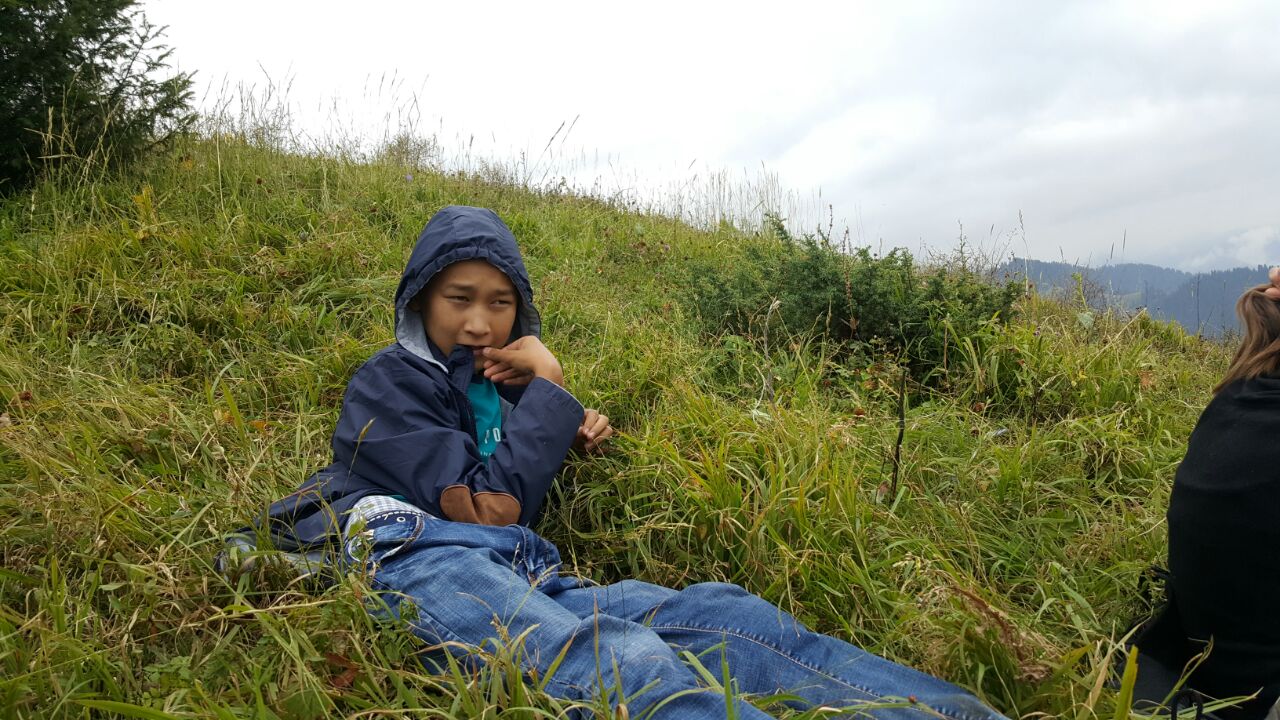
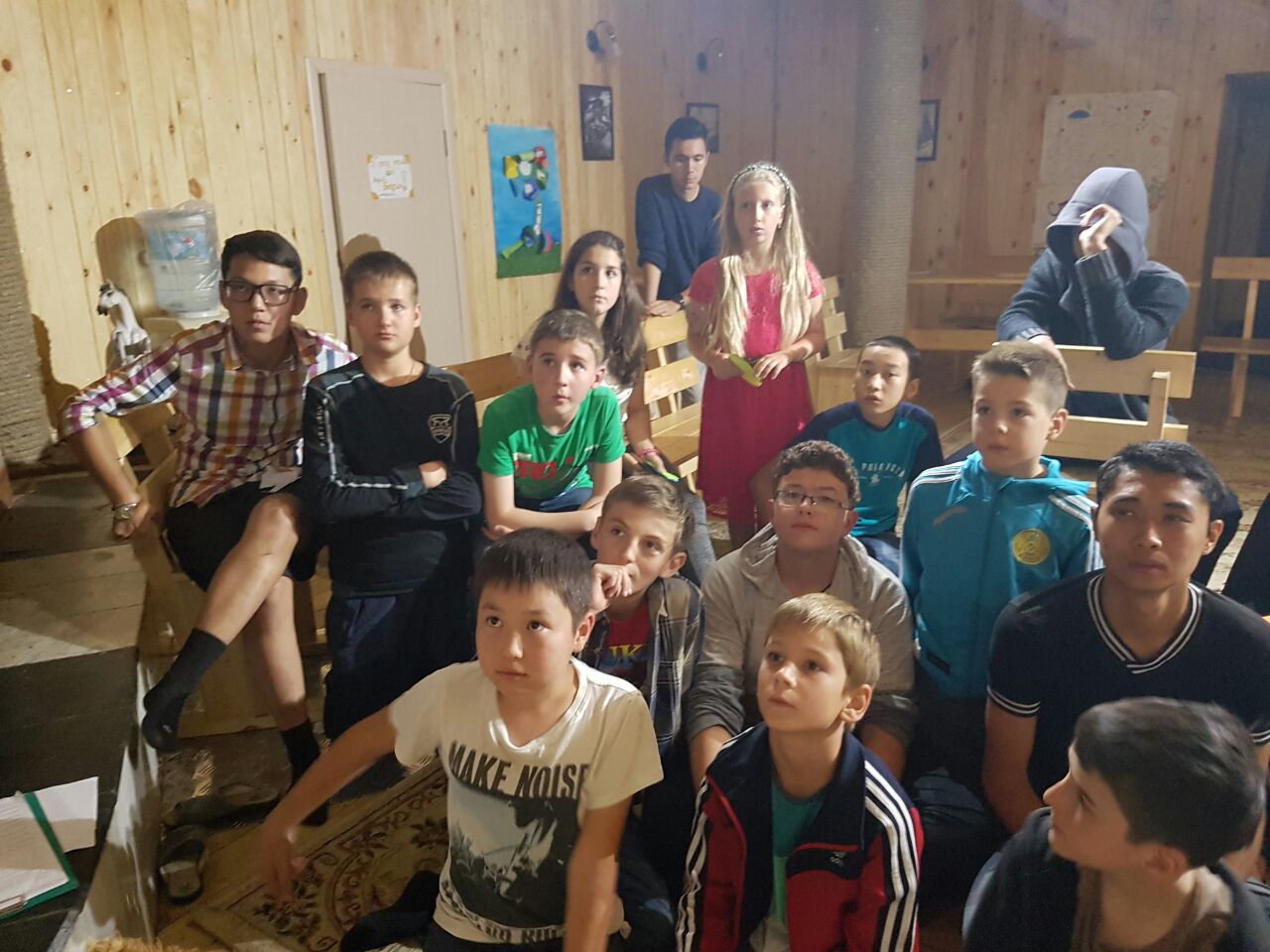
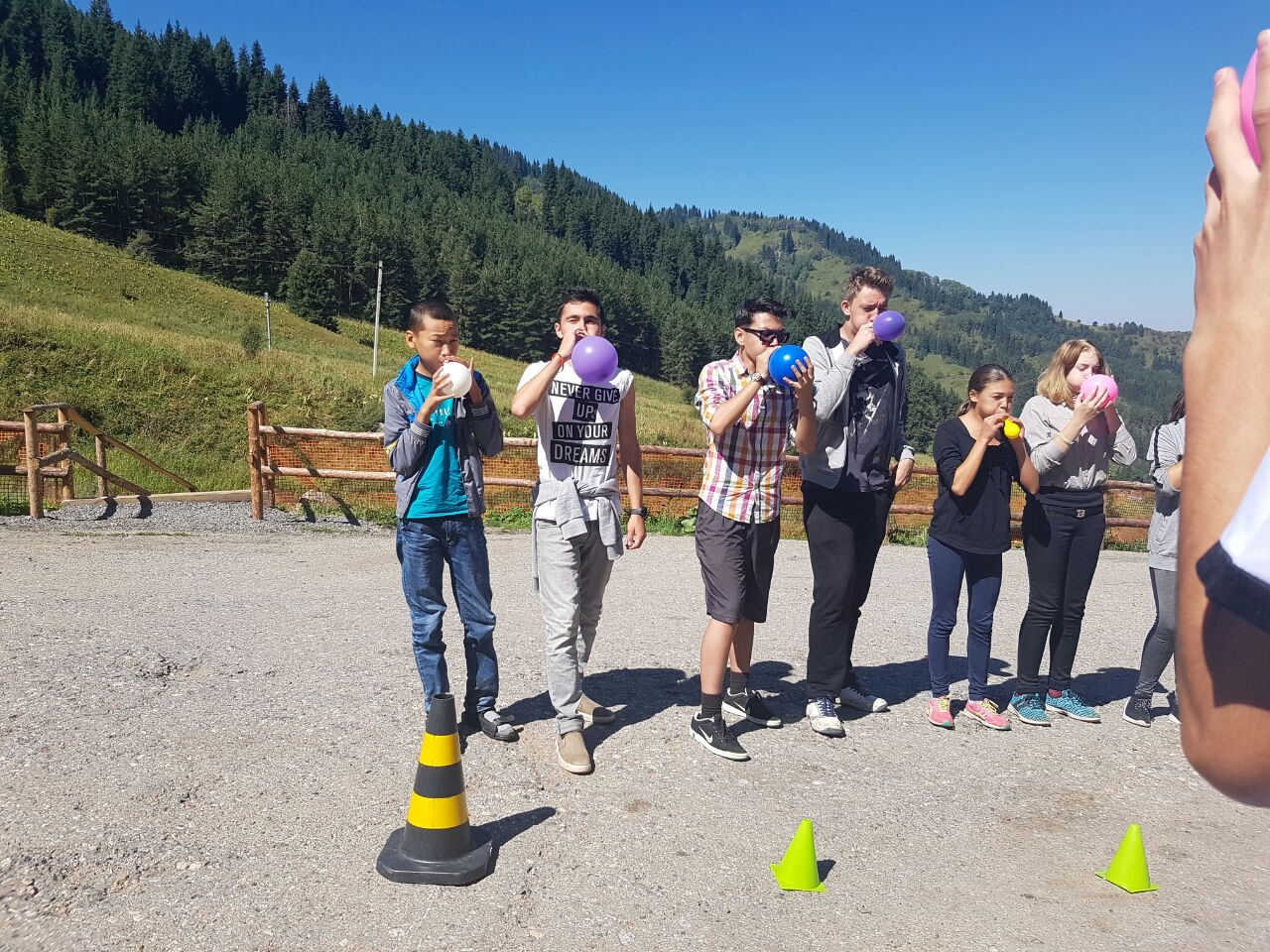
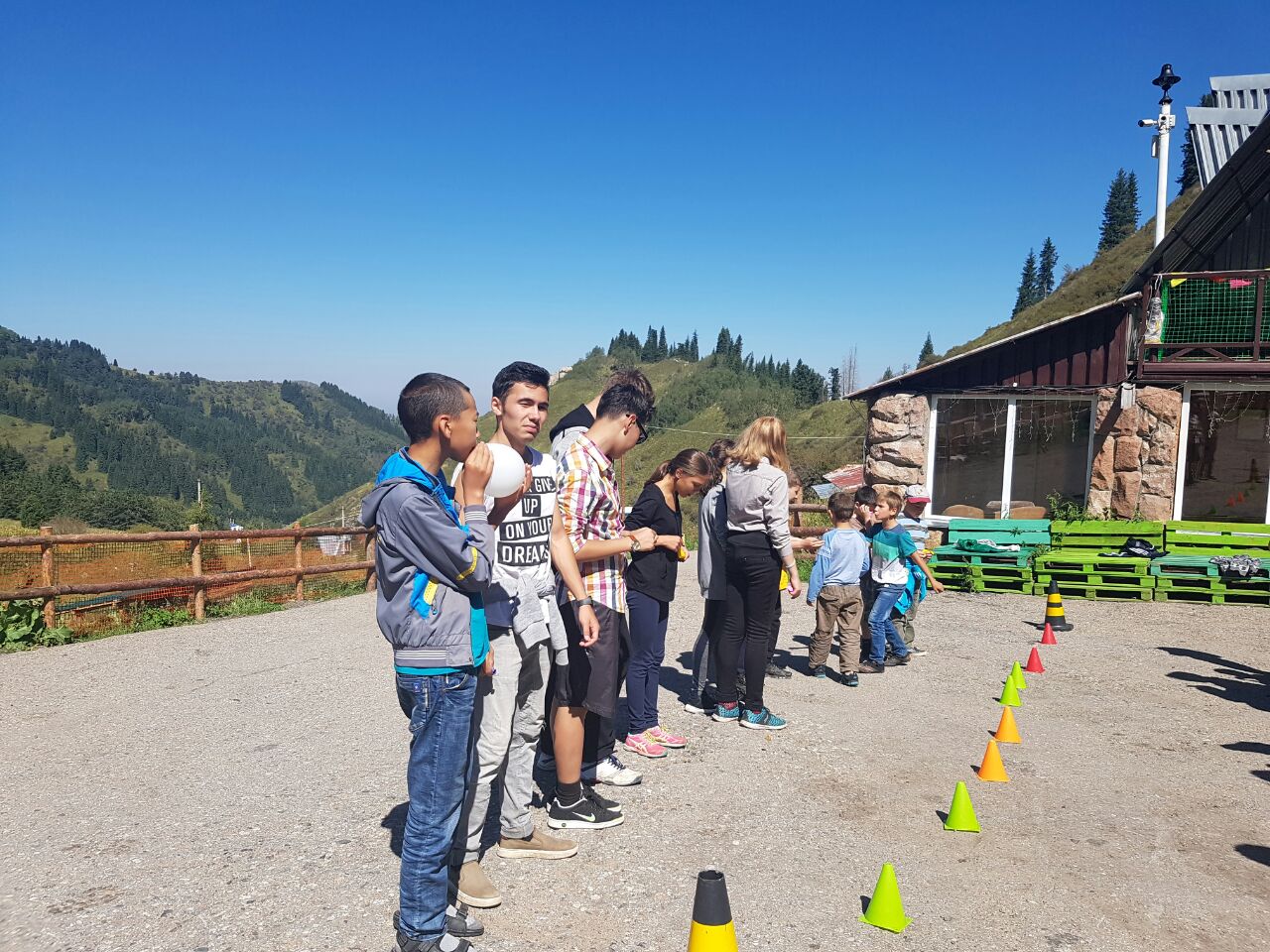
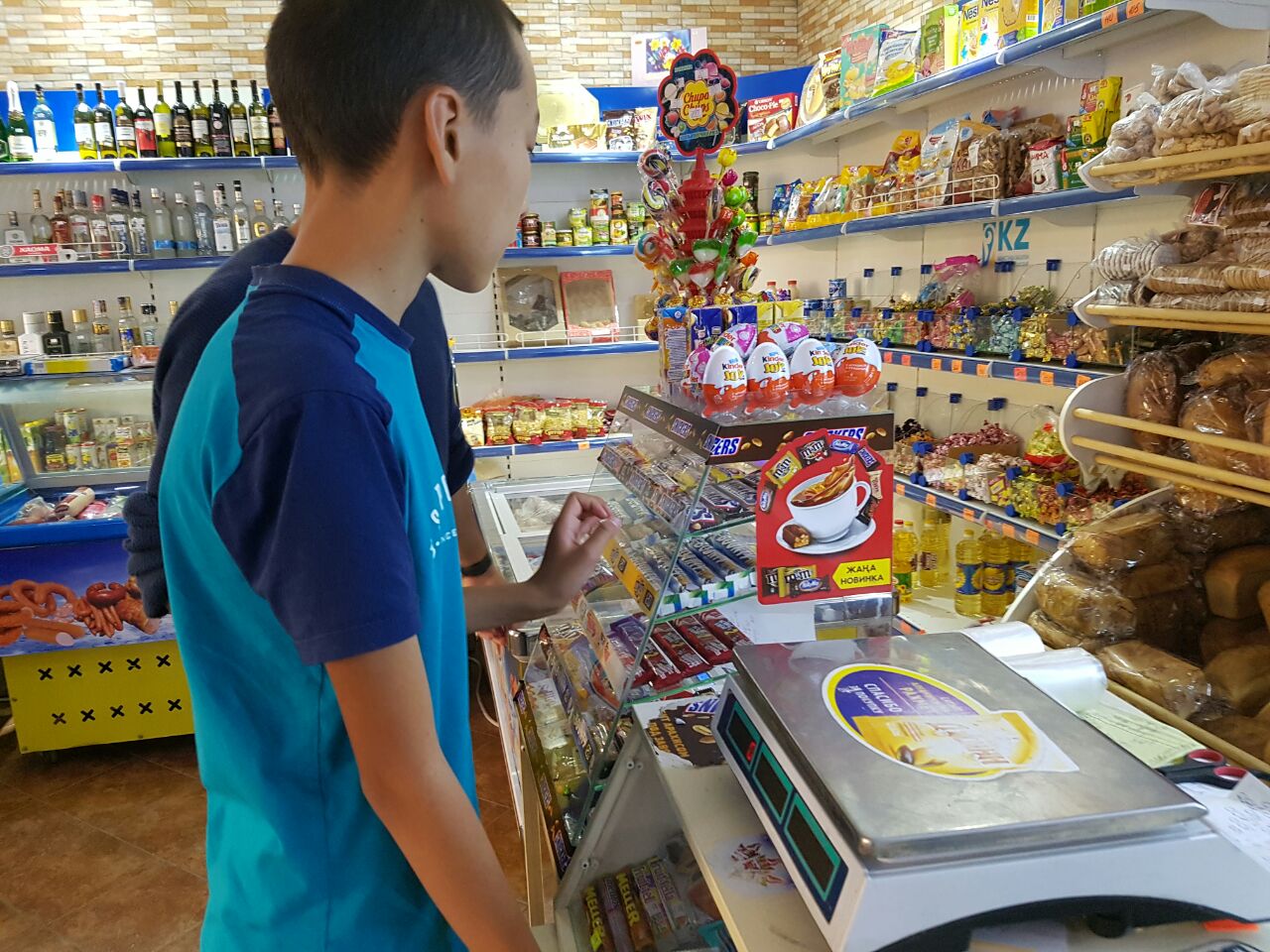
The following images show several moments of our participation in Pioneer’s inclusive camps in 2016, especially with Arthur, Mansur, and Tima. They are placed at the end of the article as a visual complement for readers who wish to see more concretely what Pioneer made possible: exploration, confidence, activities, connection with nature, social participation, progress, and a non-defectological approach to autism.
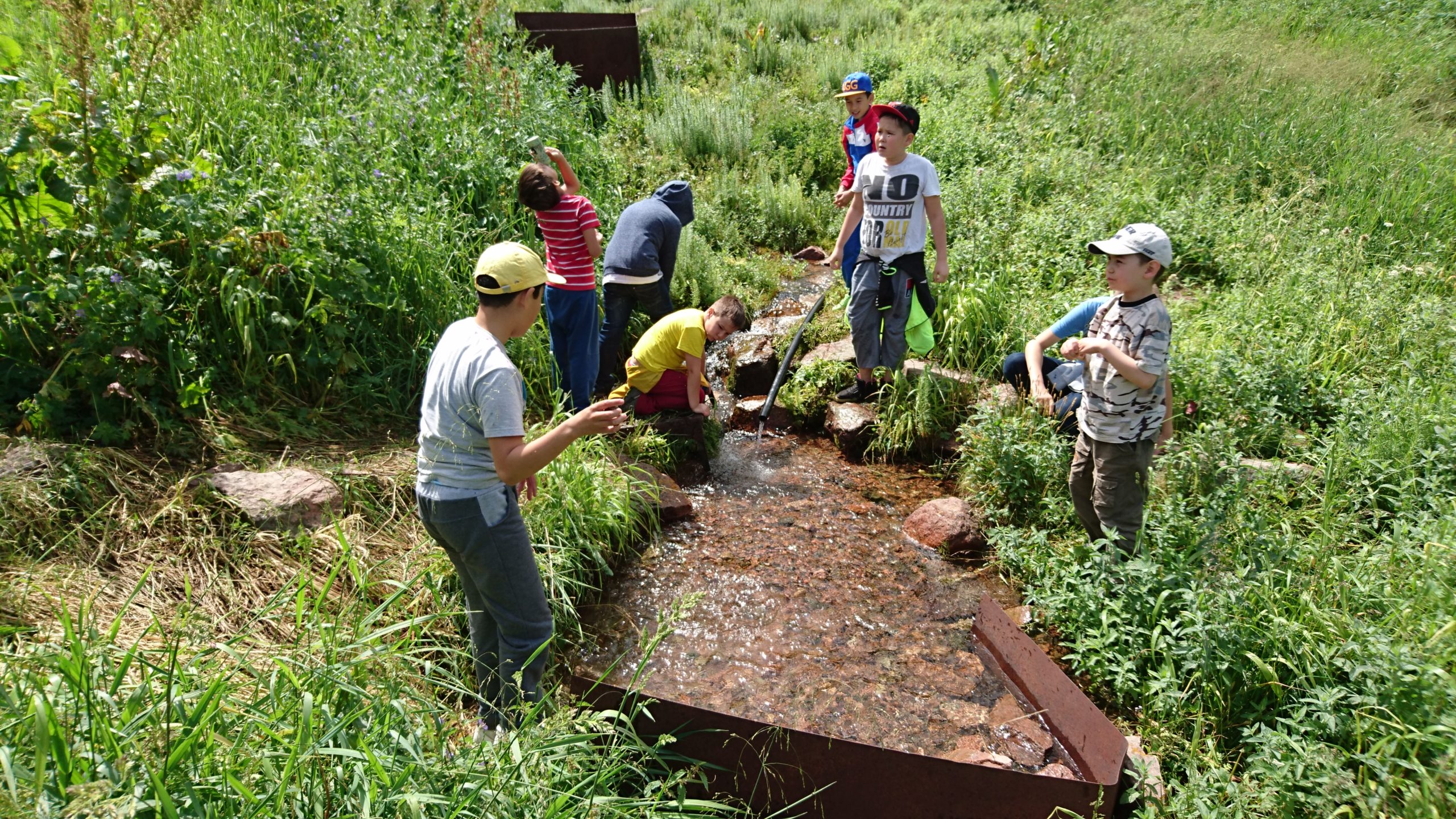
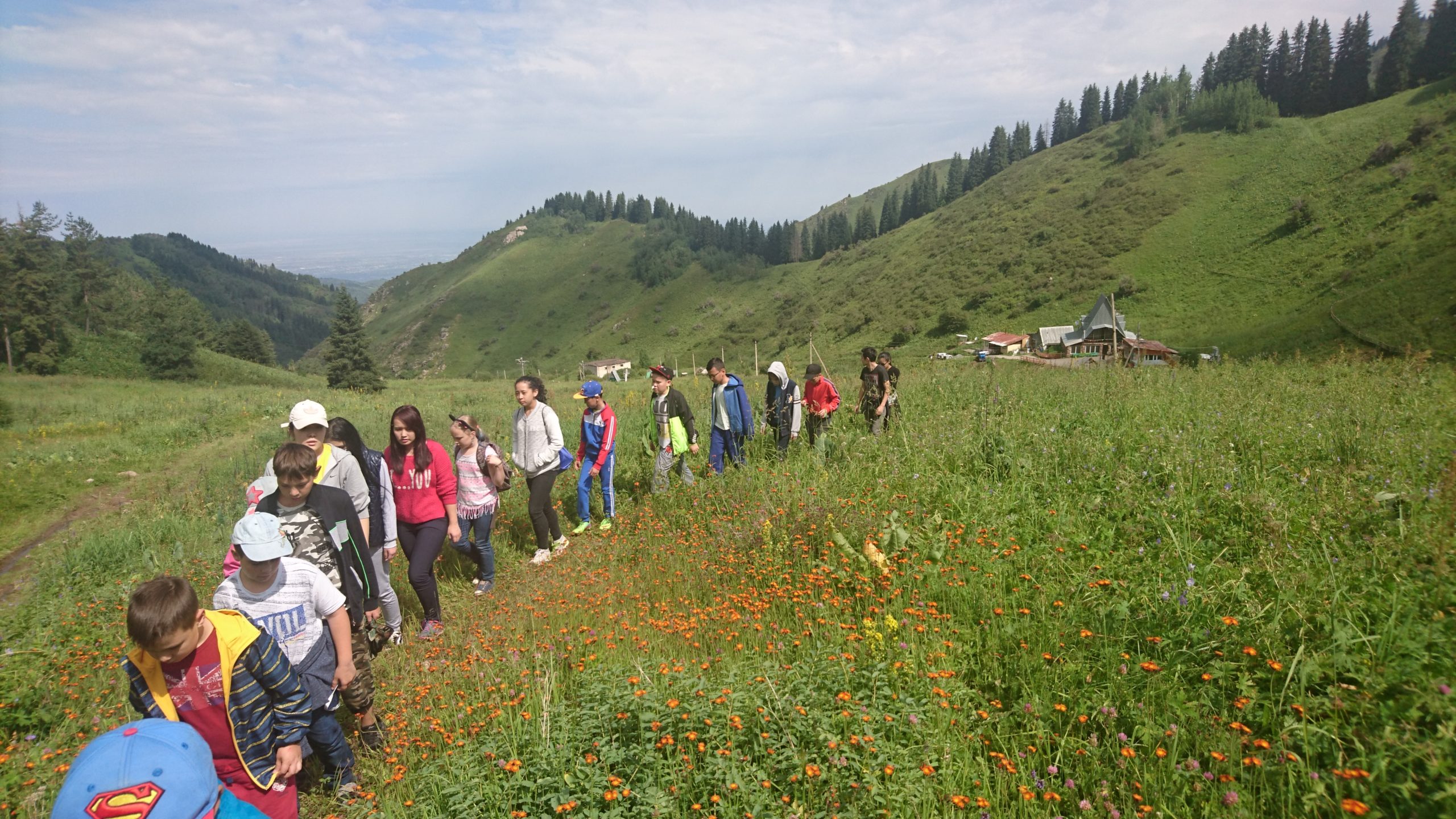
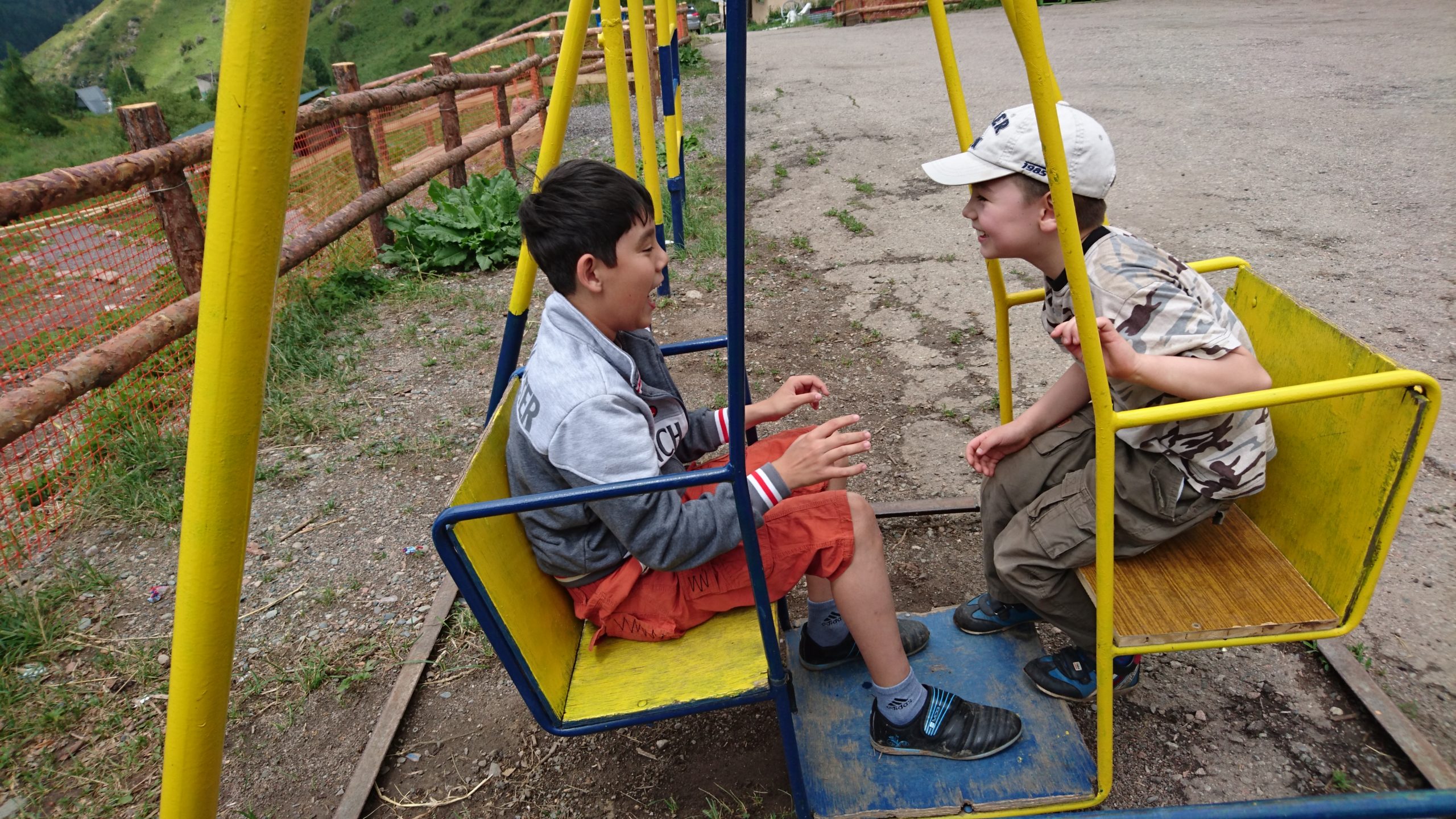
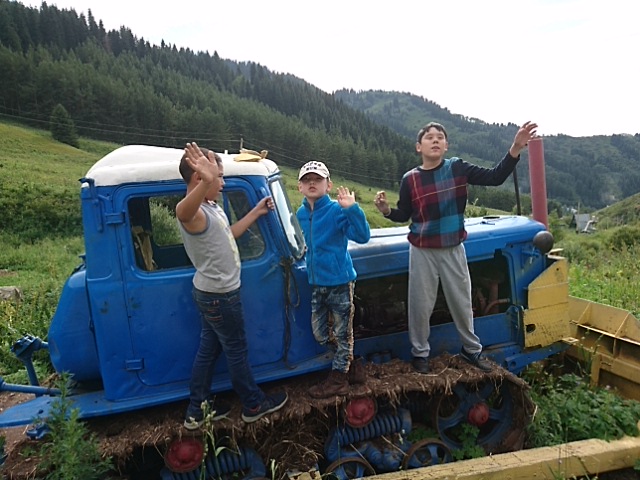
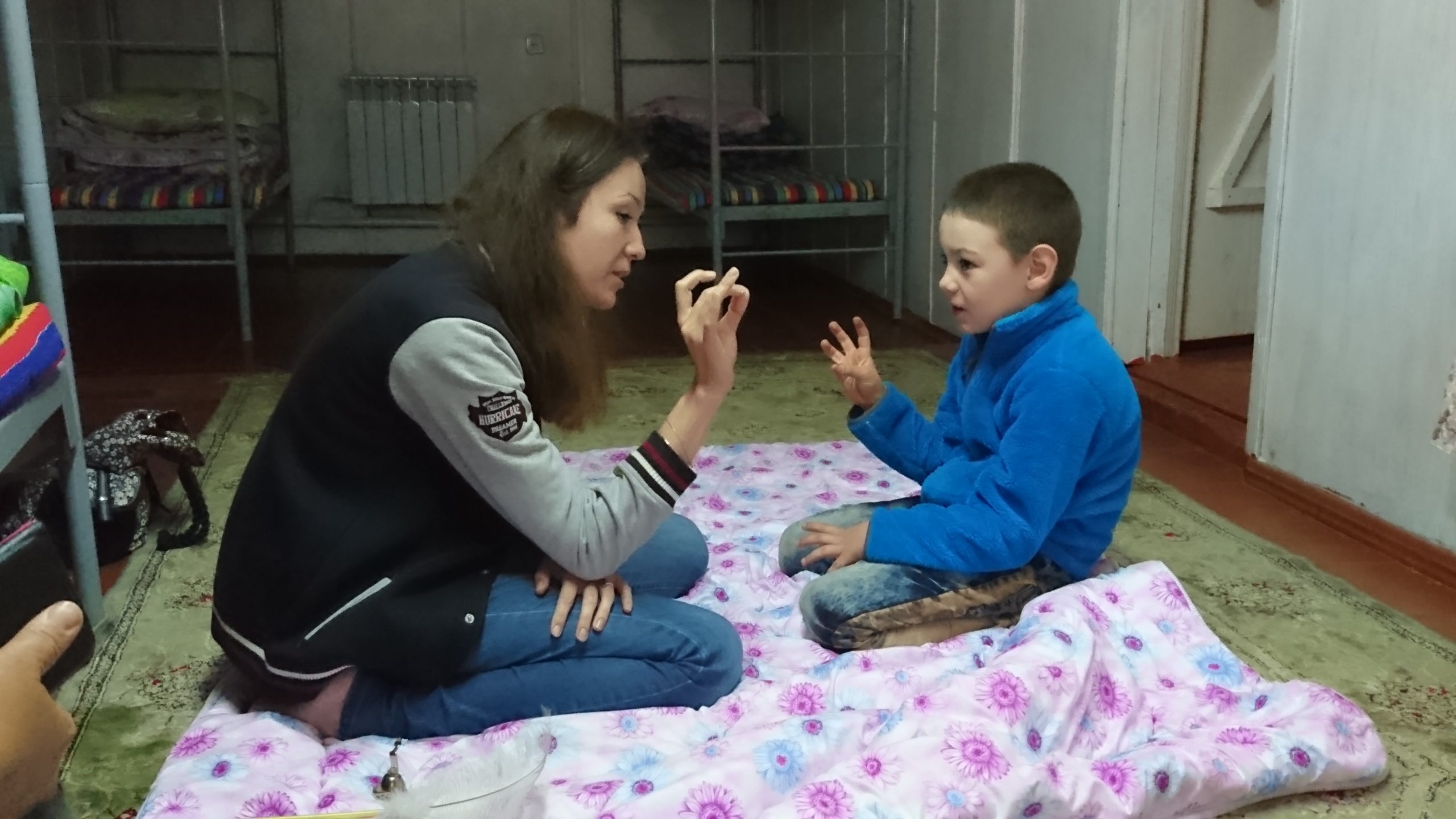
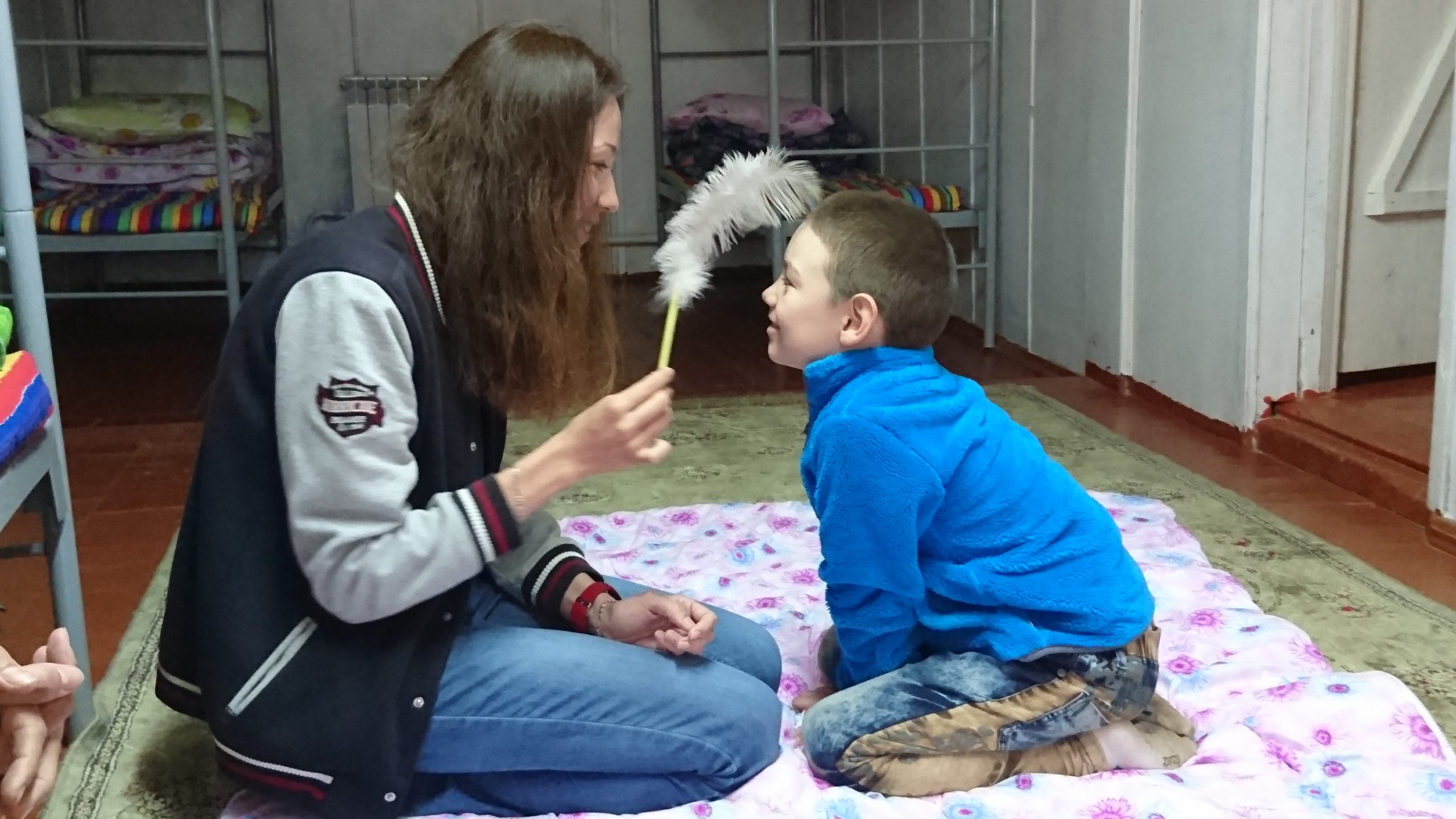
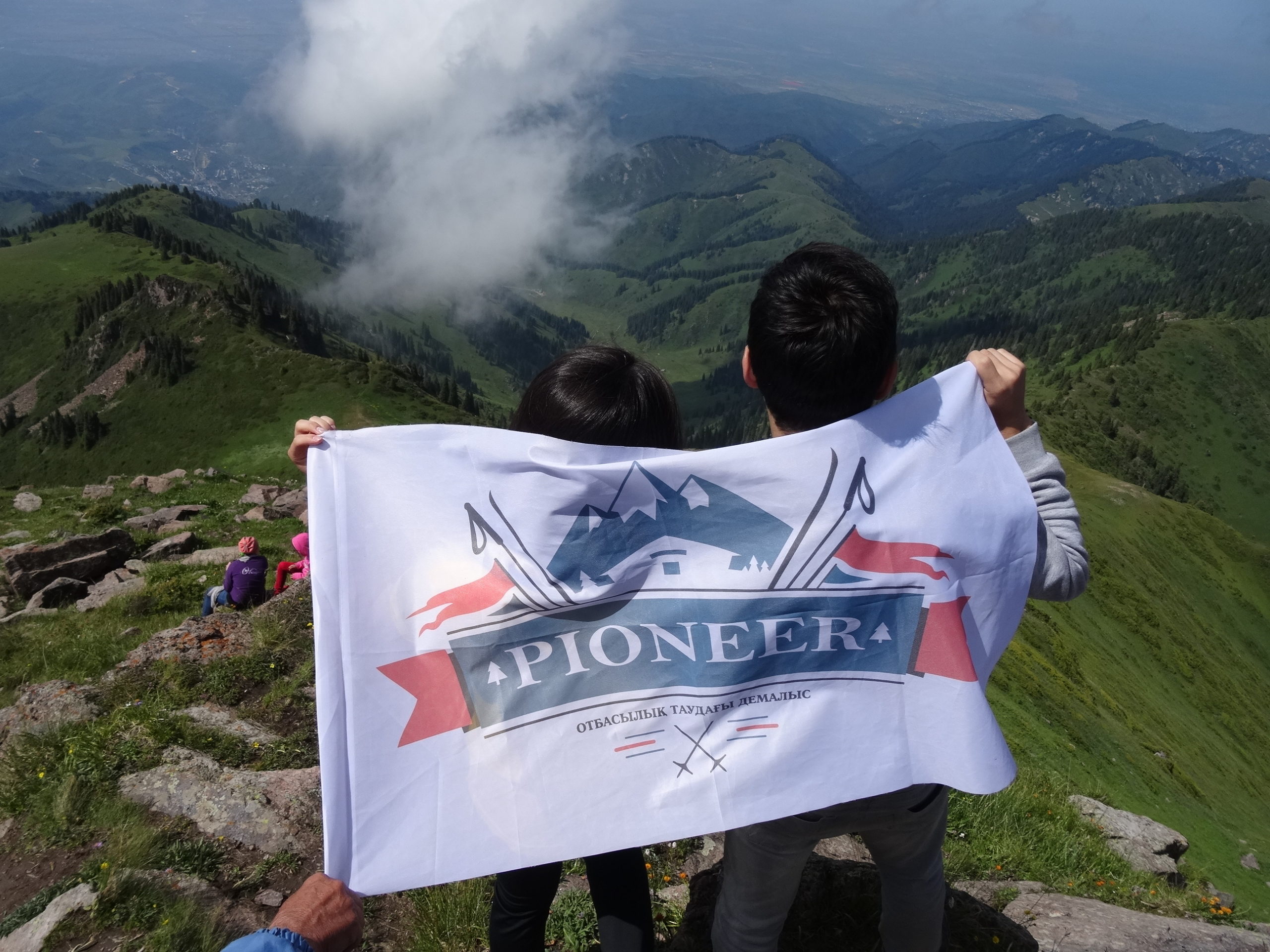
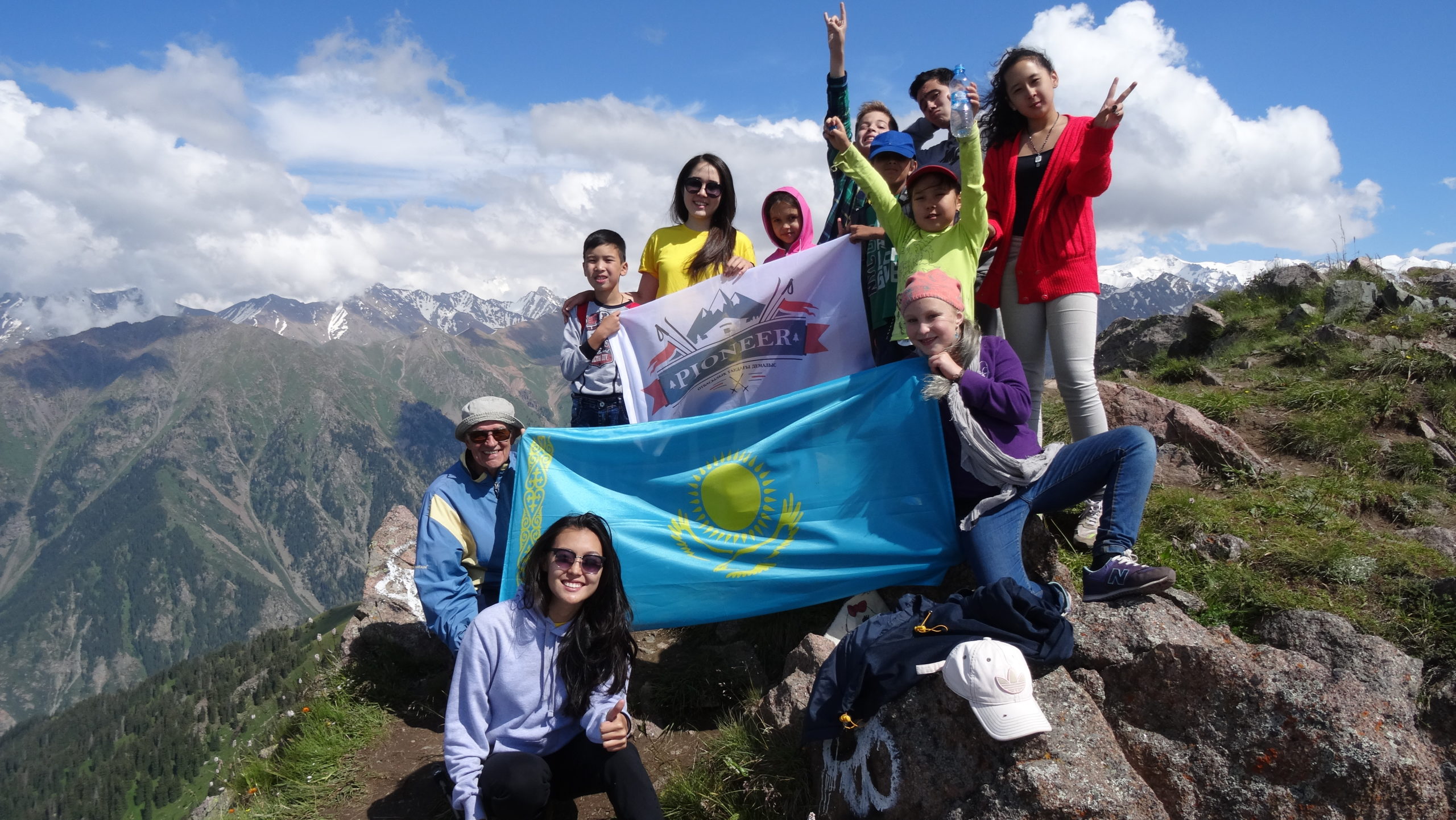
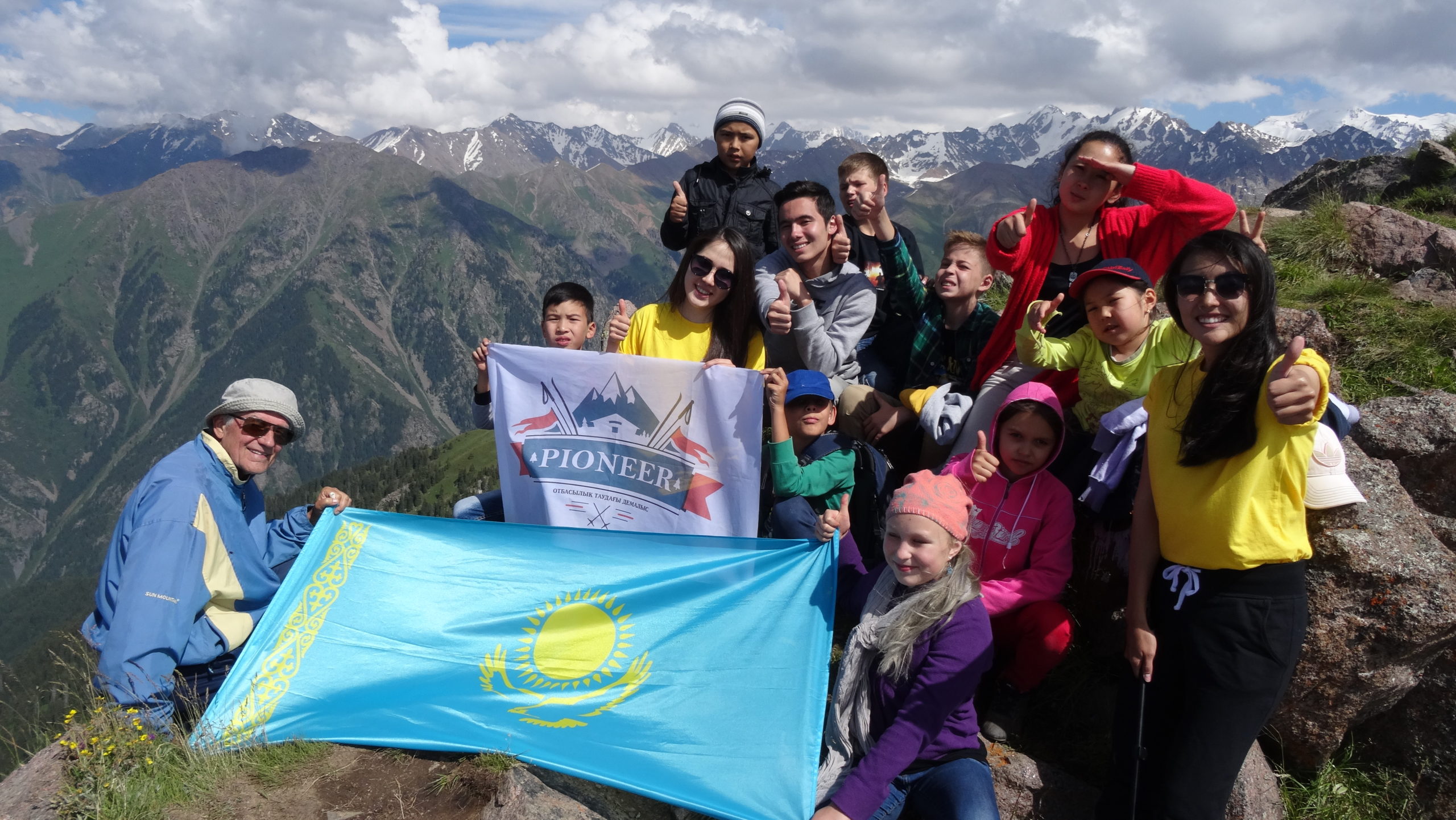
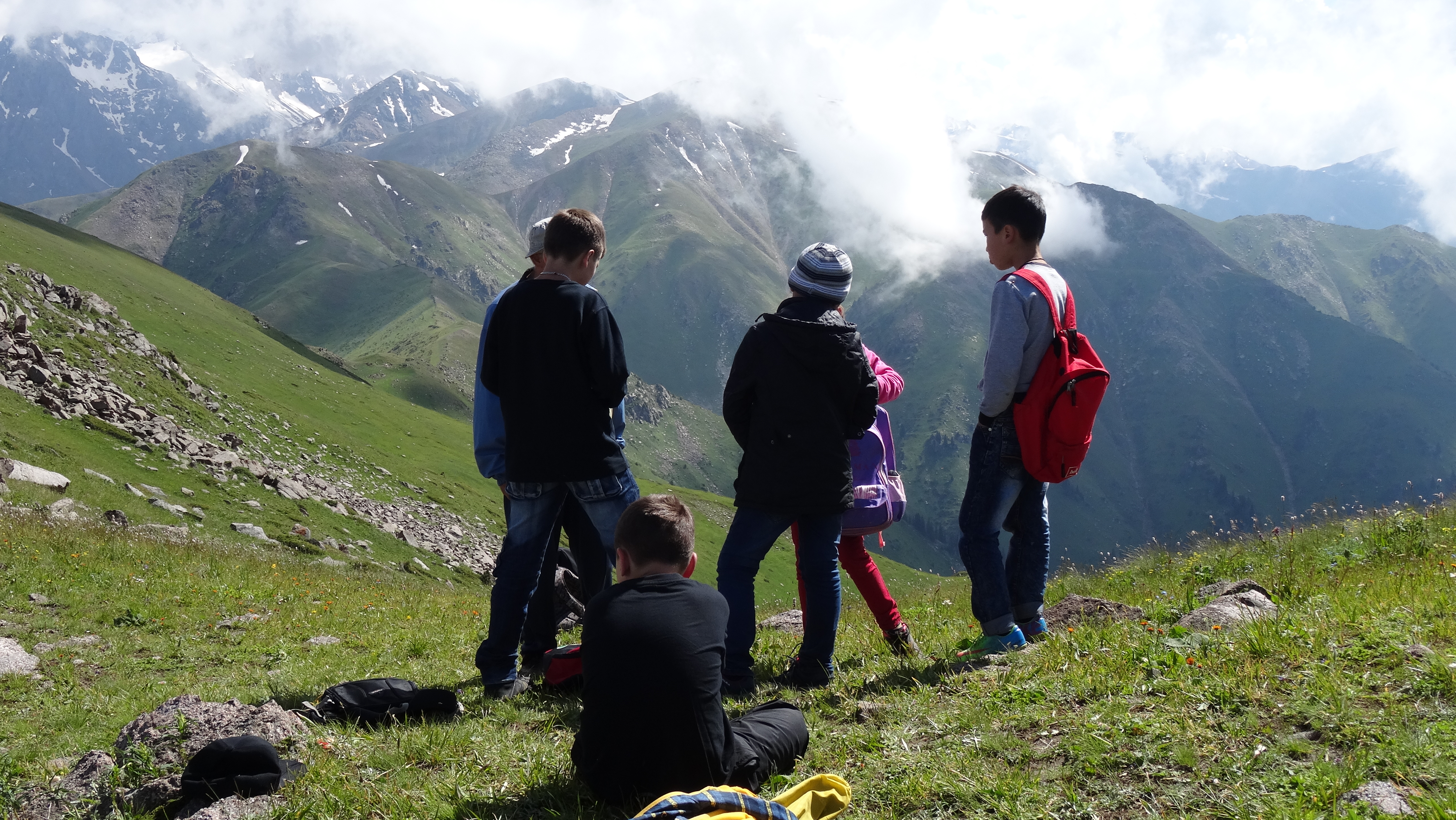
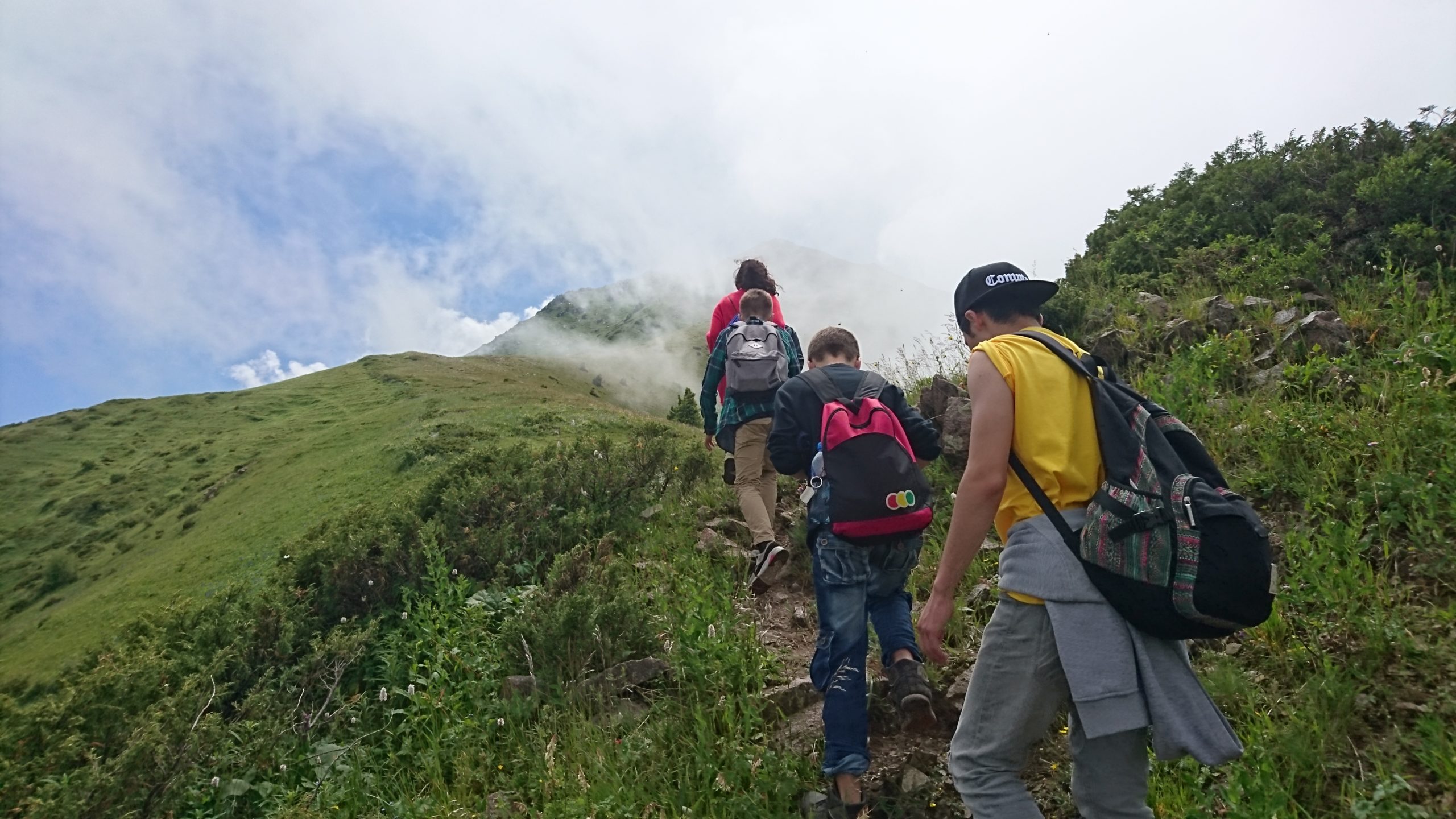
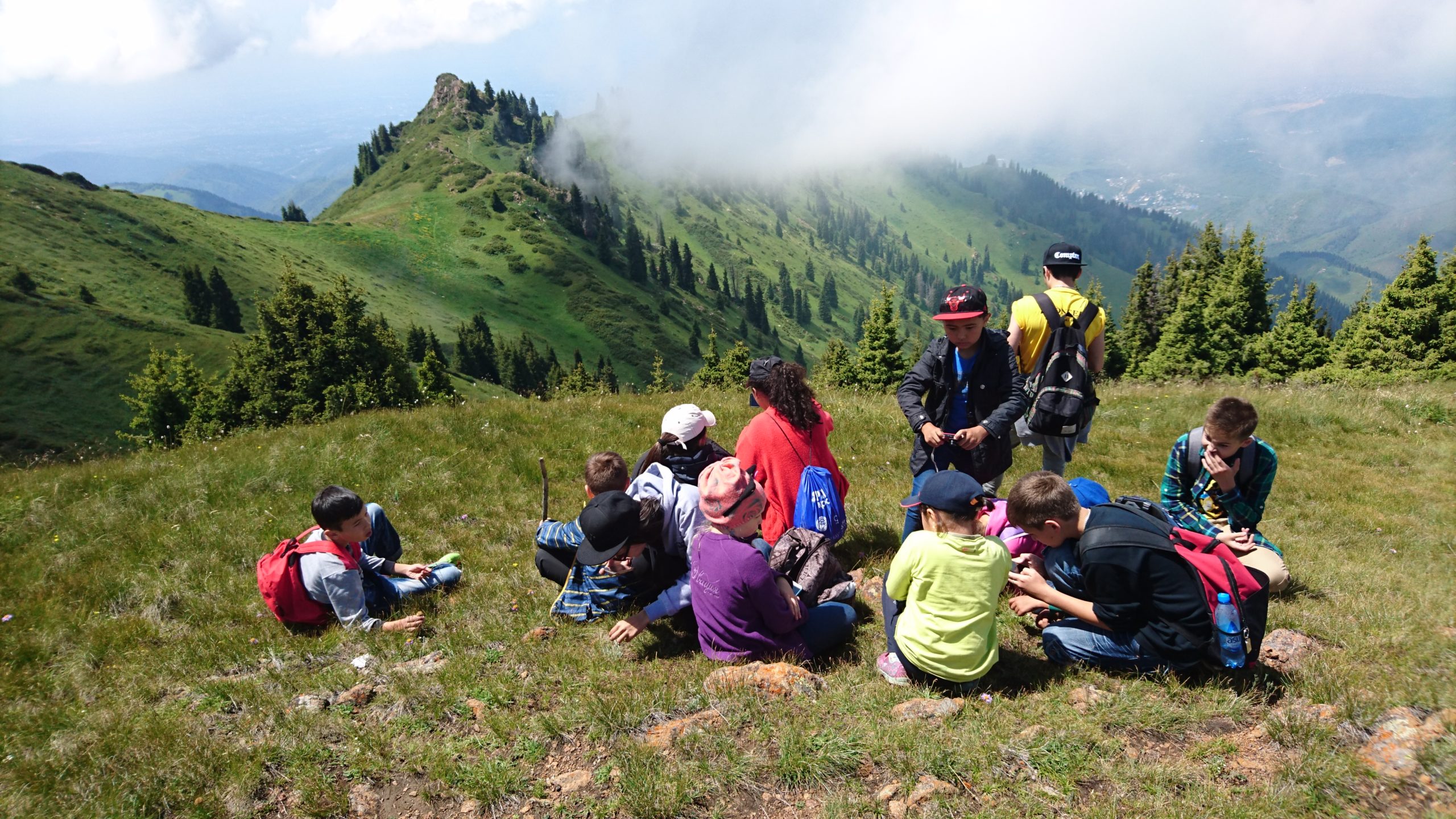
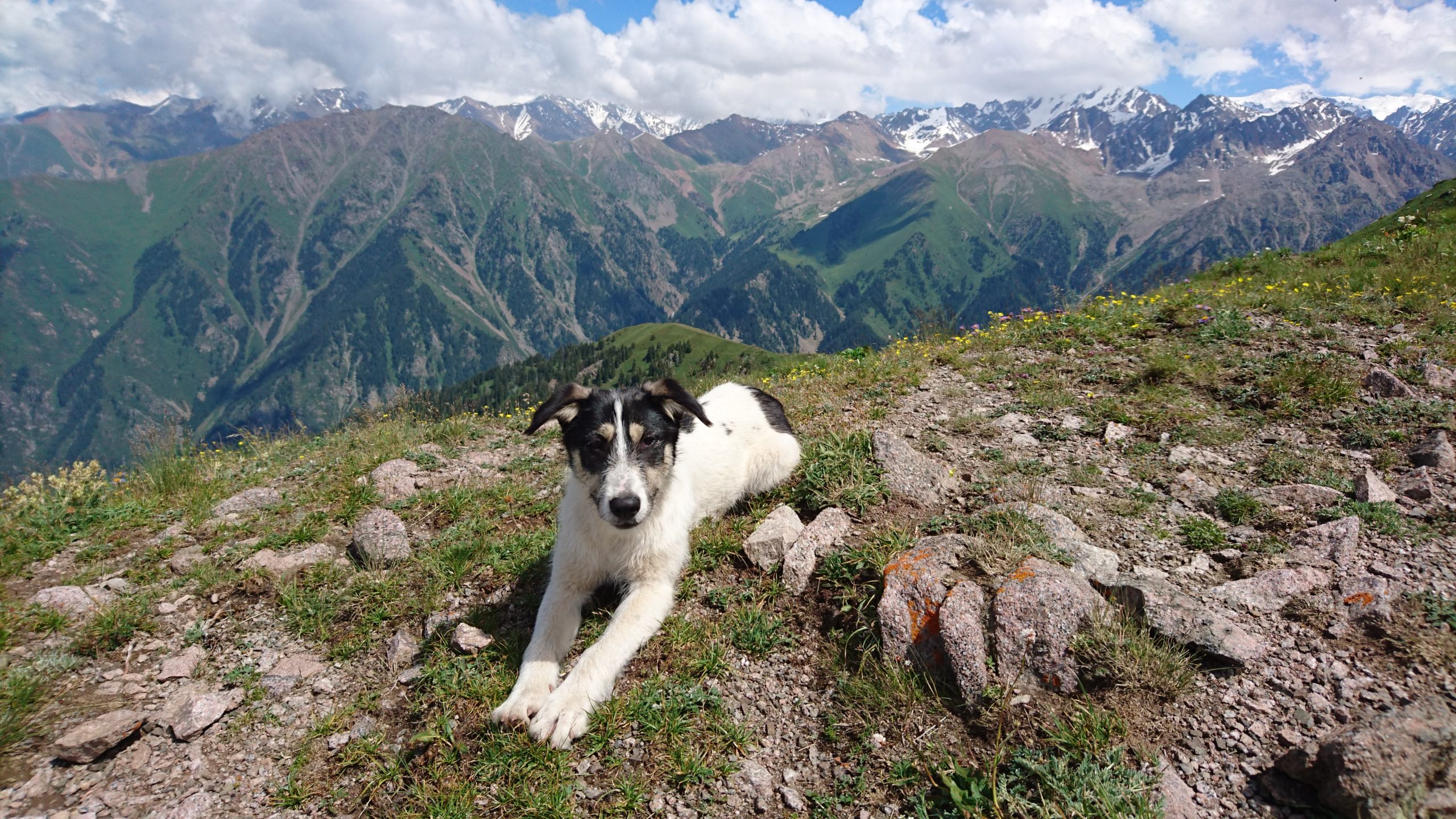
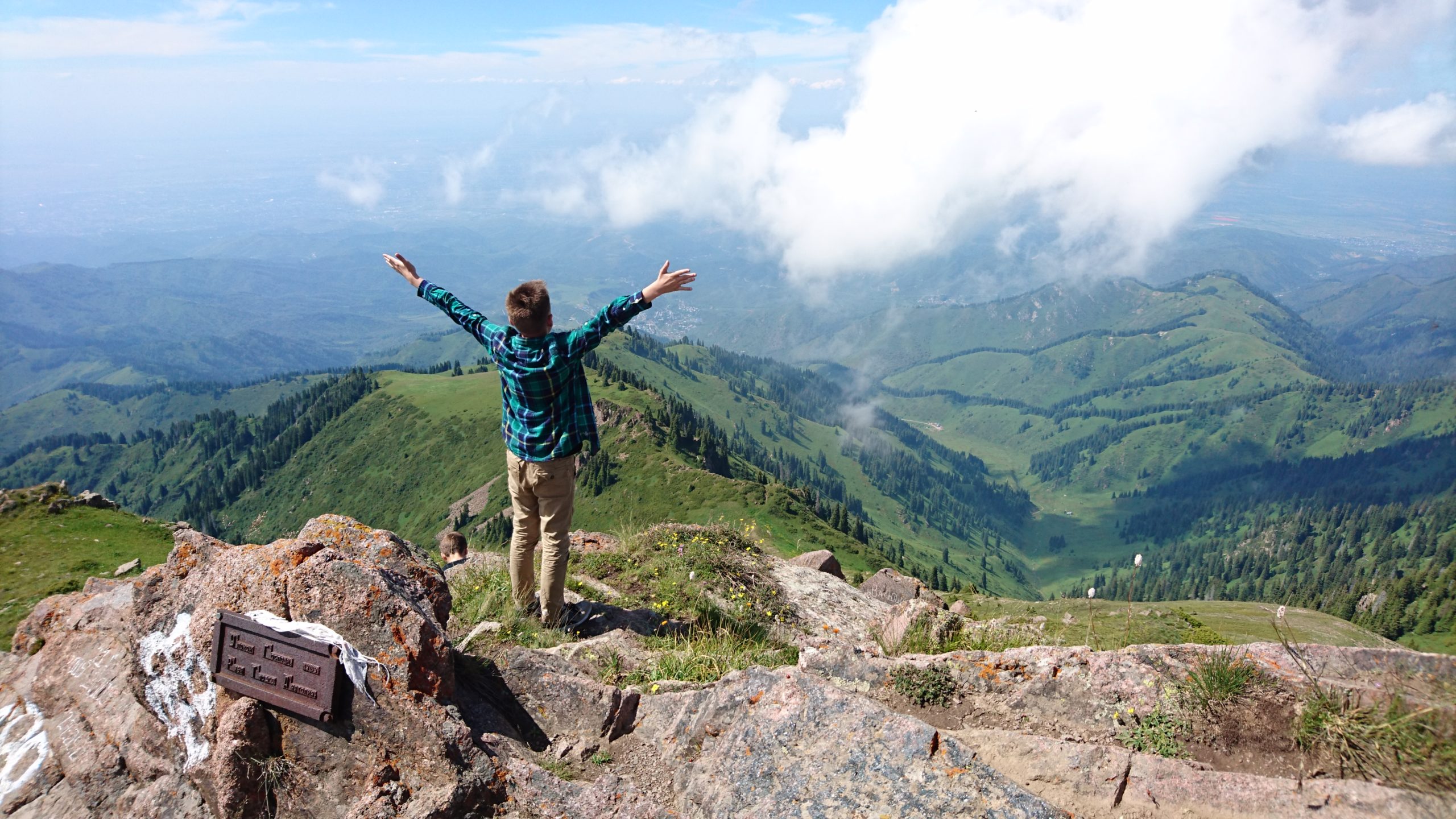 At the top of Pioneer Peak. An image that says more than a million words.
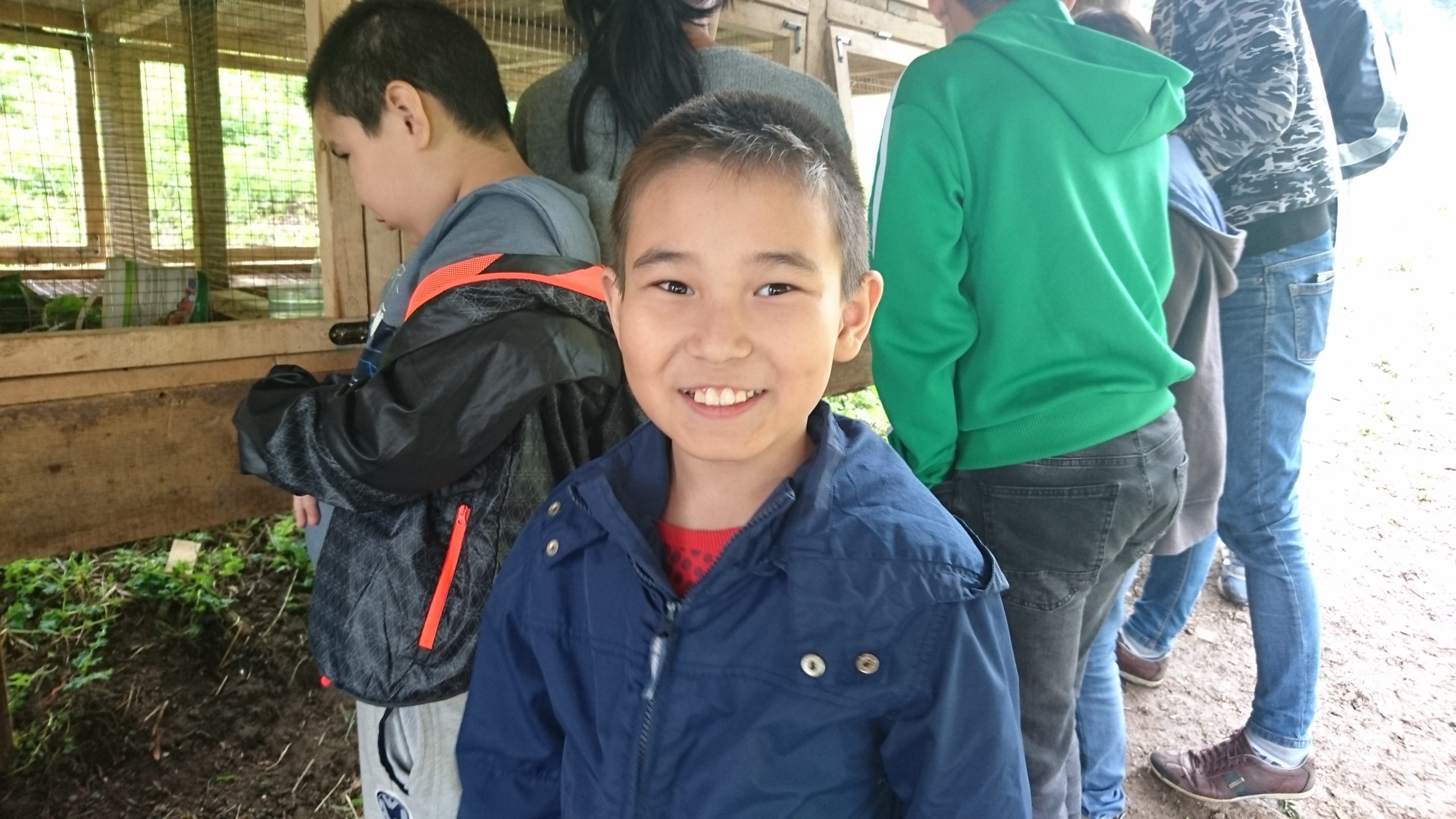 Mansur.
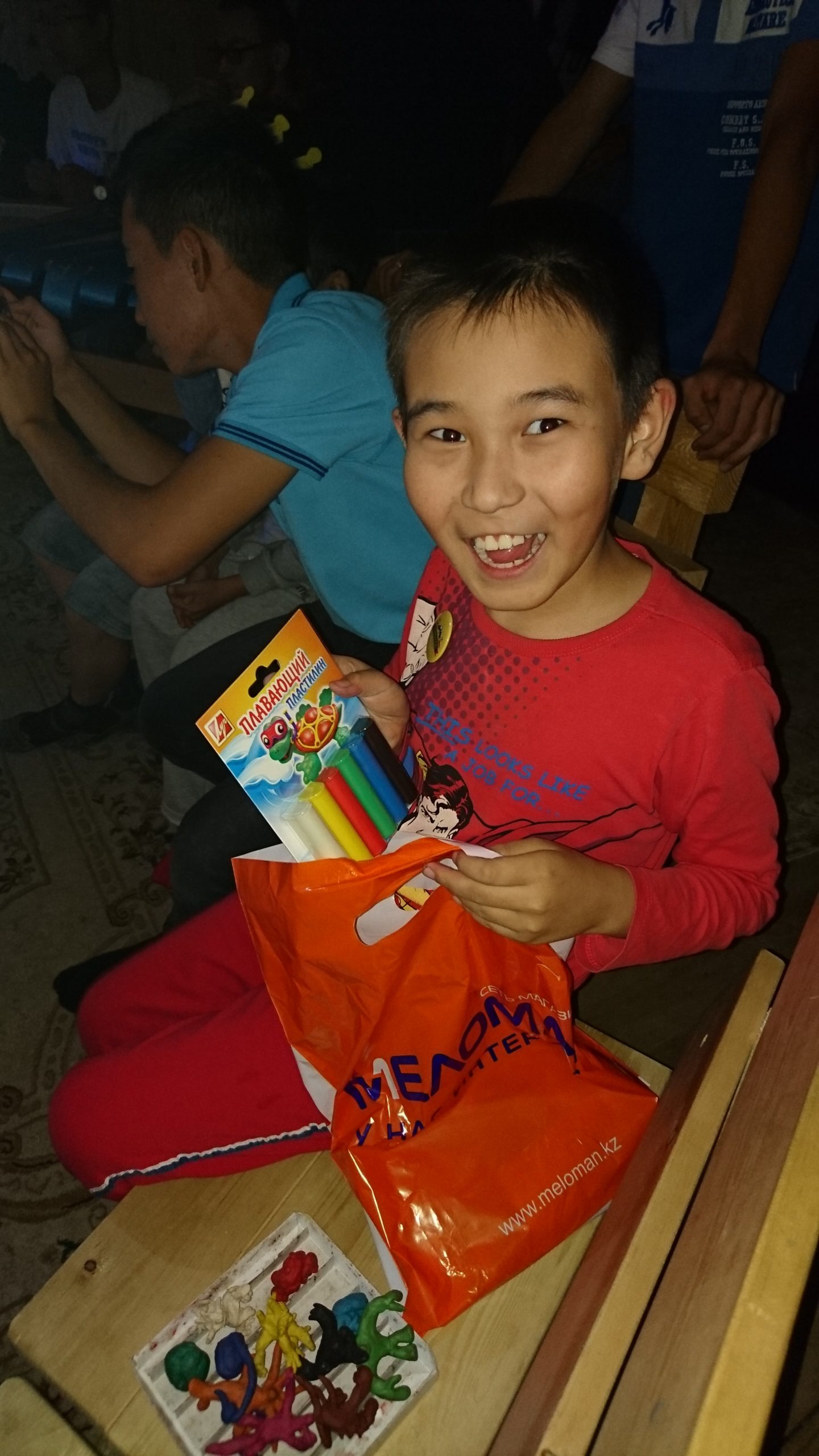
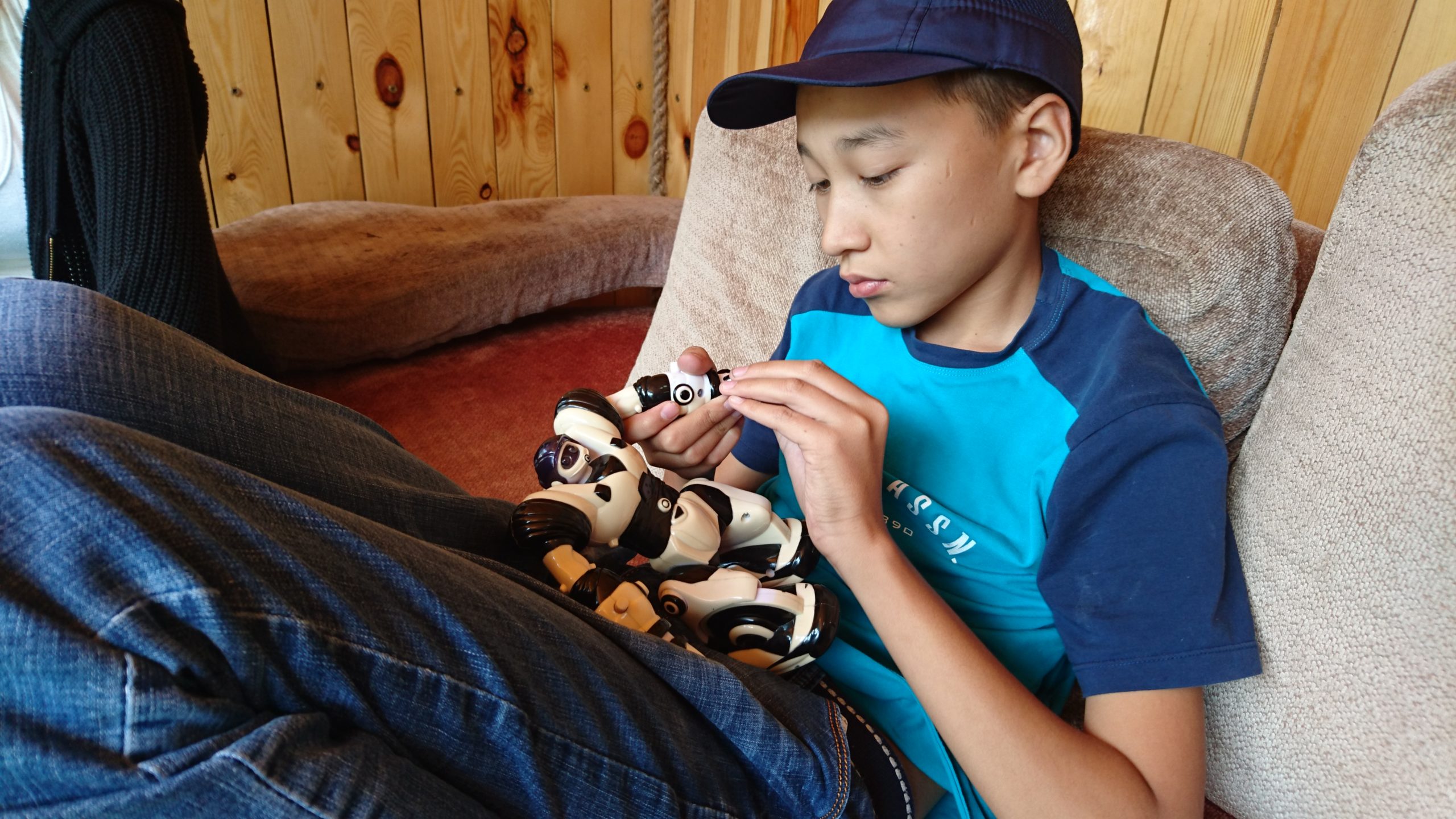 Tima on the first day, solitary.
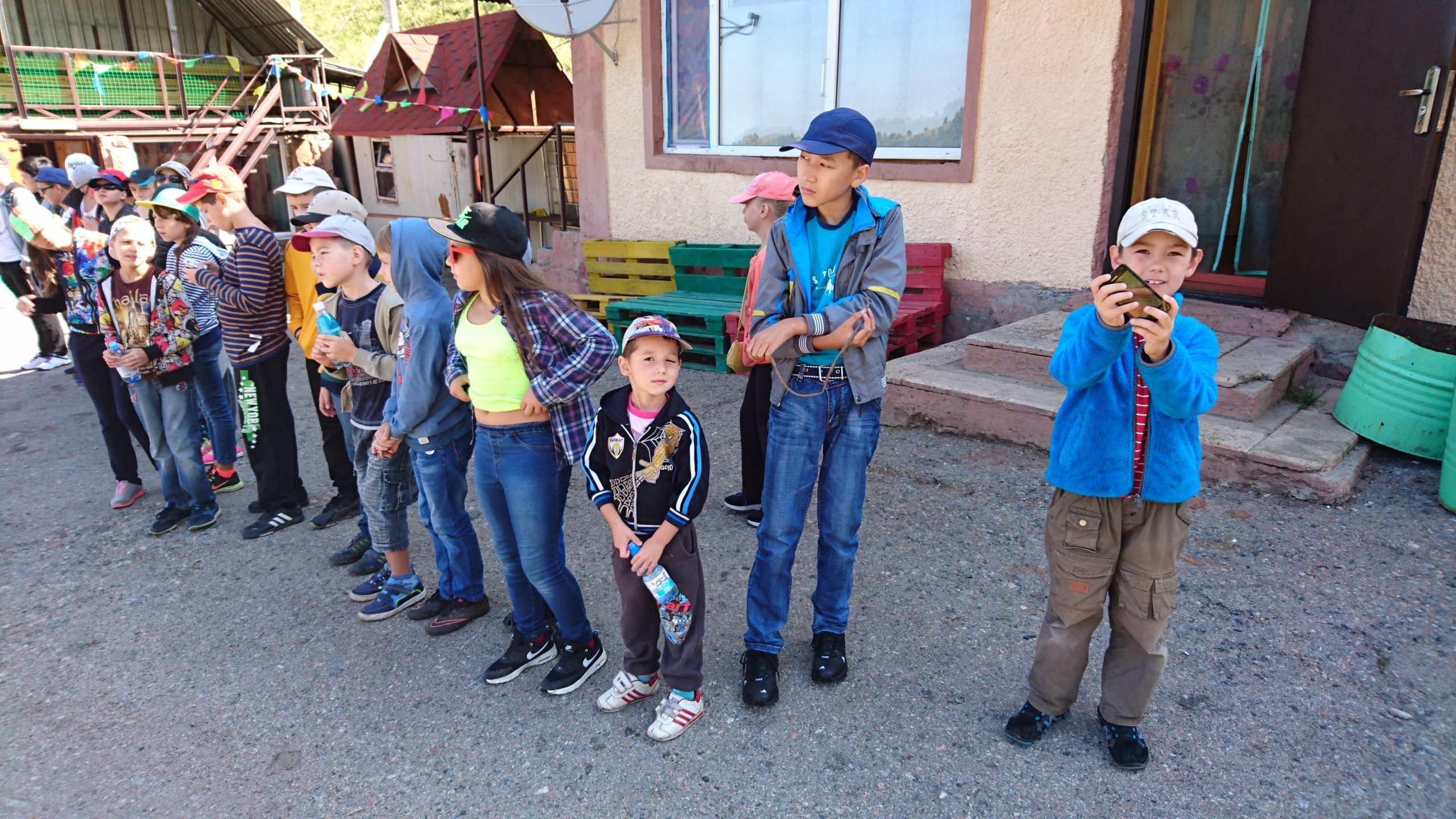
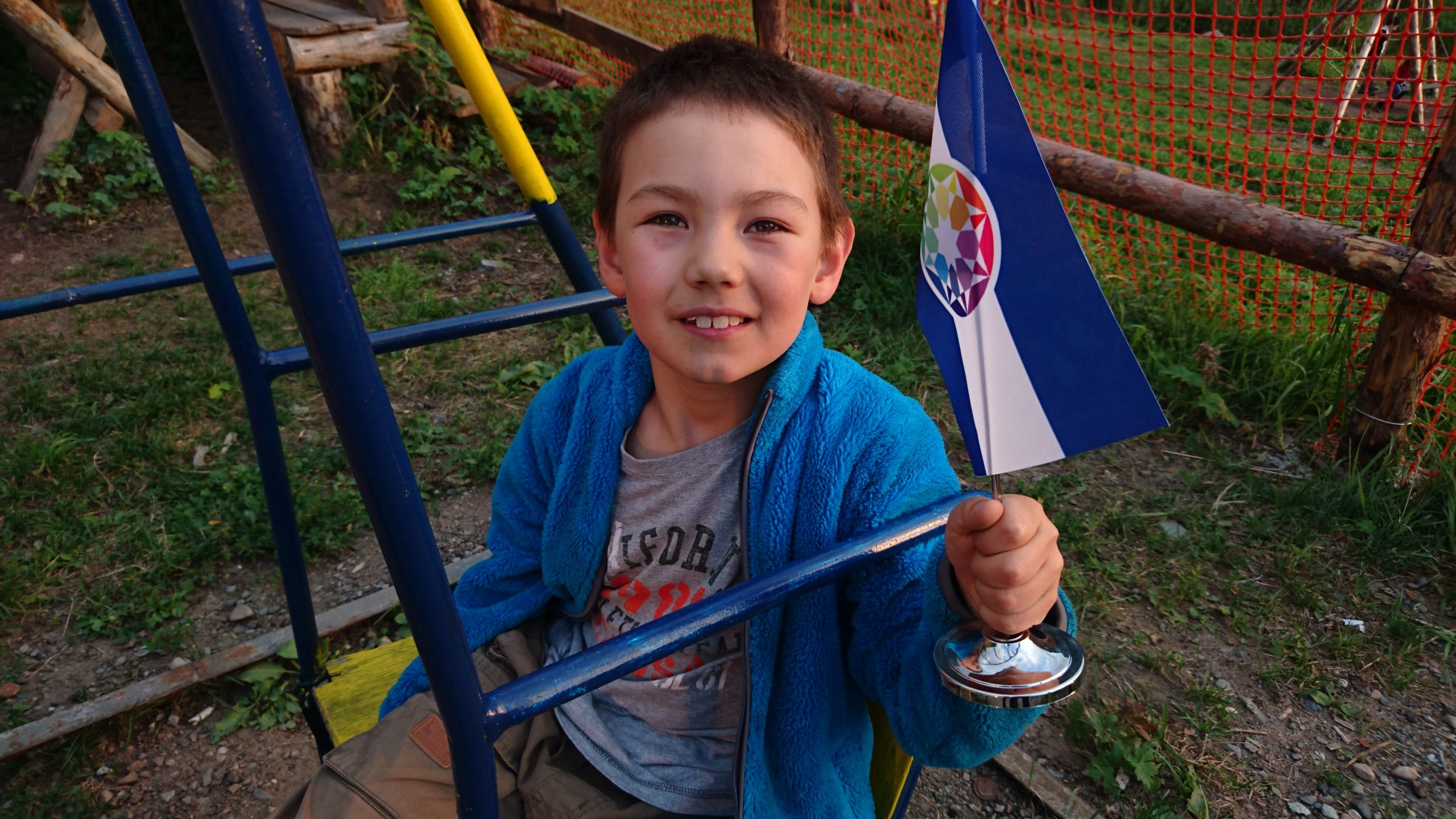 Arthur.
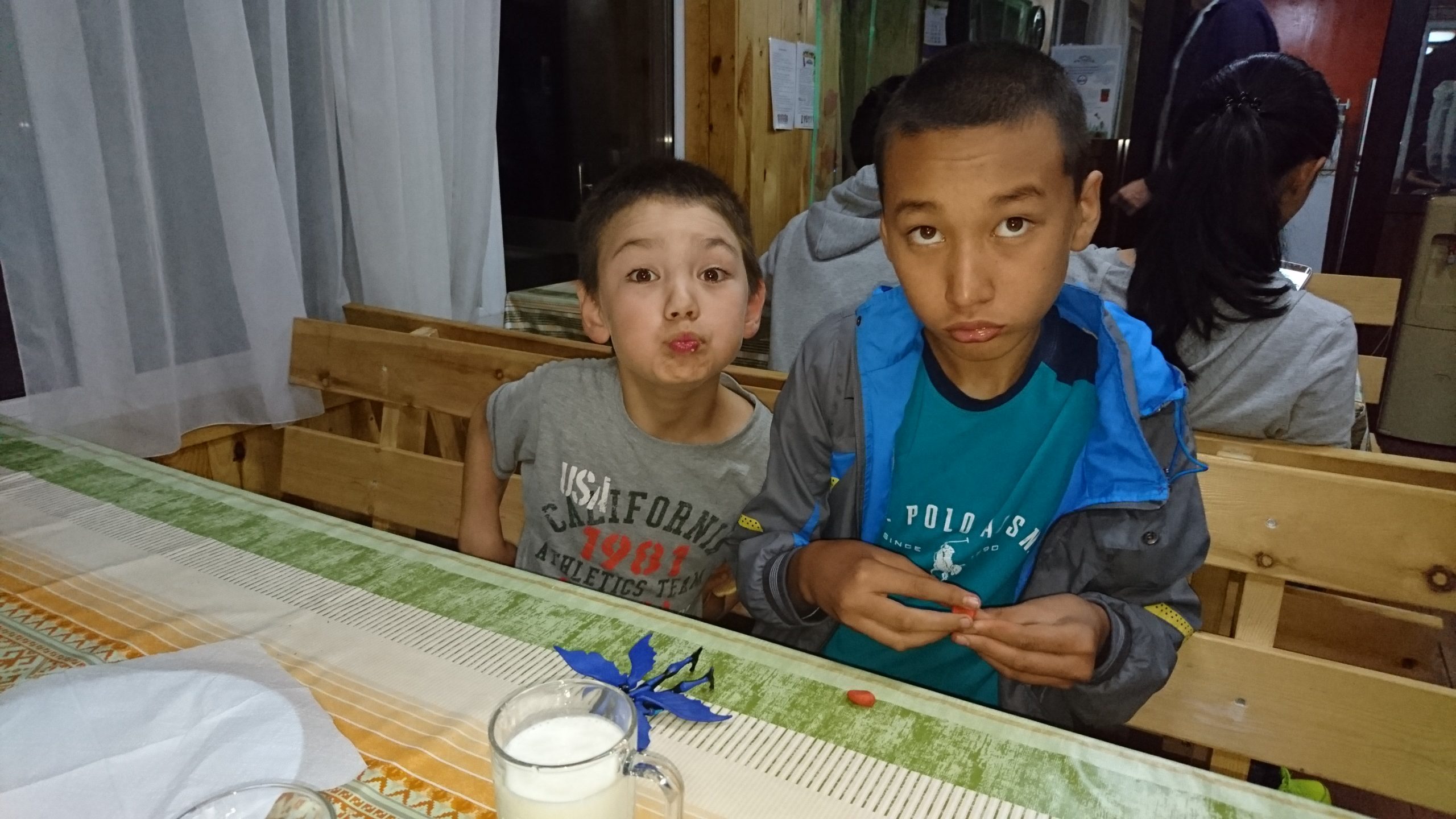
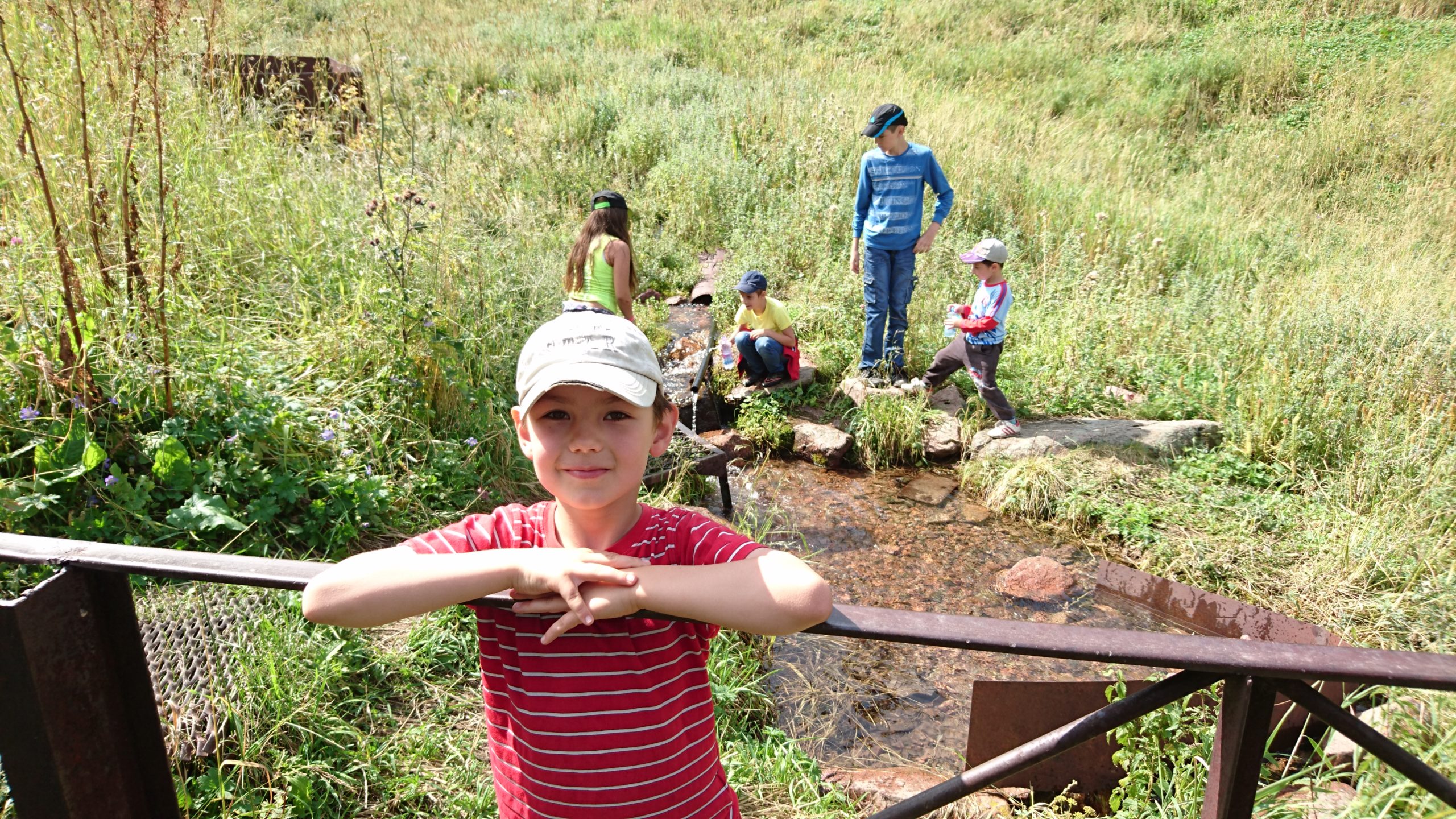
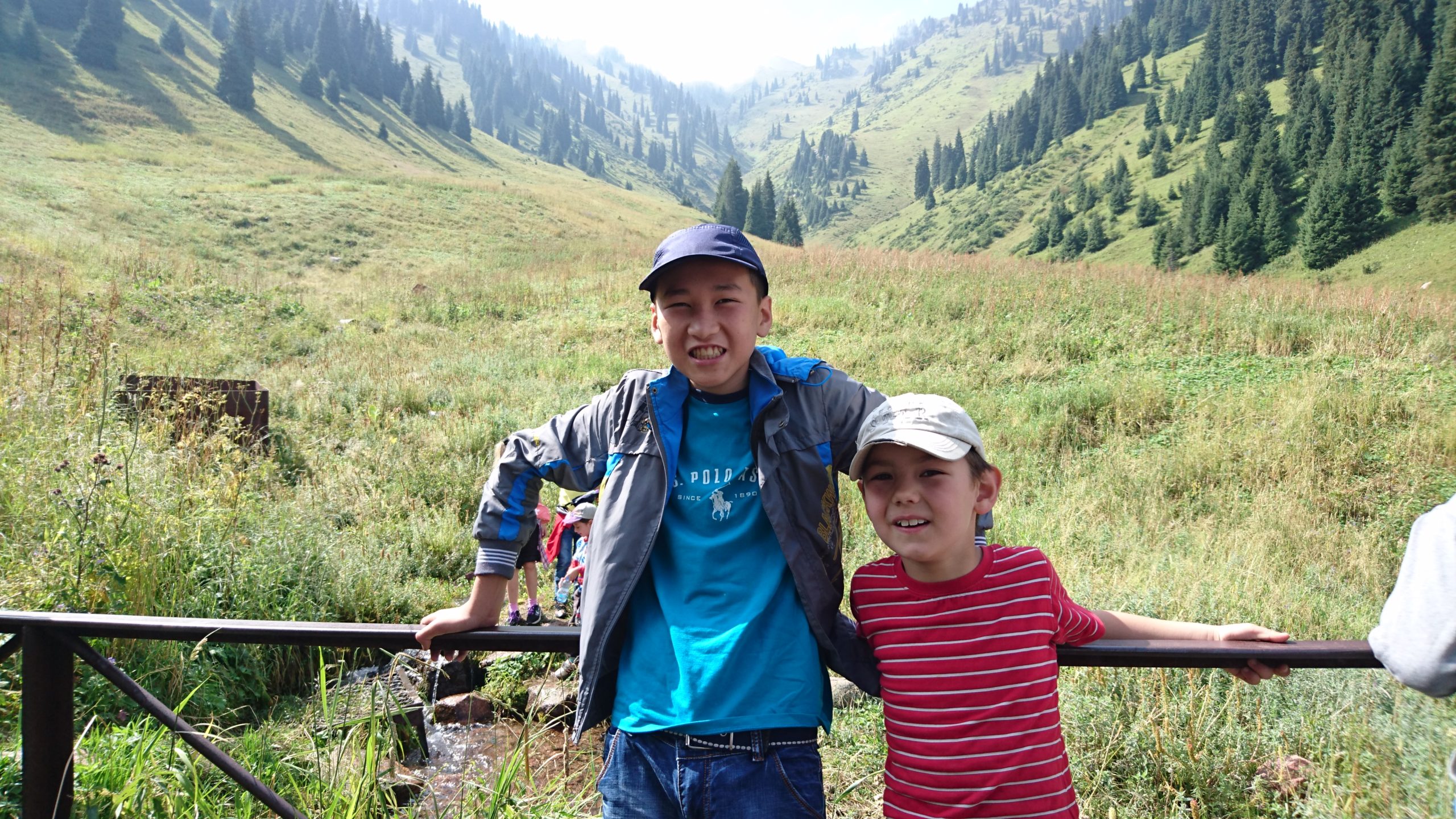
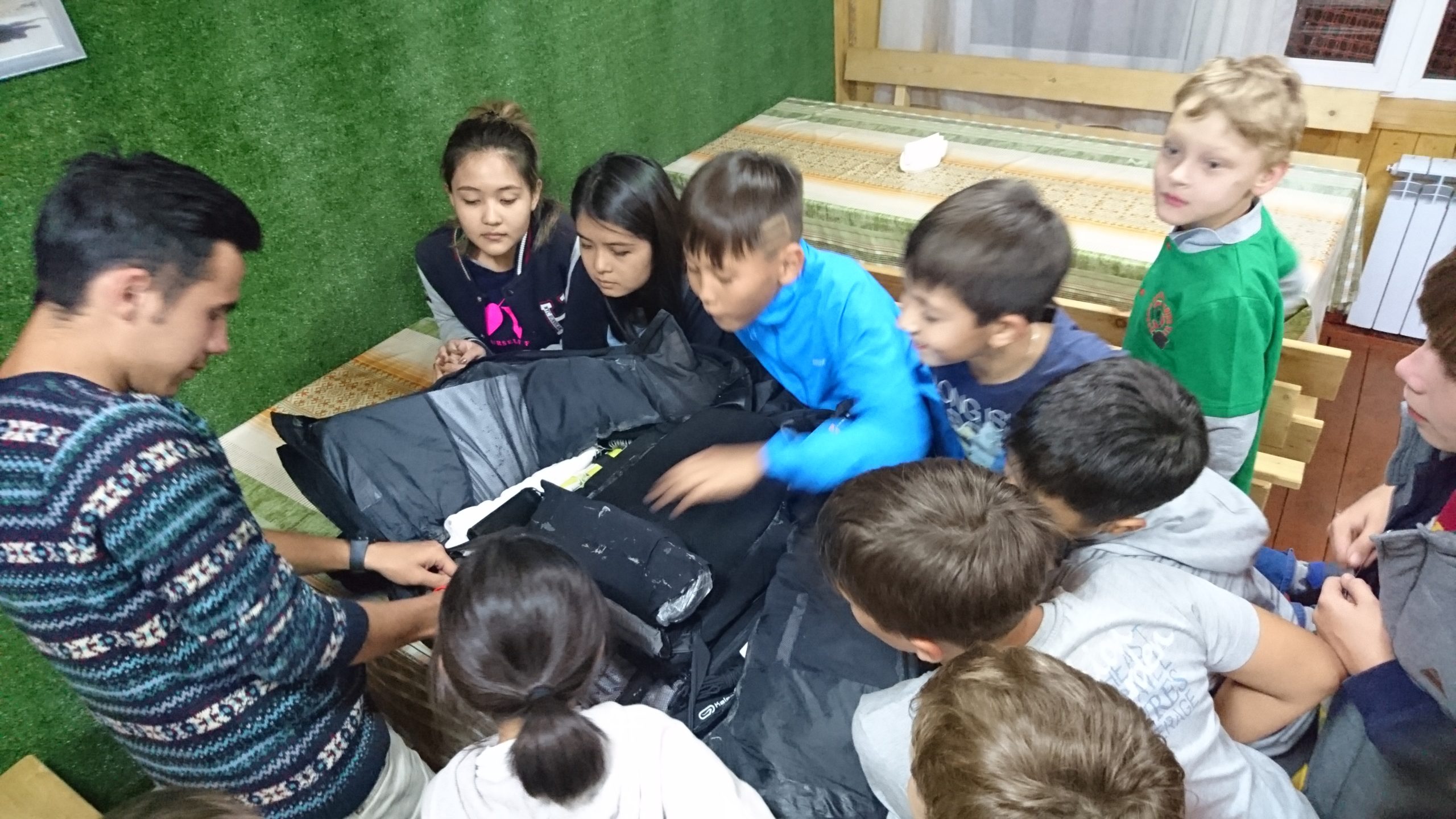
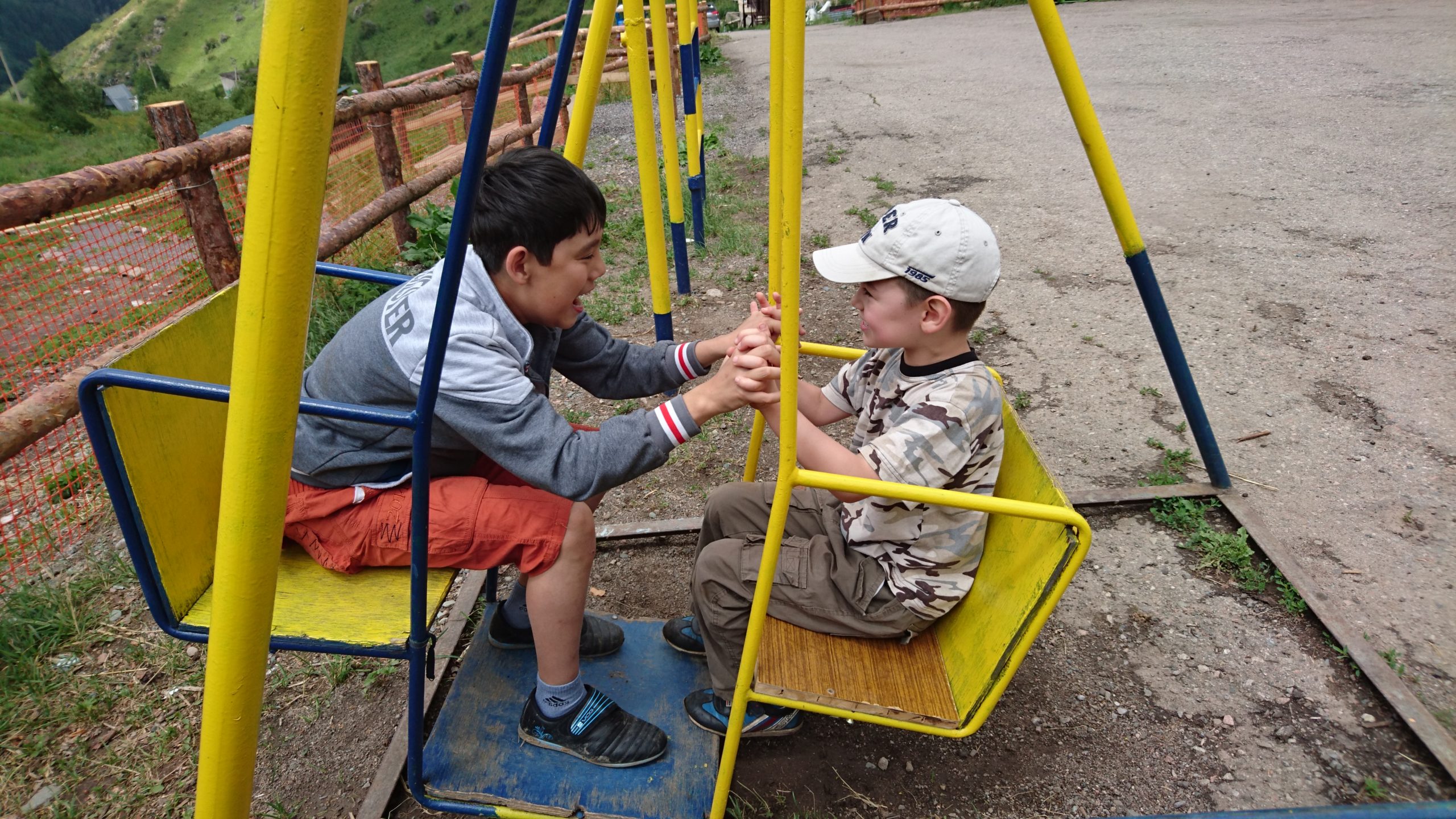
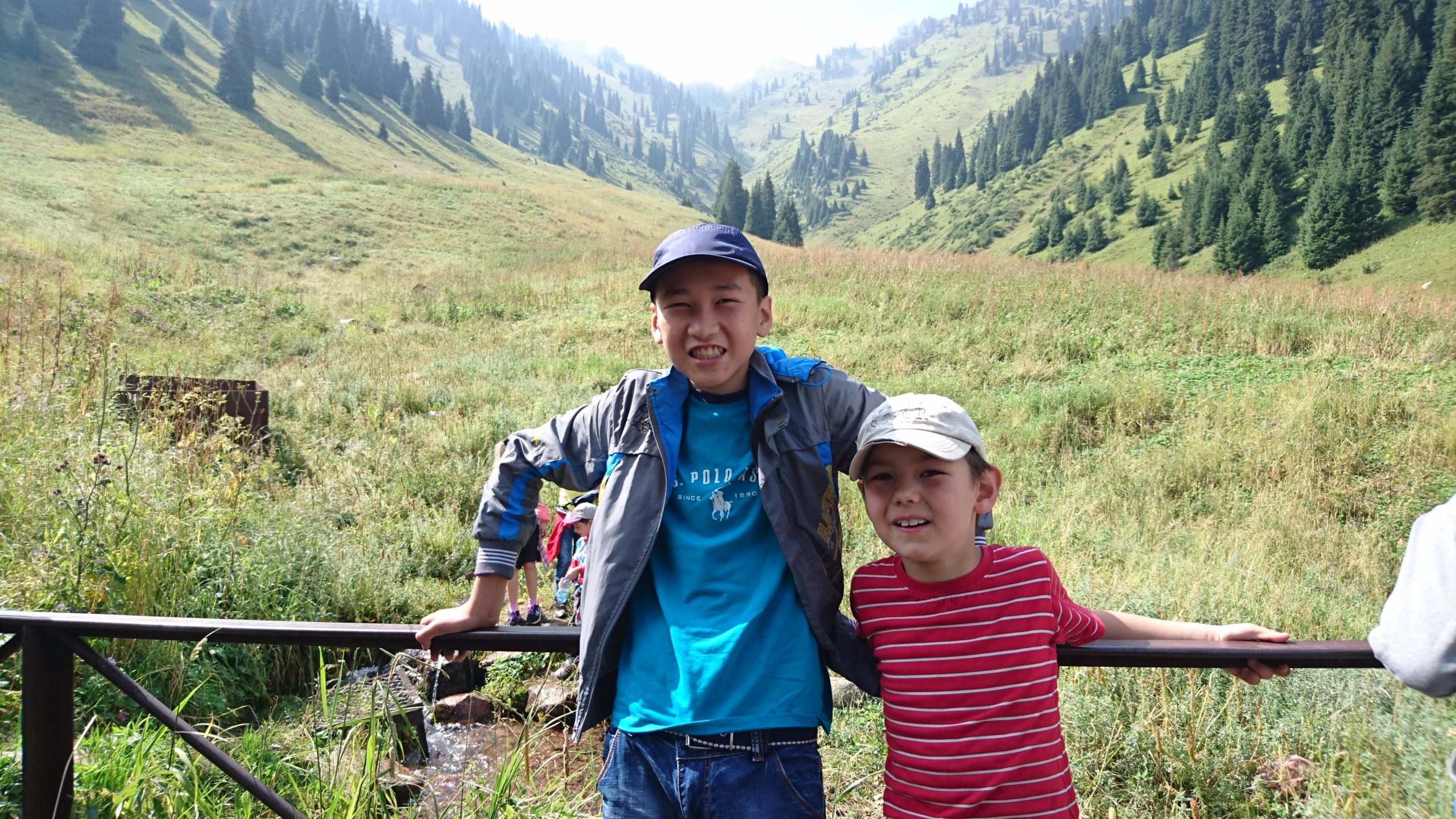
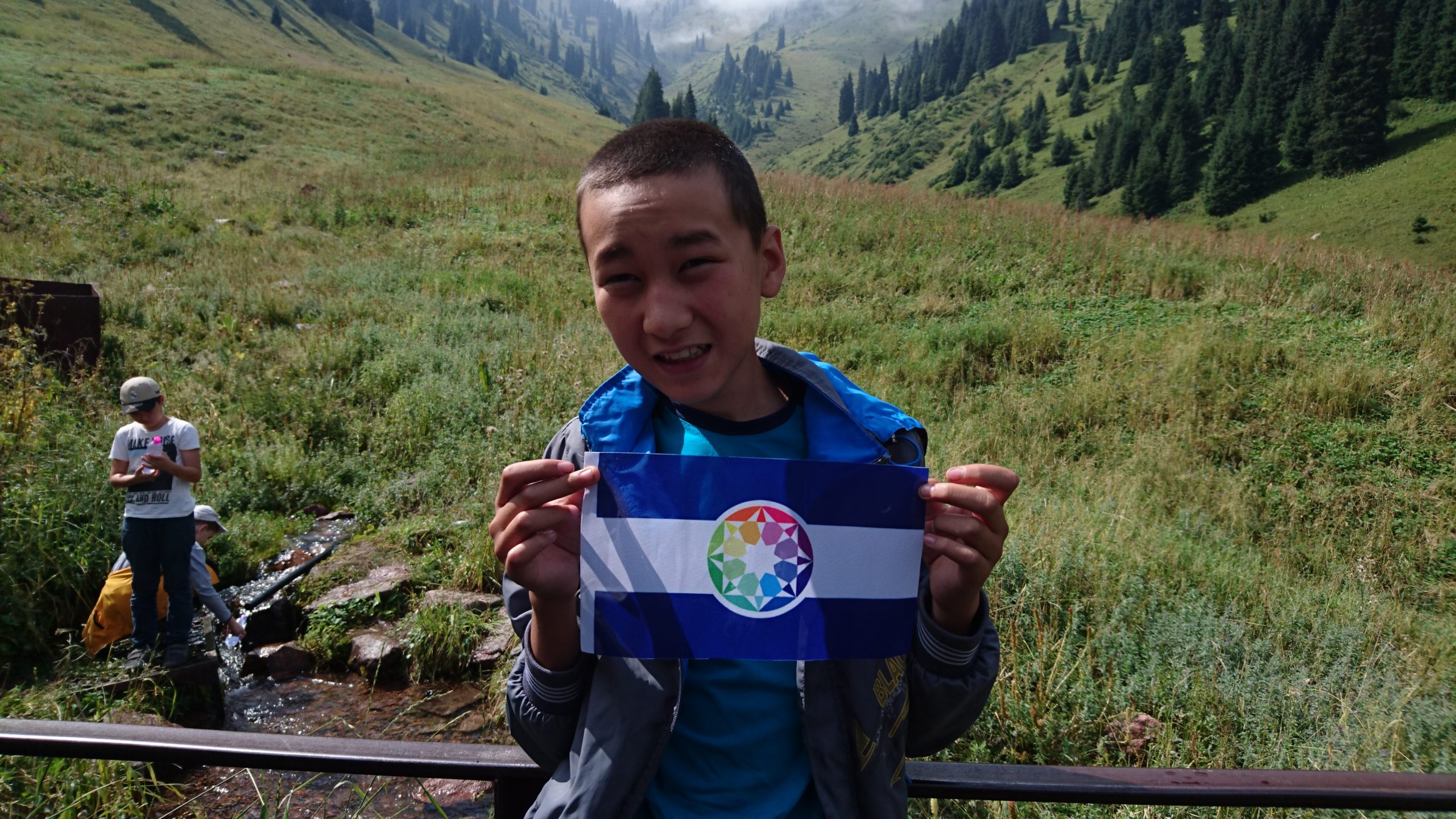
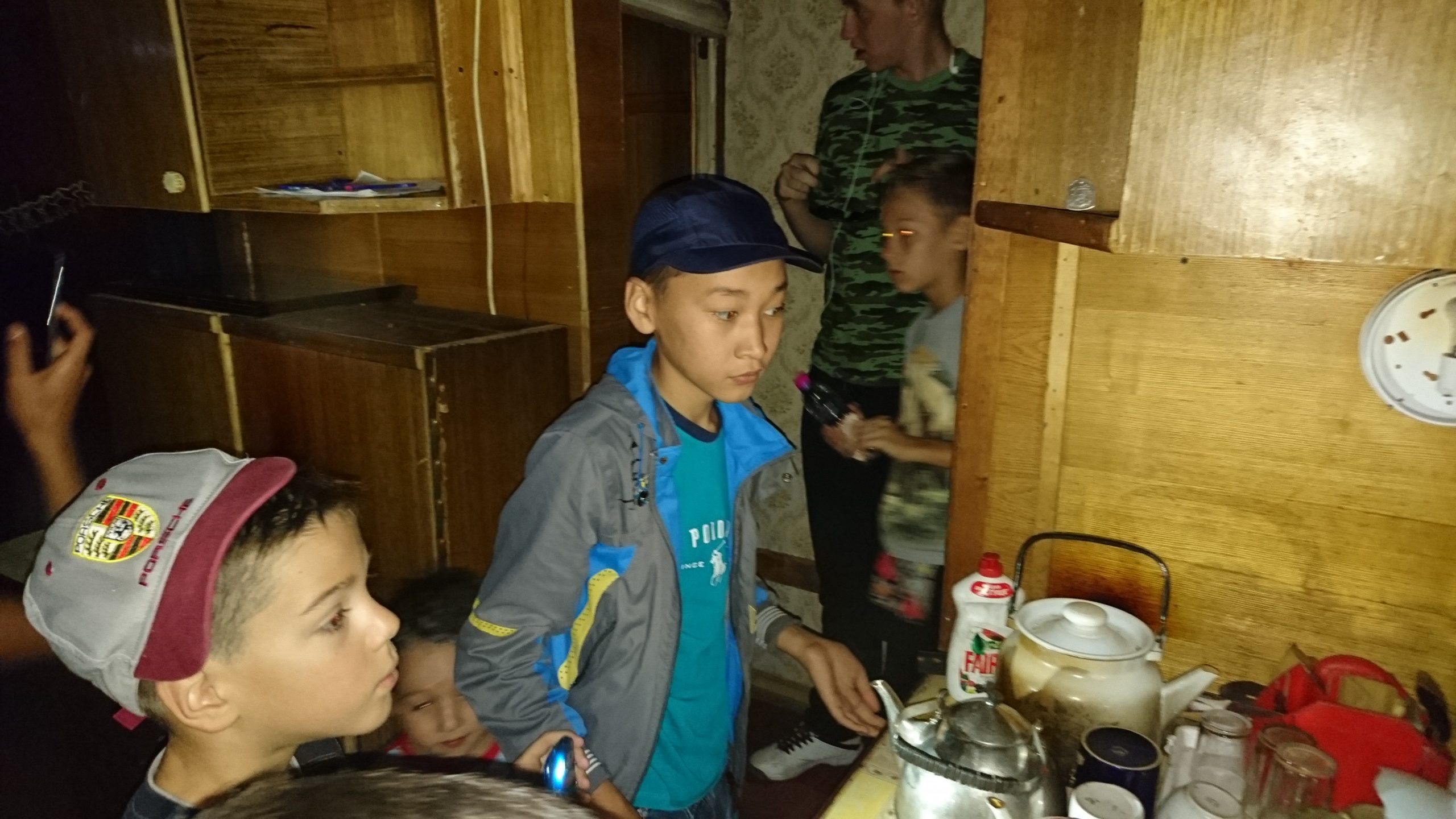
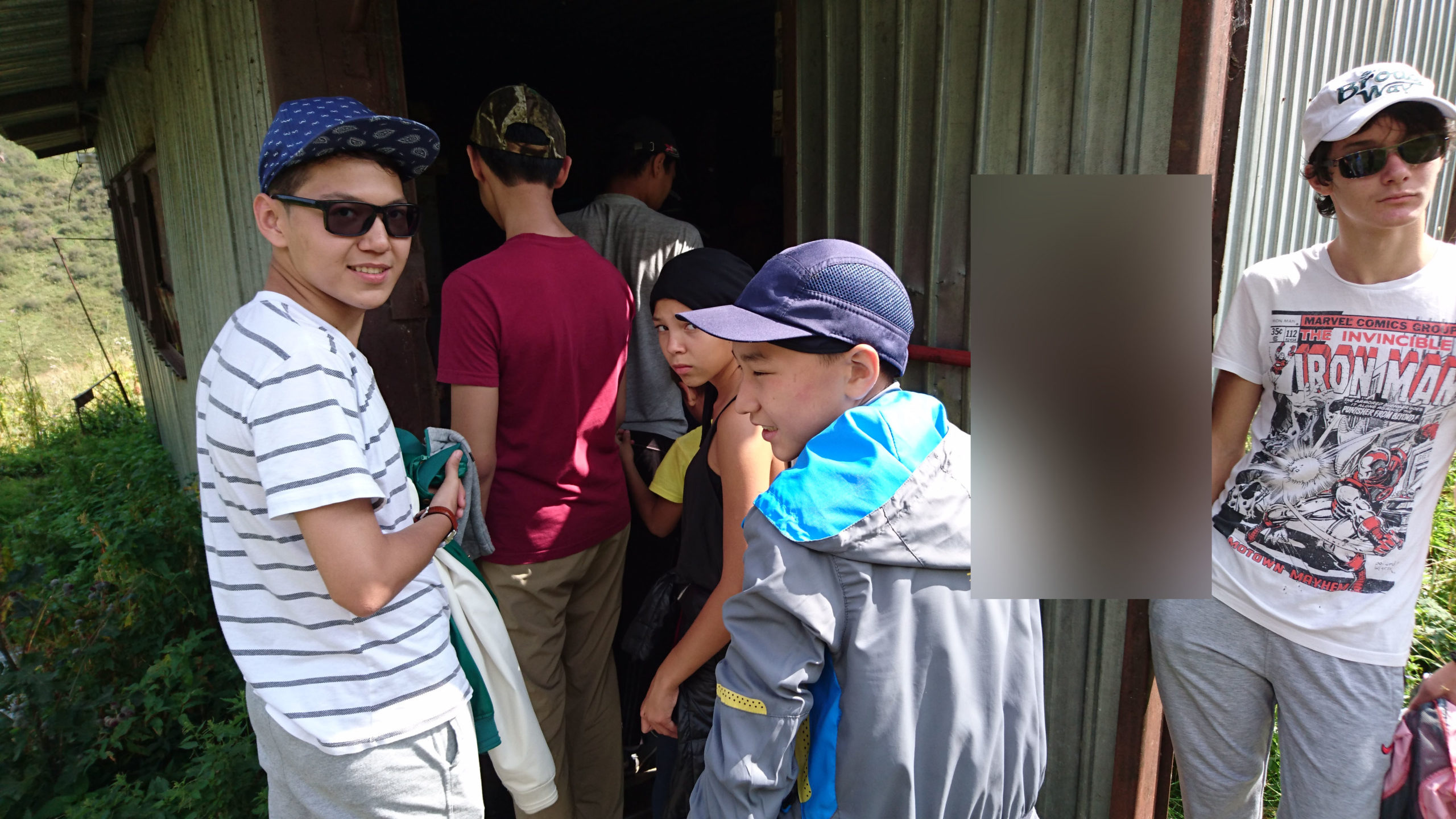 Discovering the “little house in the mountain” on the Pioneer estate, after twenty minutes of attempts to uncover the secret of the very special locking system, blurred in the photo. A very strong moment of discovery for the children.
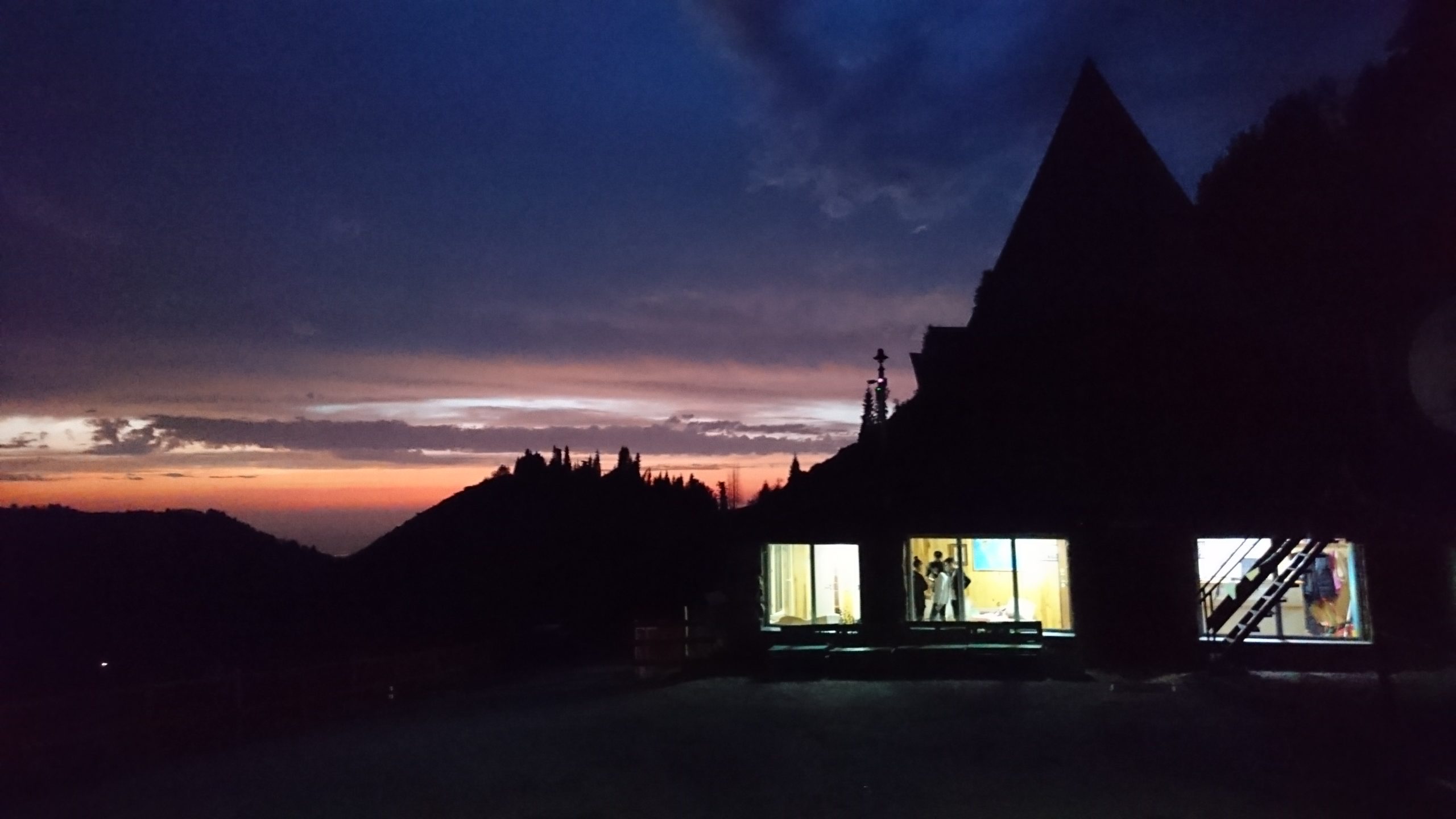 No, these are not just ski slopes…
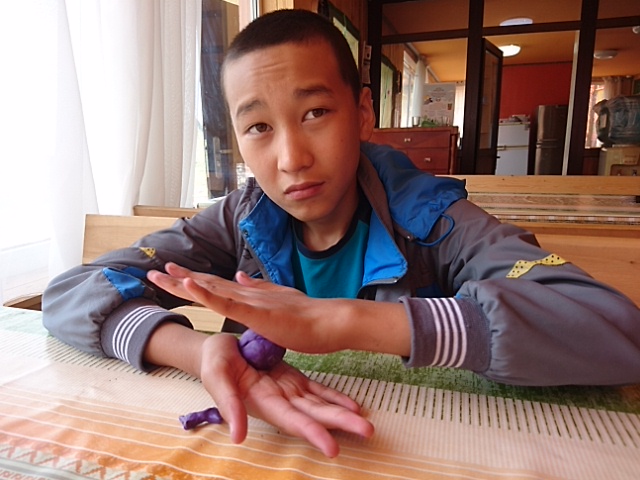
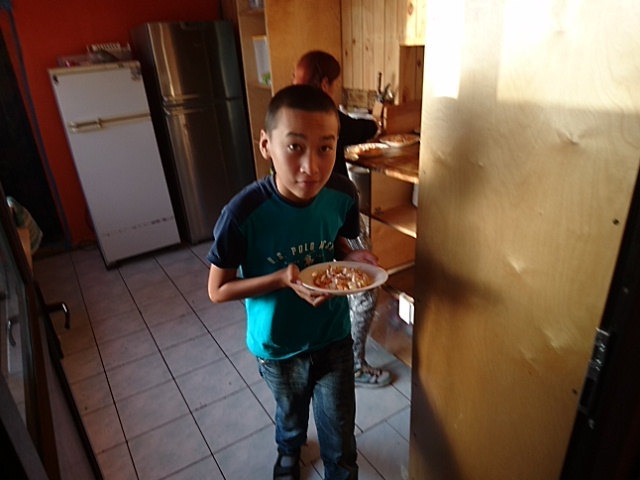
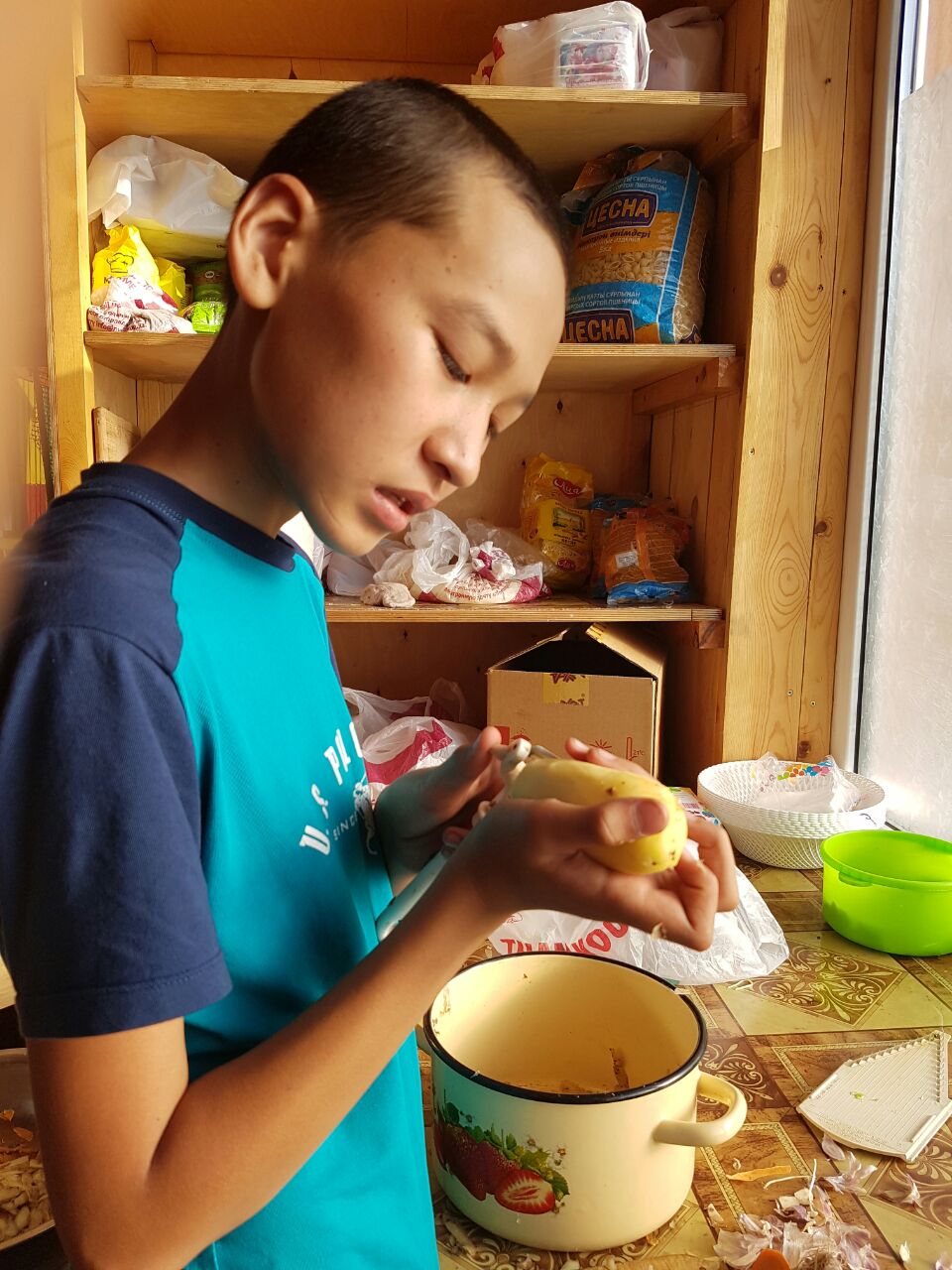
Tima begins to learn to do things with his hands.
The family was convinced that he was incapable of anything, and had warned us, wrongly, that there would be “problems”.
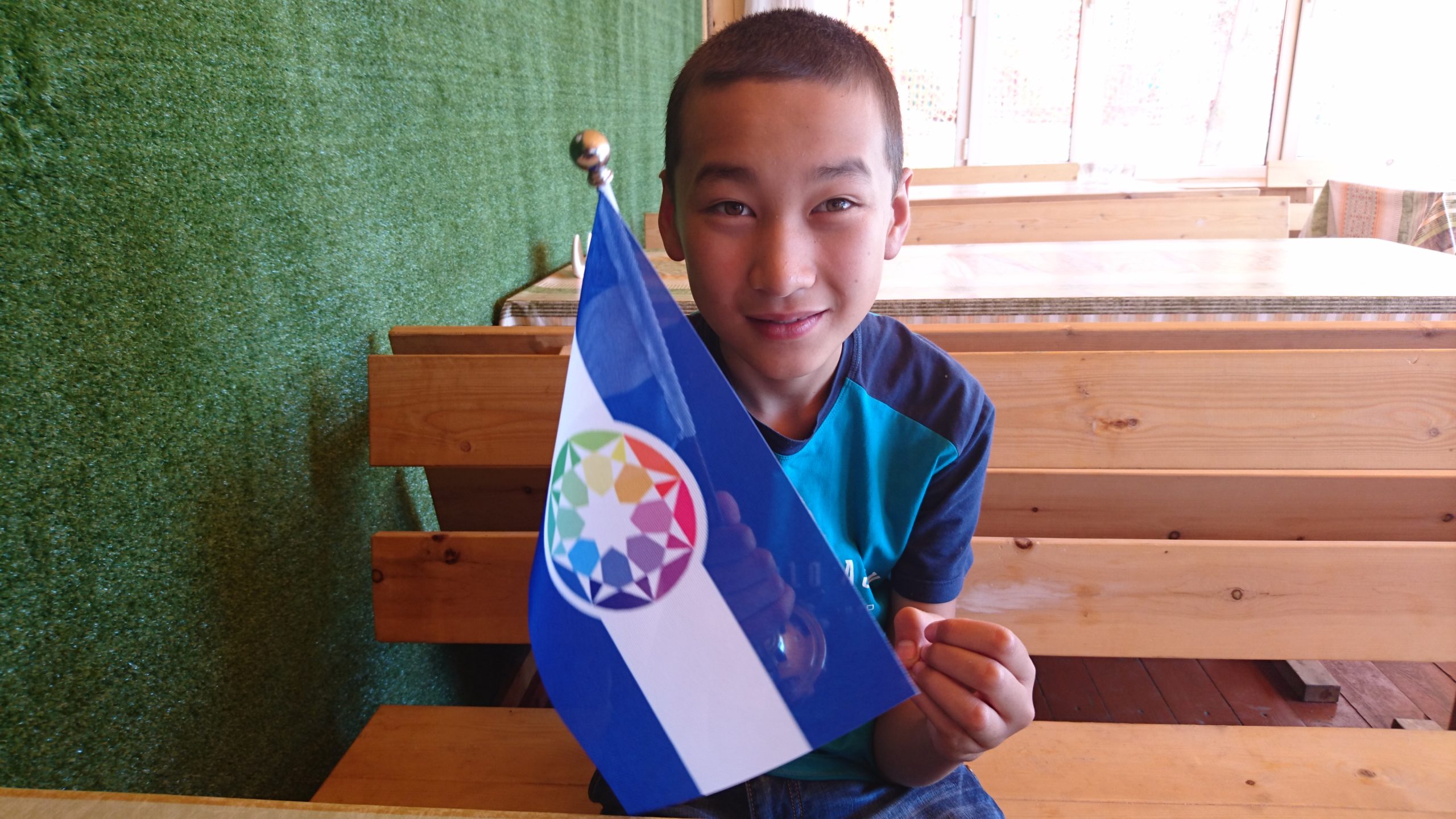
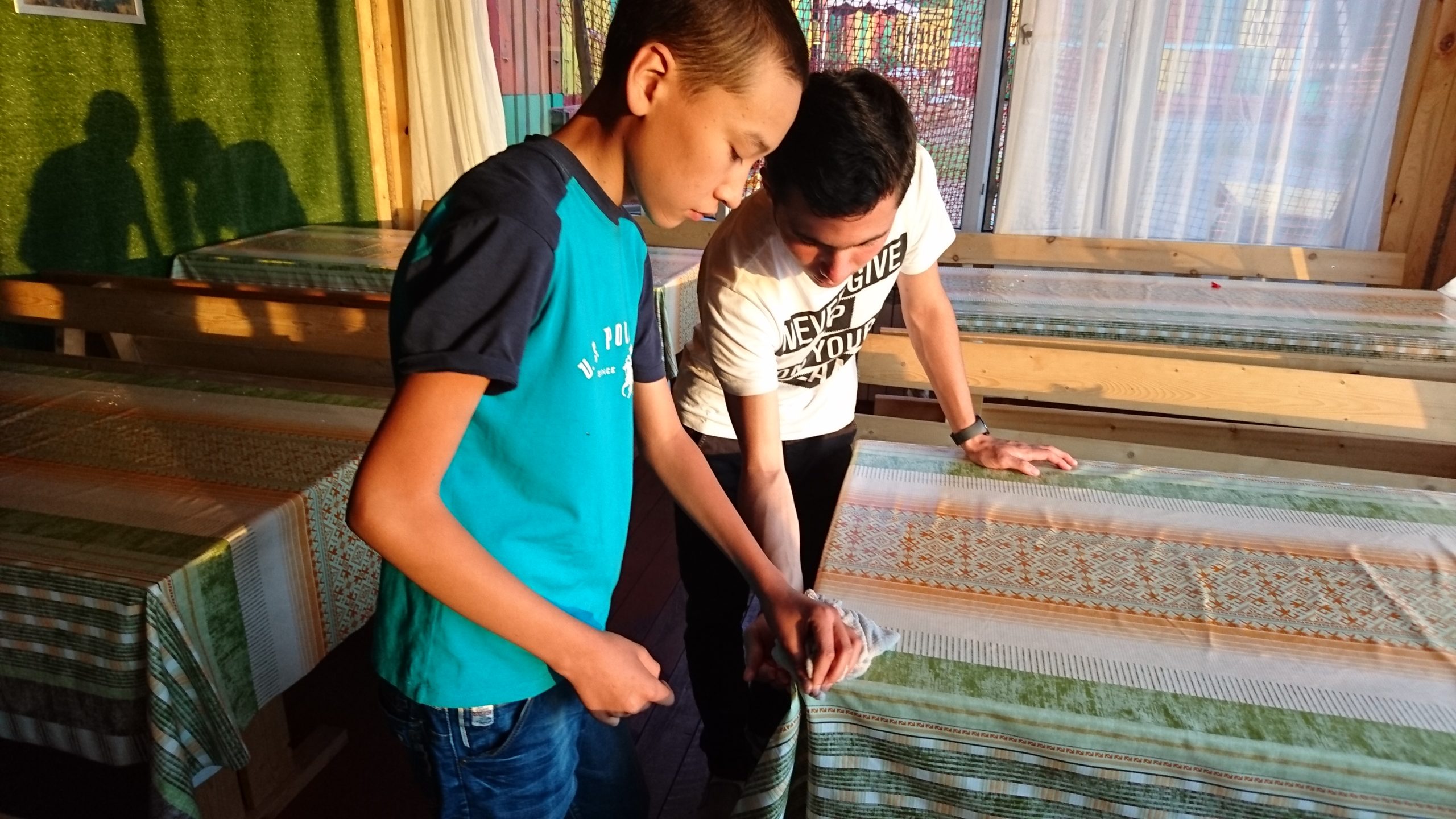
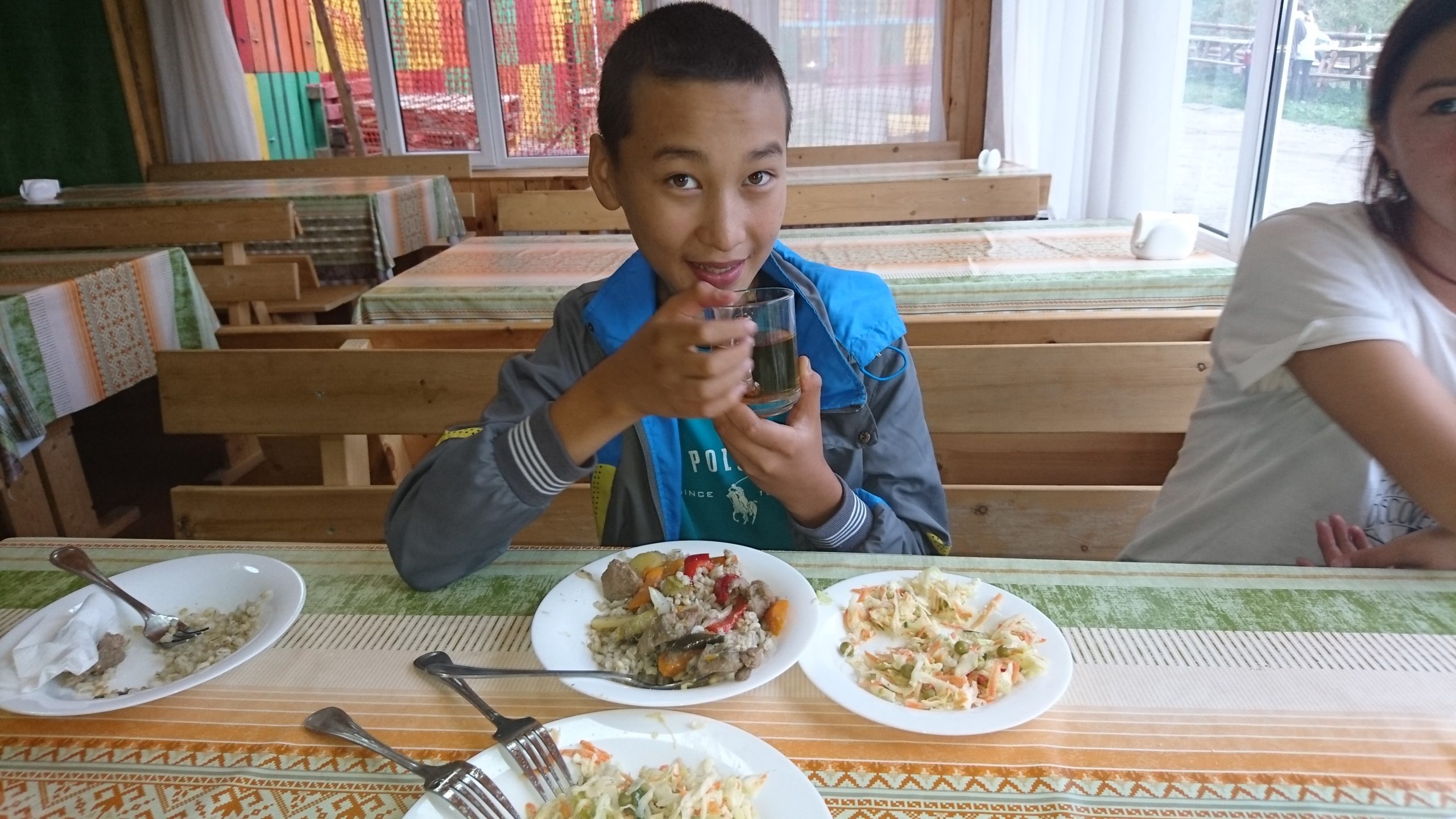
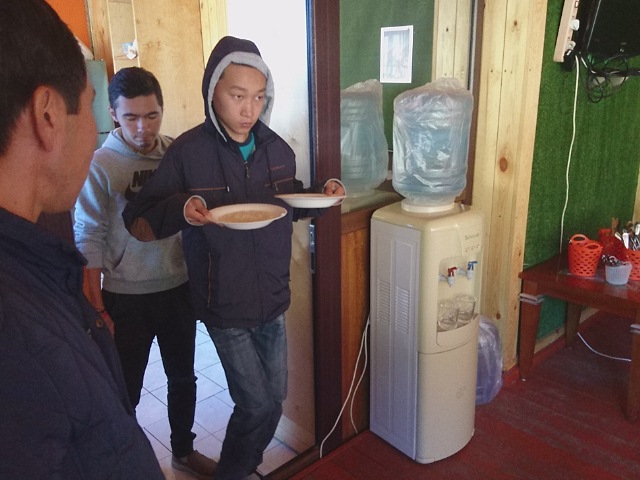
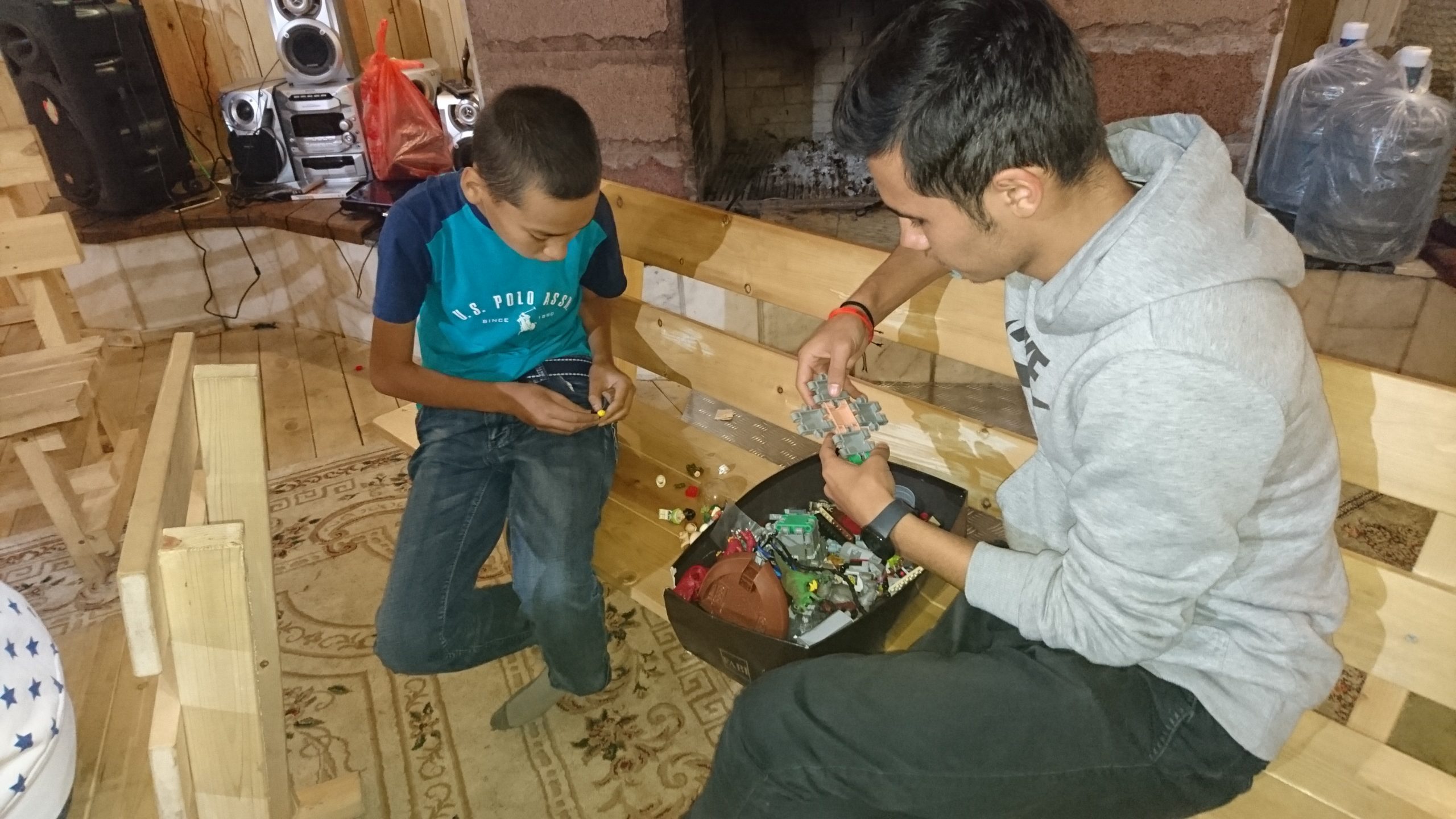
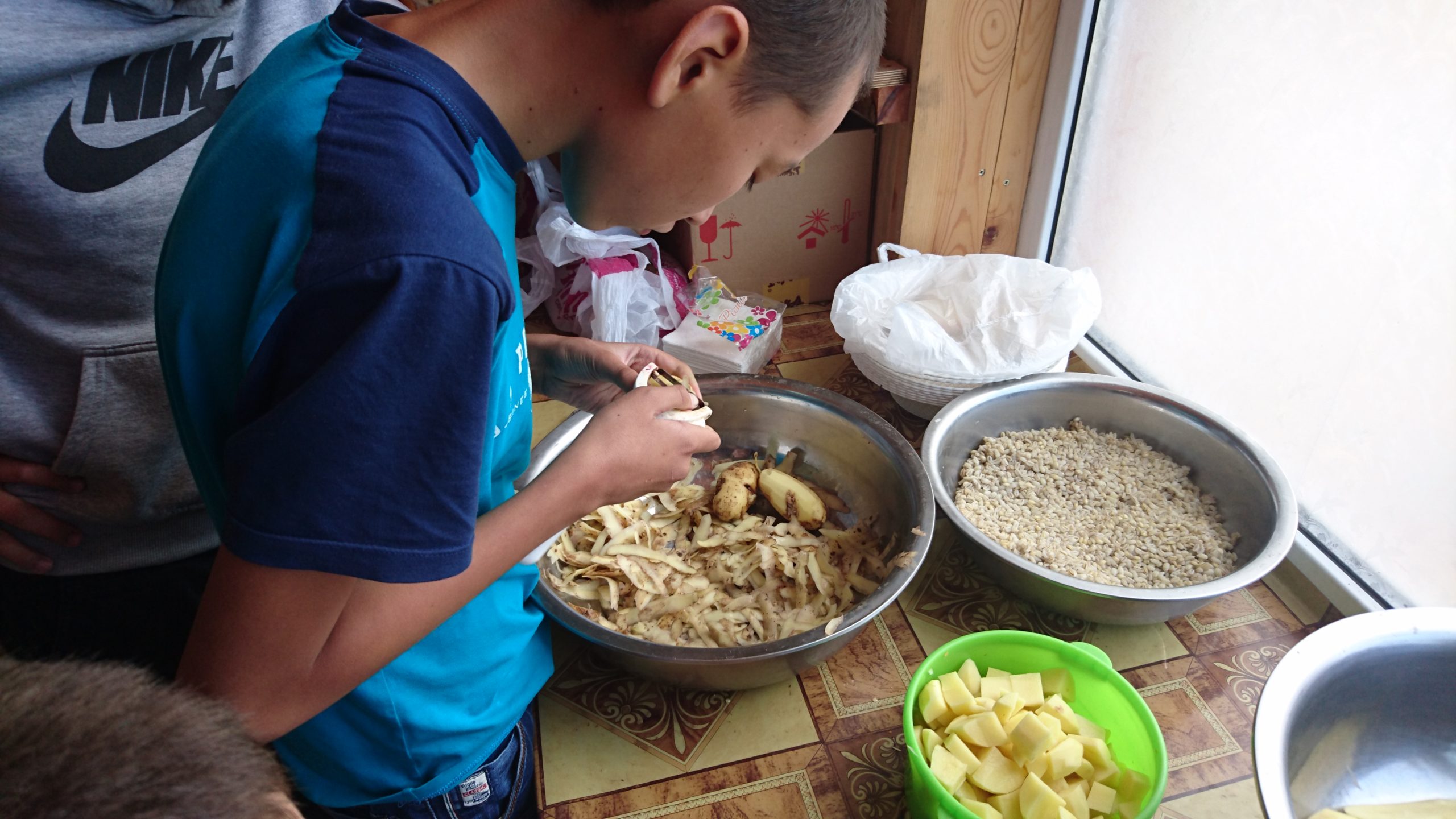
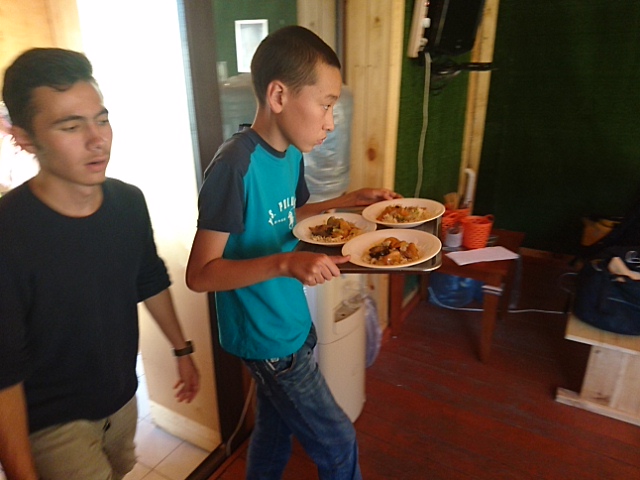
Always accompanied by his attentive instructor, also with our observation and advice.
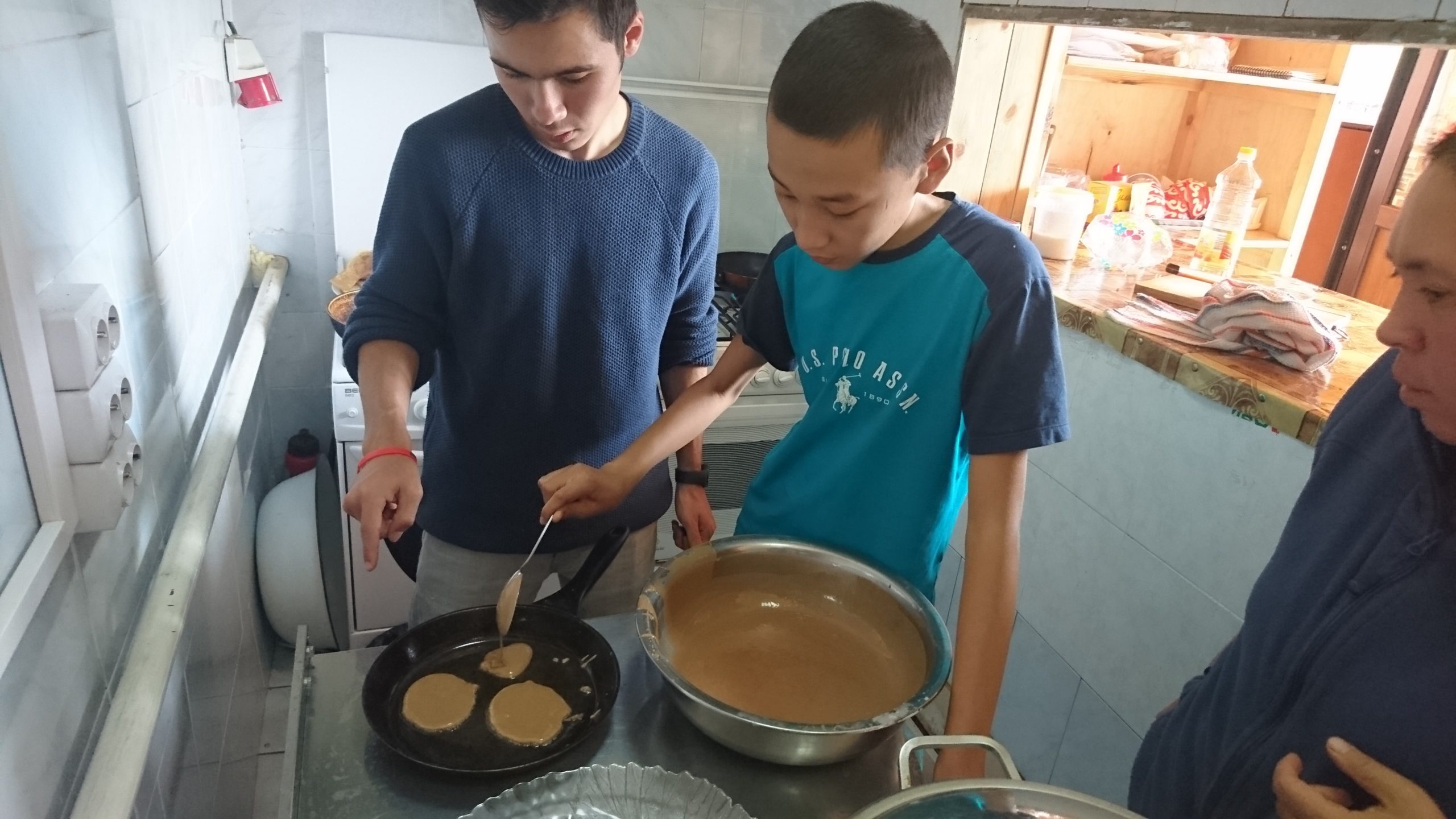
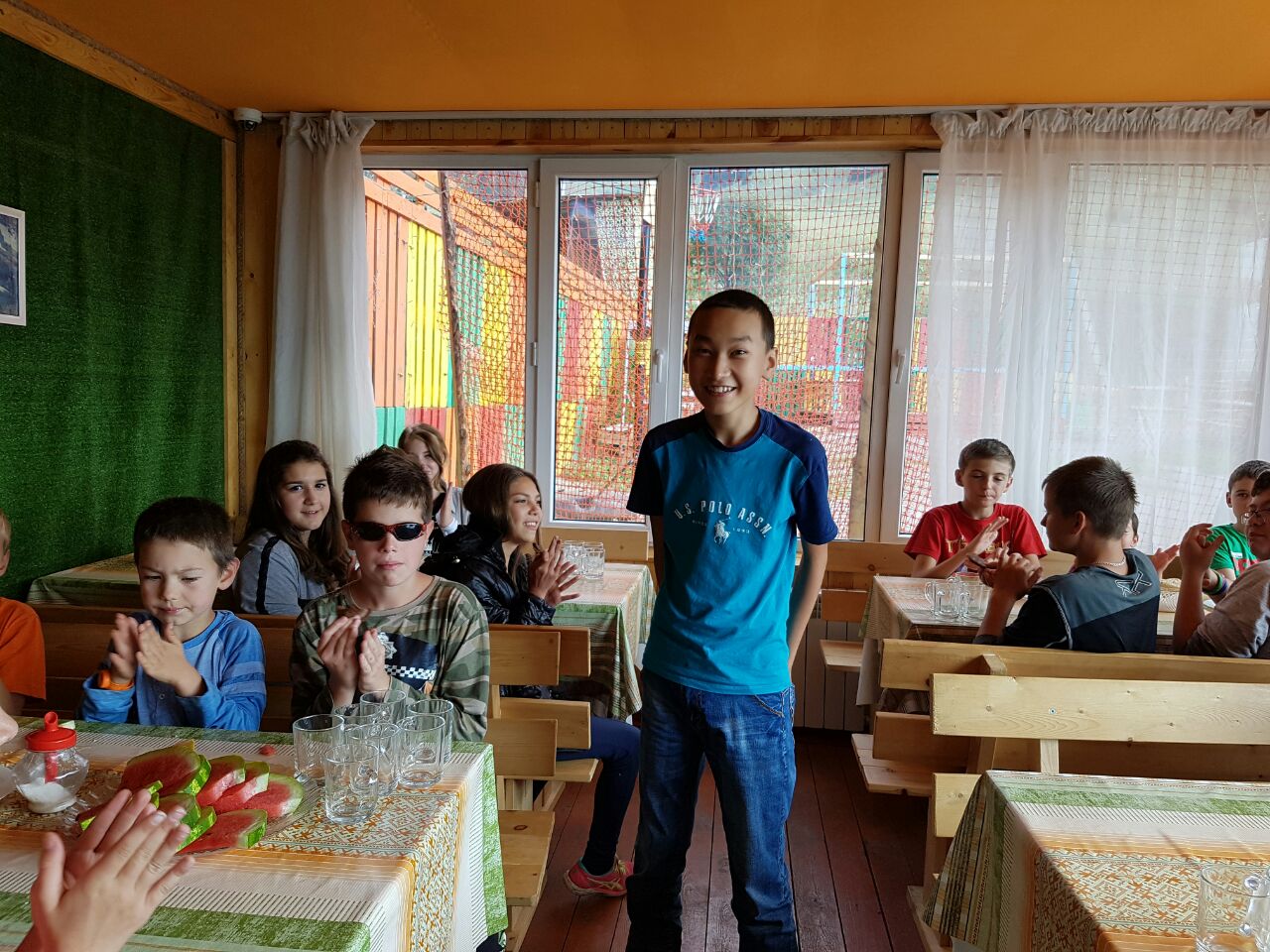
Tima is applauded and congratulated by everyone, because he made pancakes 🙂
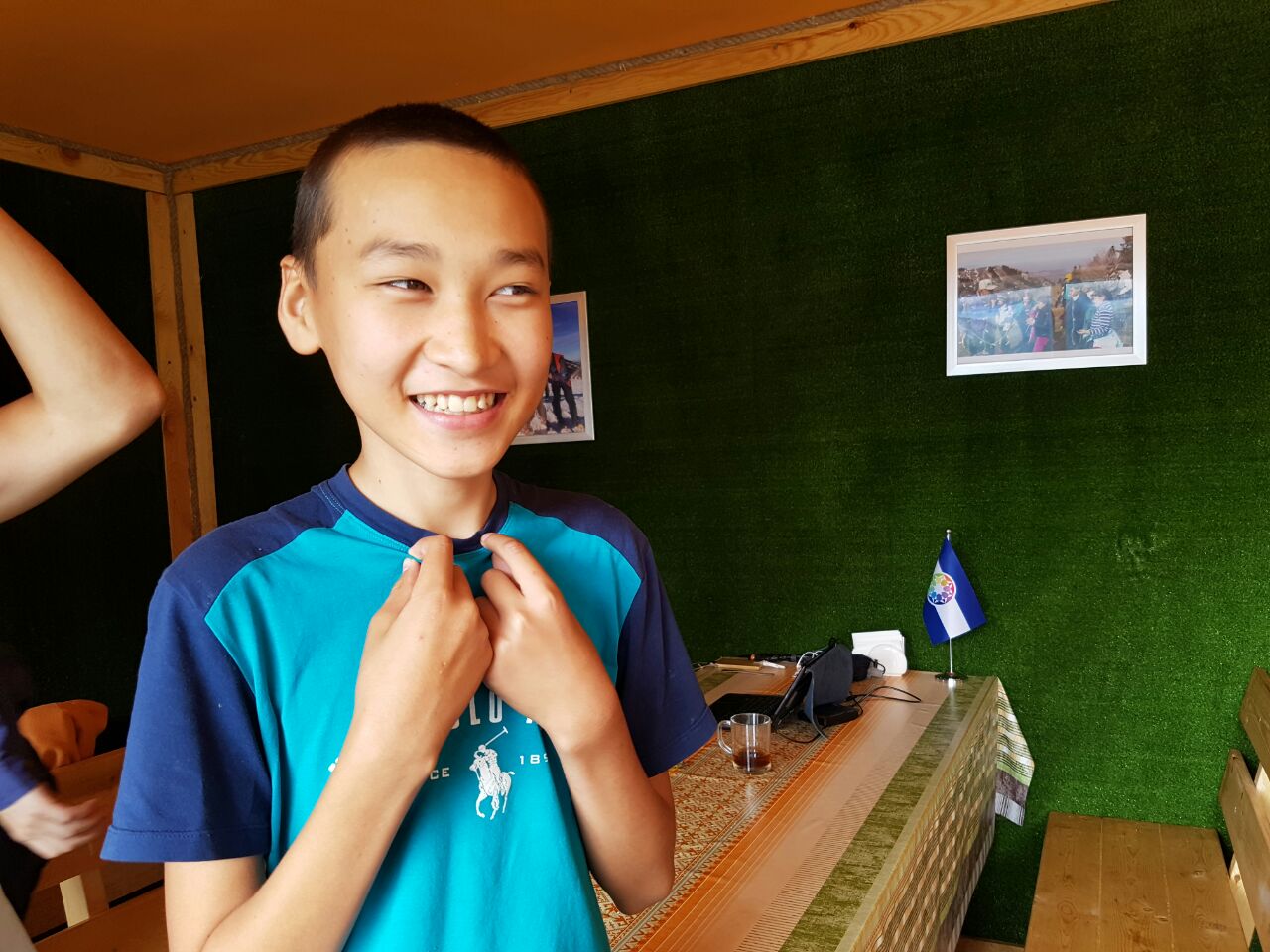 This is undoubtedly the image of happiness!
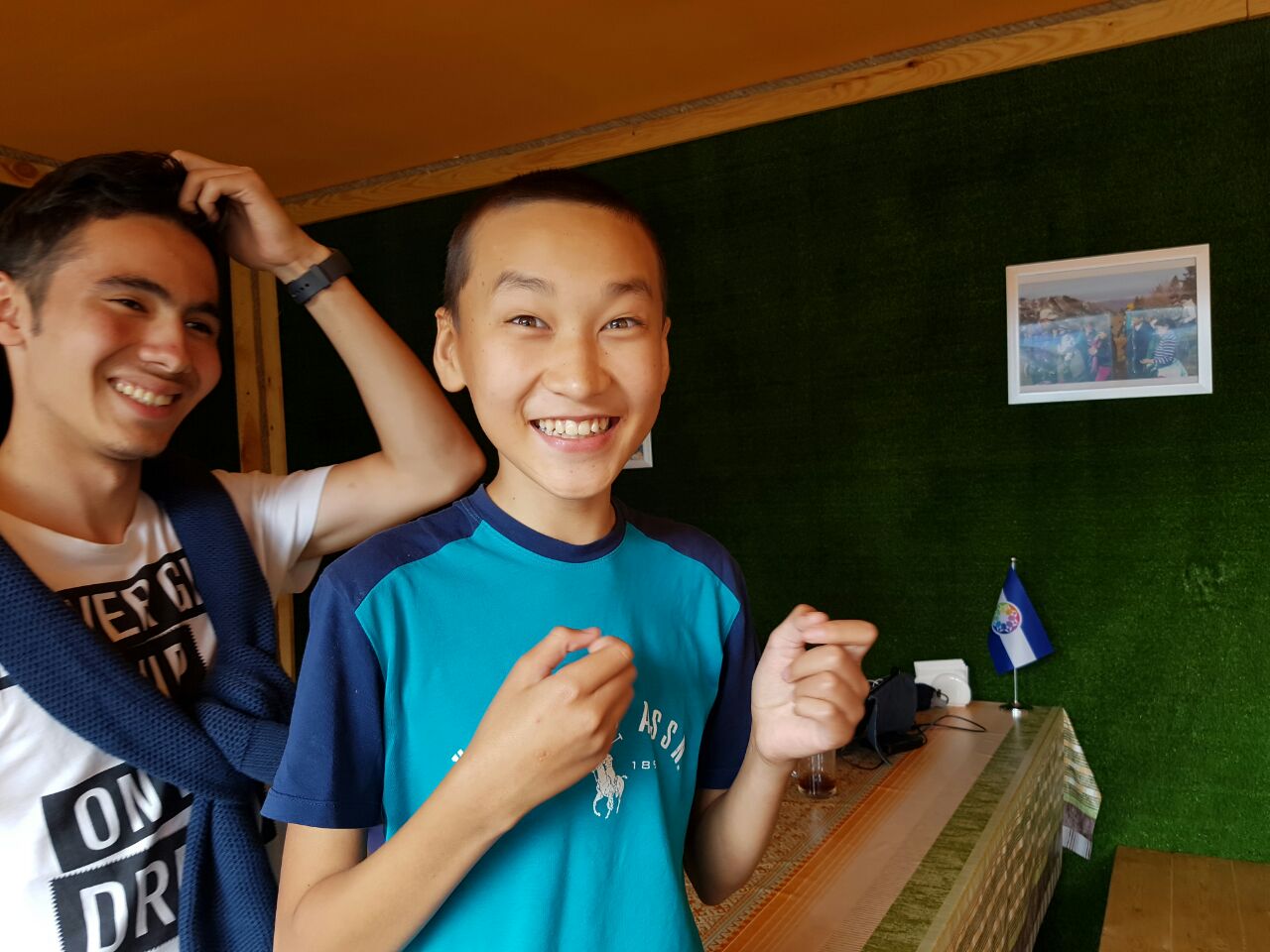
With the “office” of Autistan in the background.
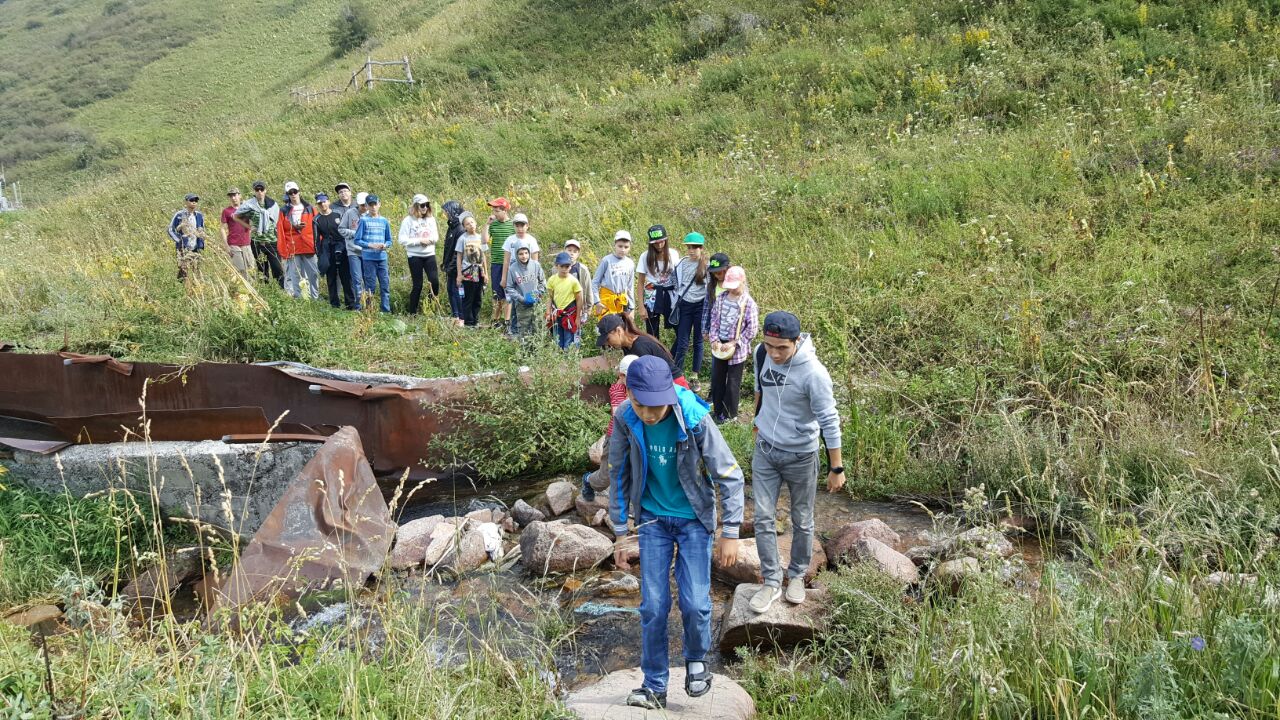 Tima leads the way!
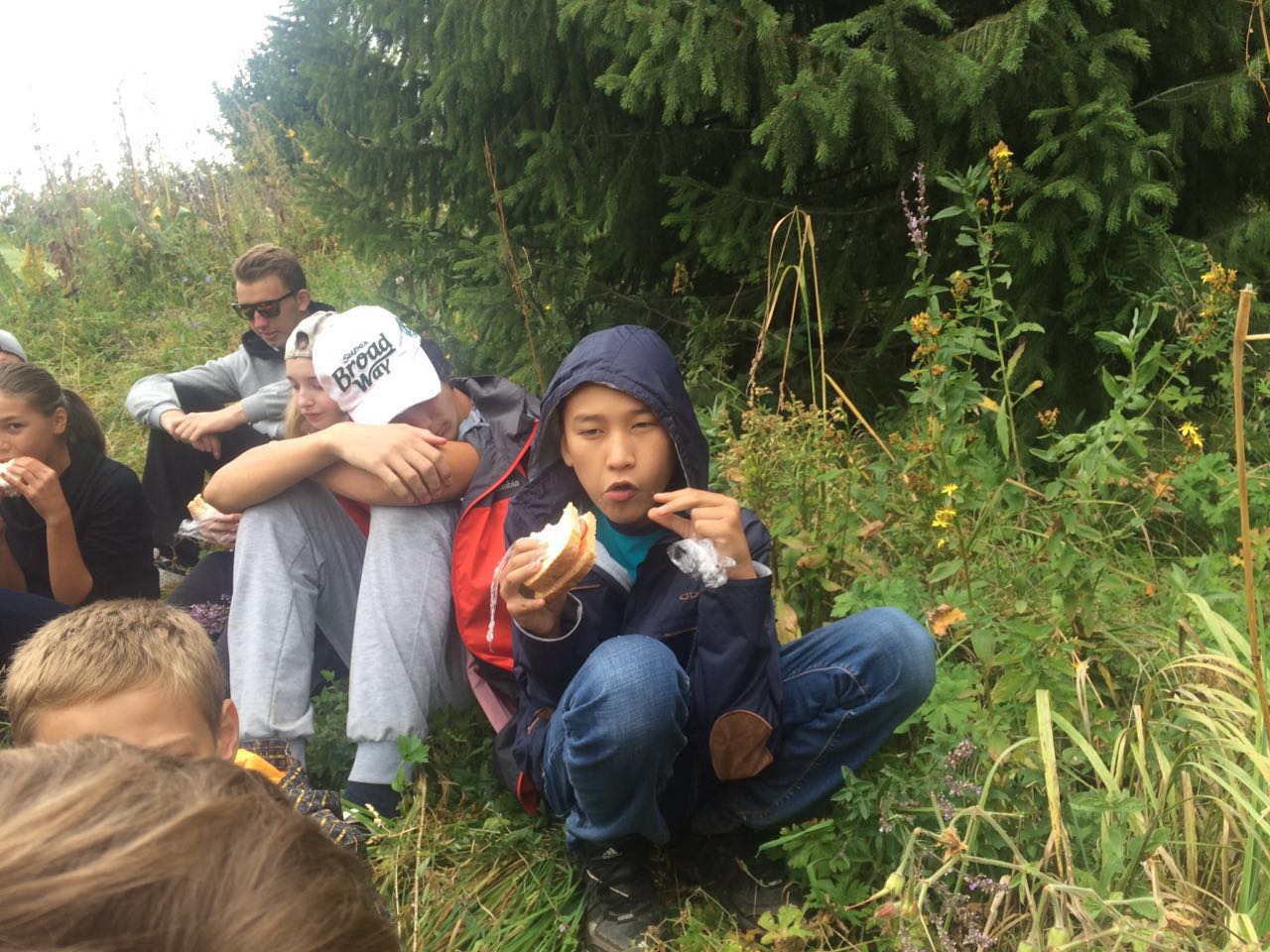
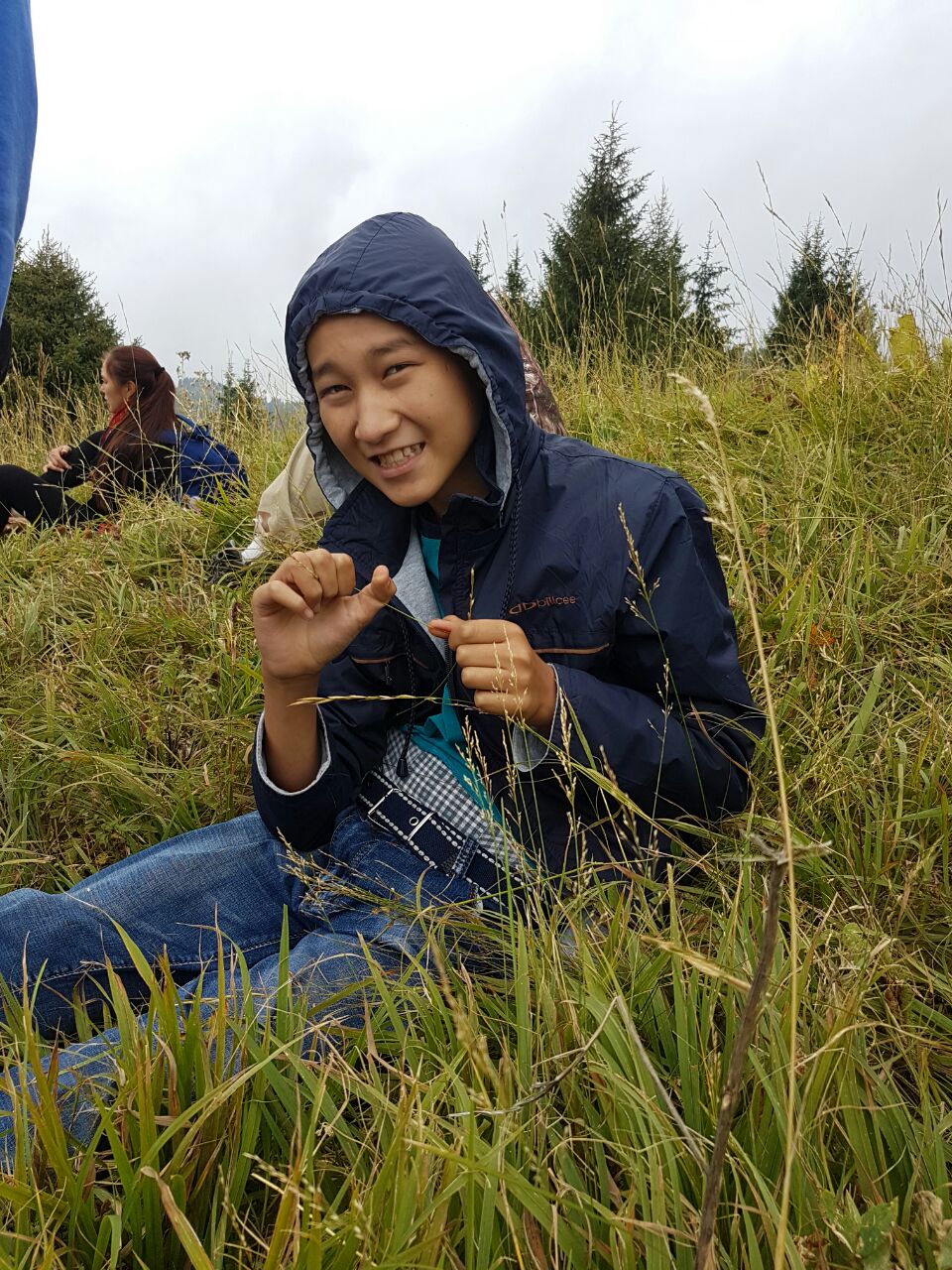
 In the village.
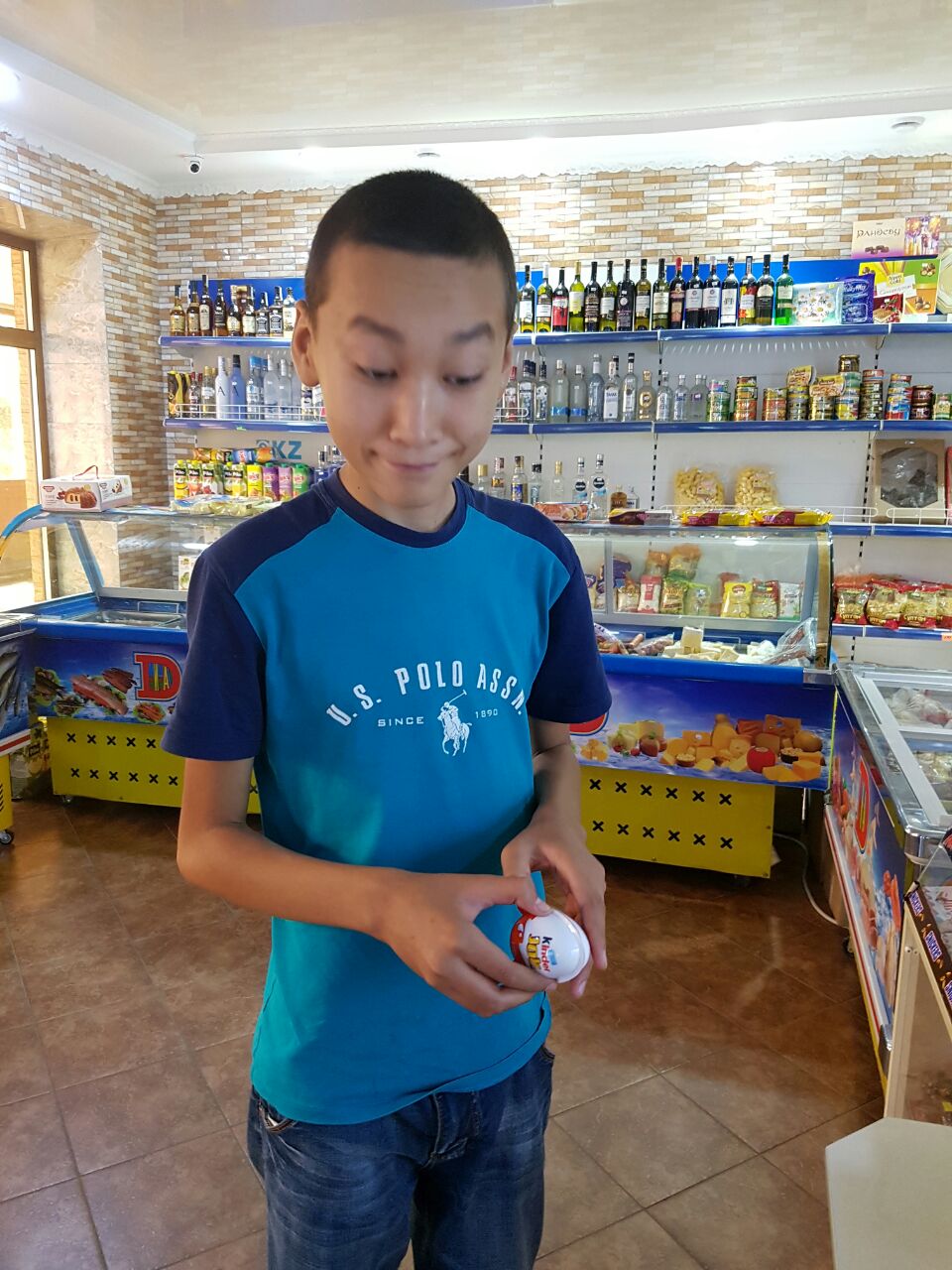
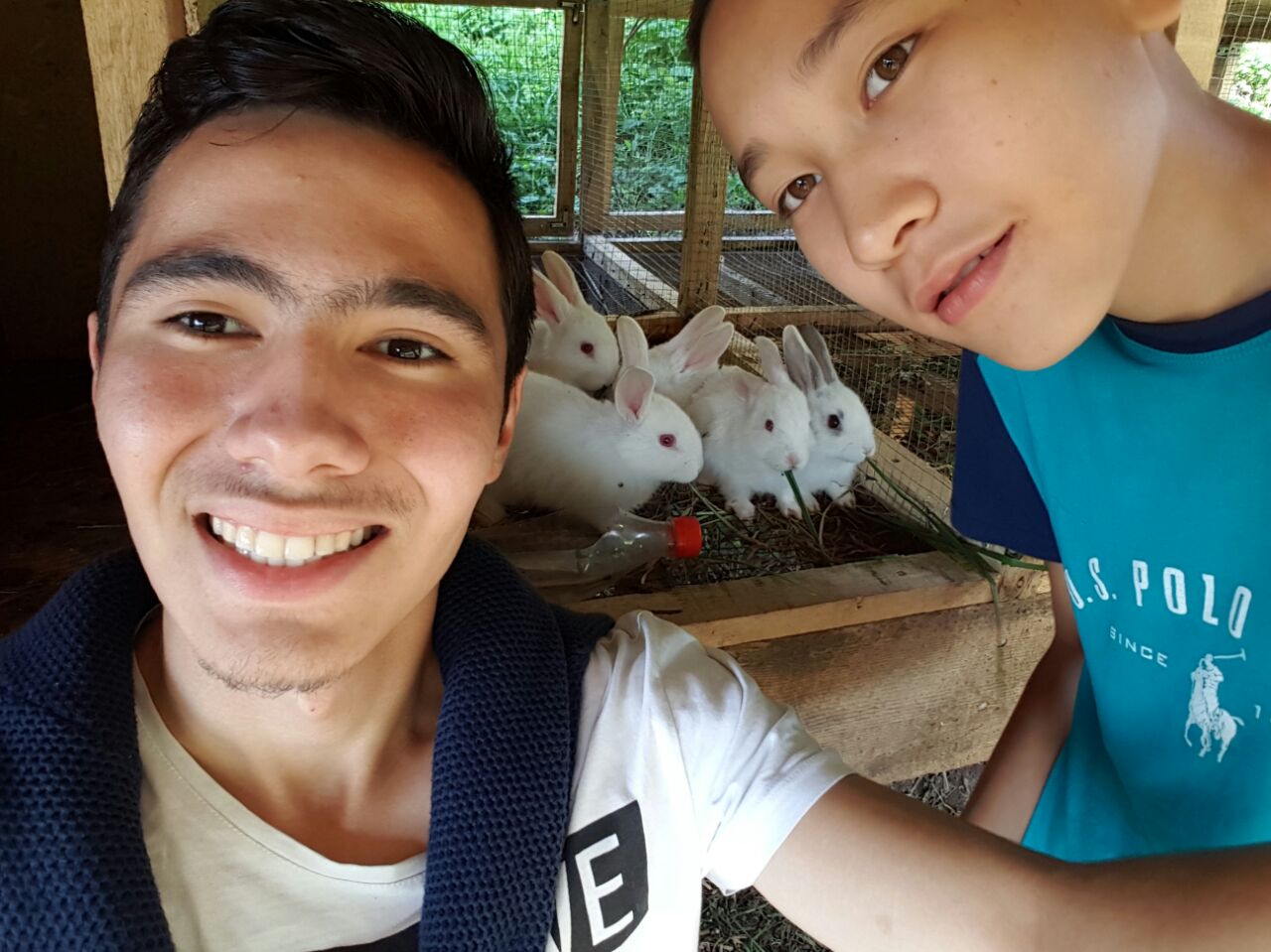
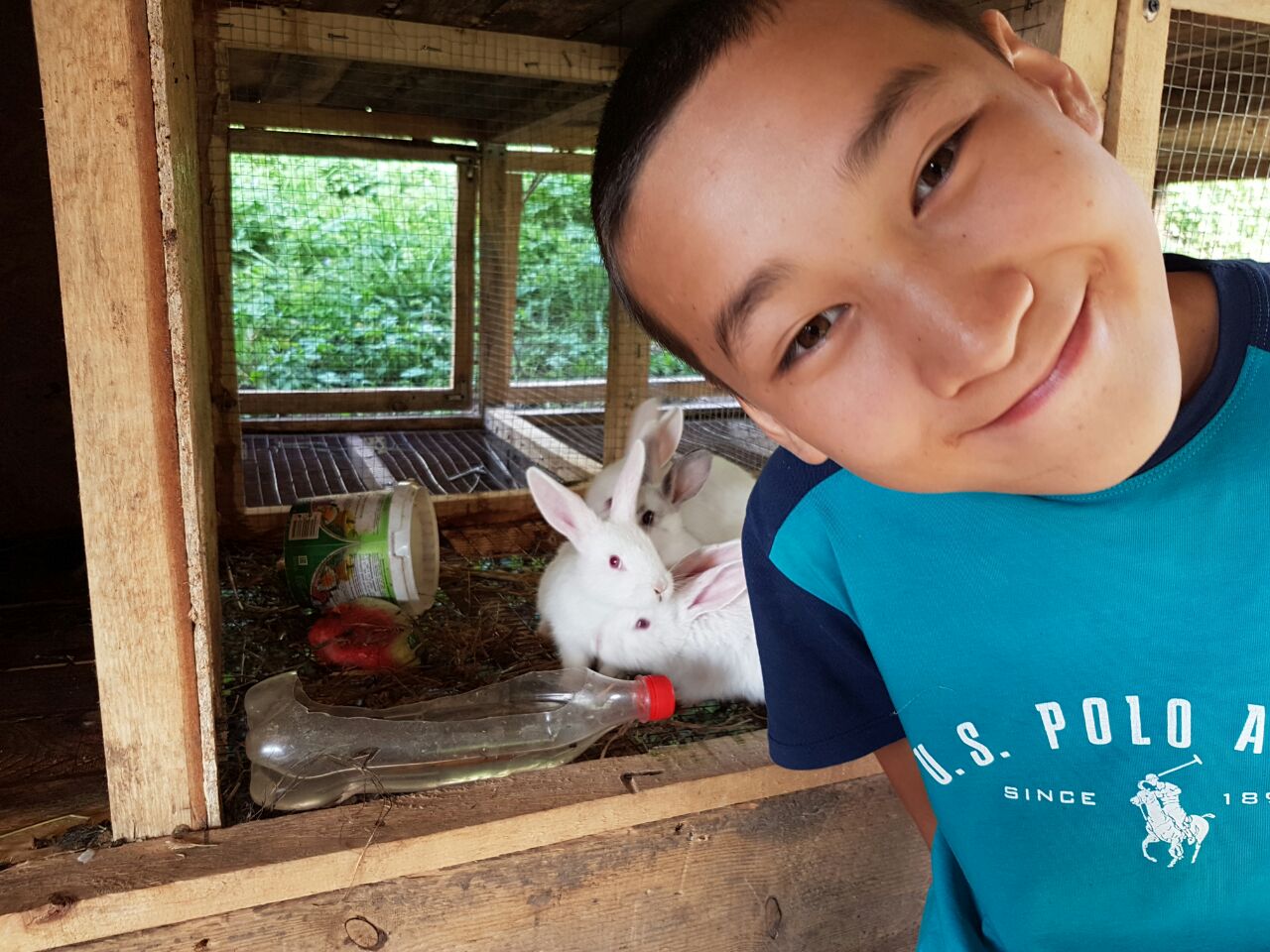
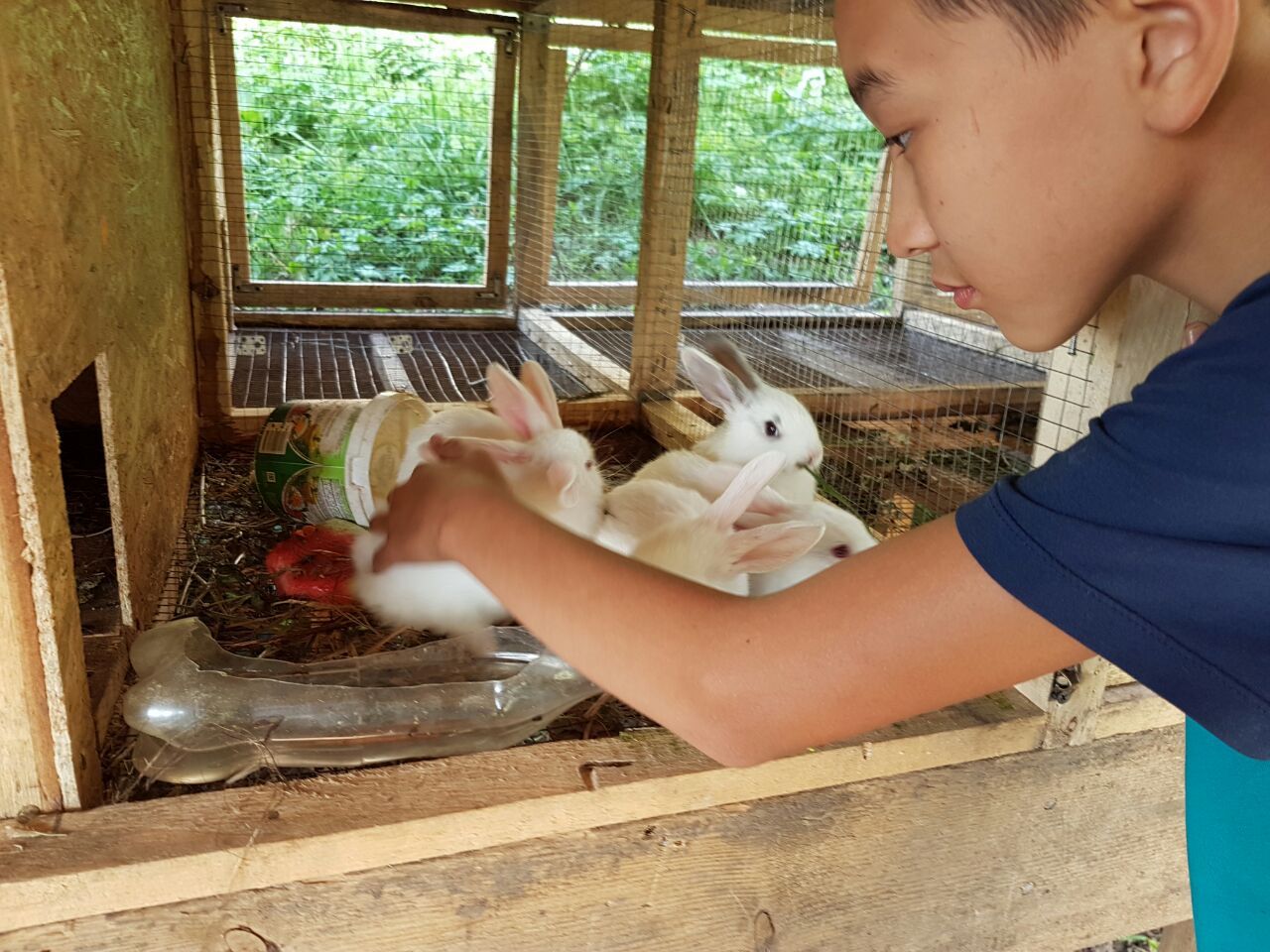
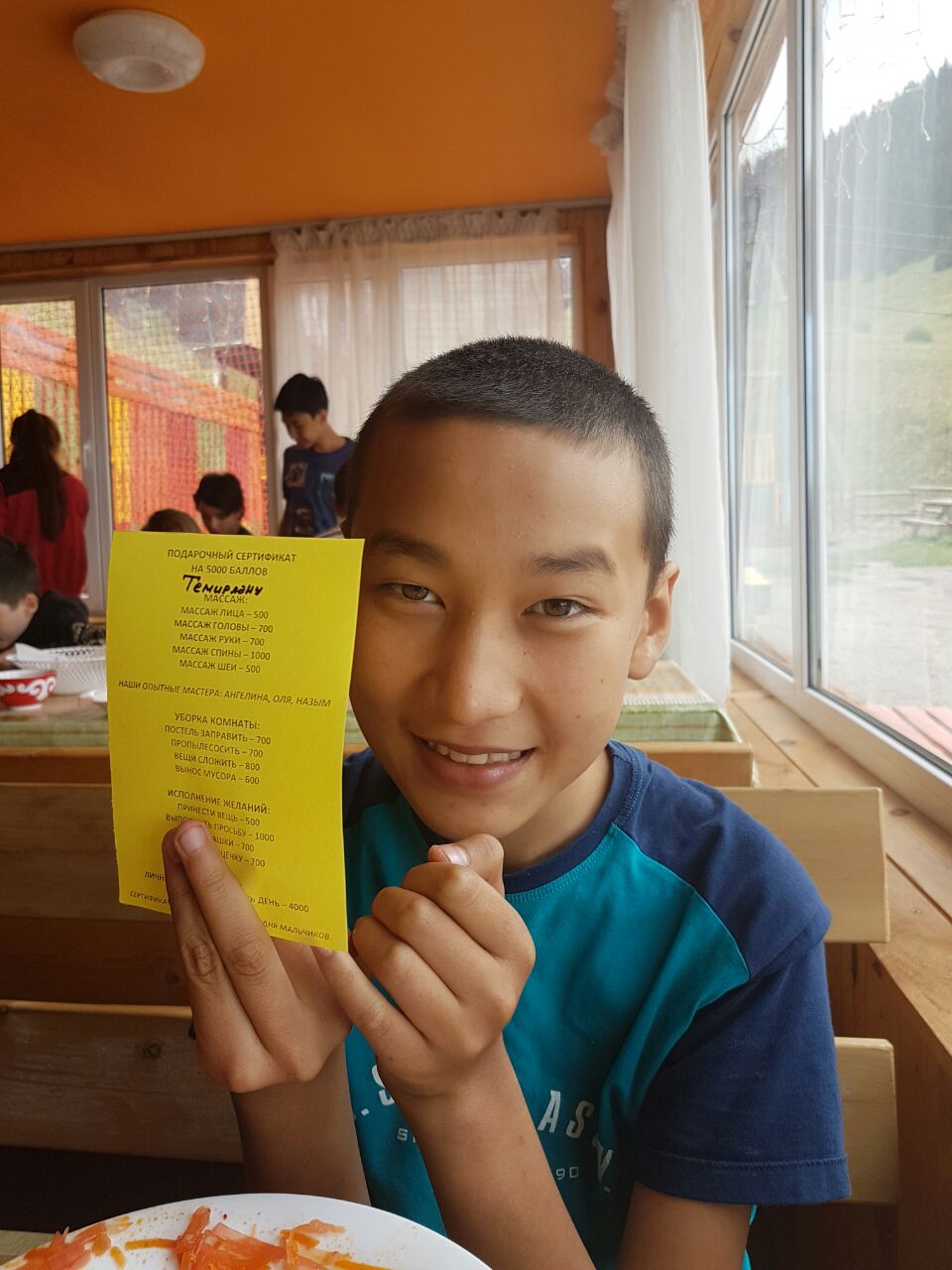 Tima had a massage session in the village, with a certificate.
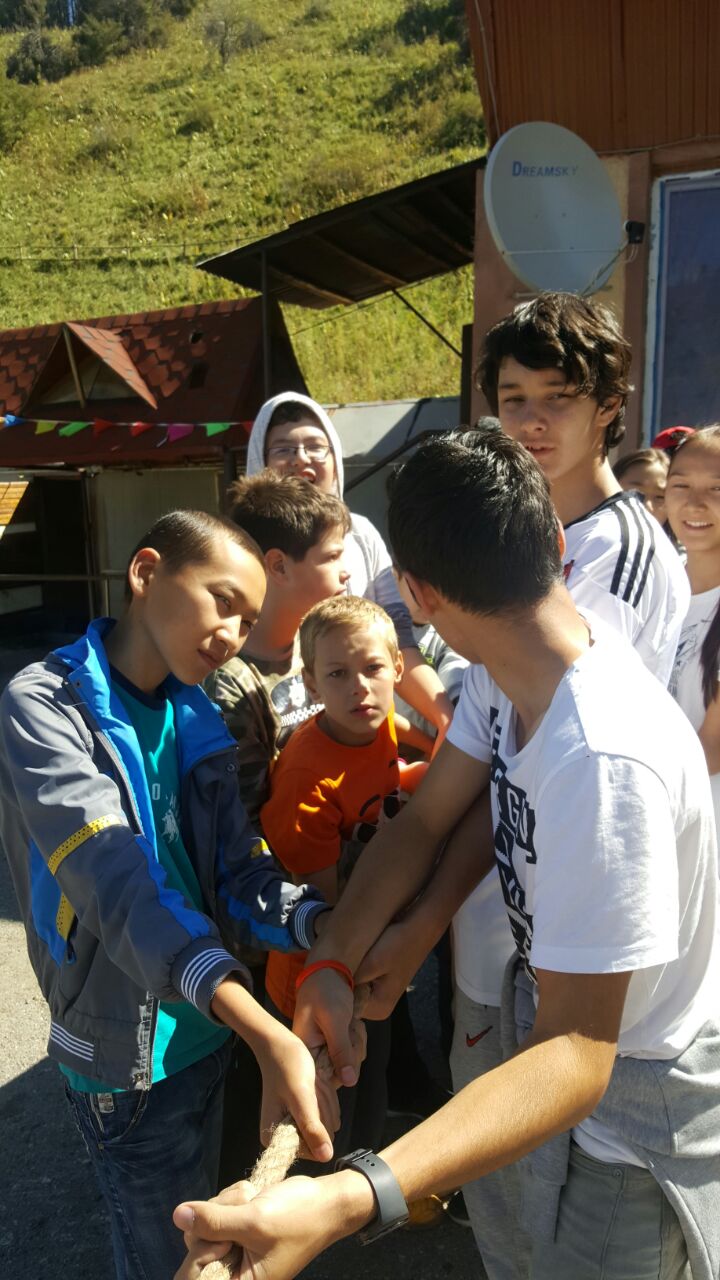
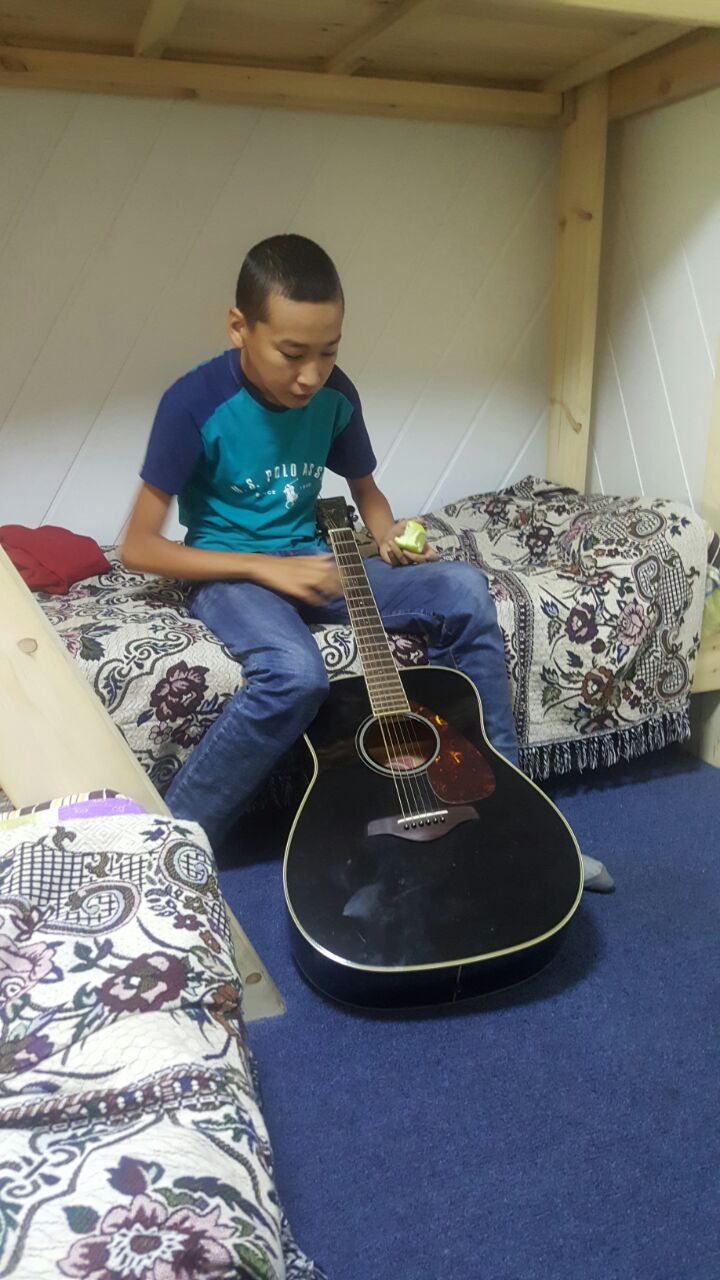
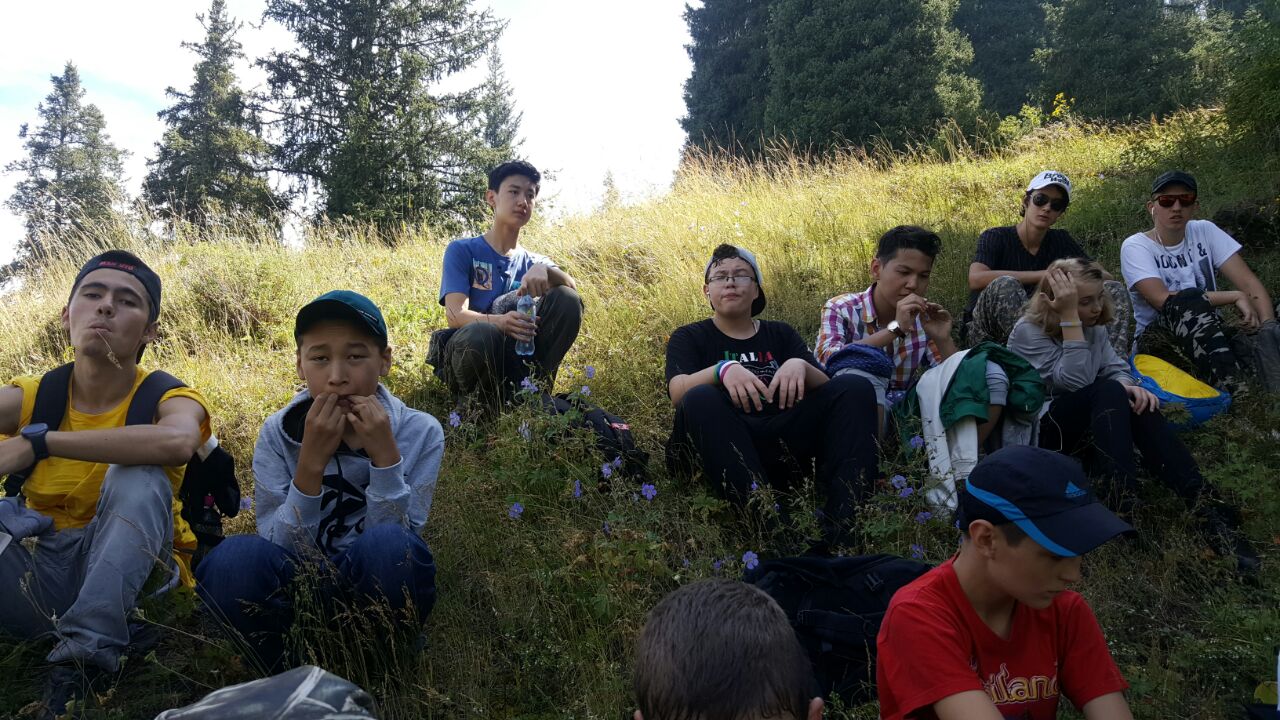
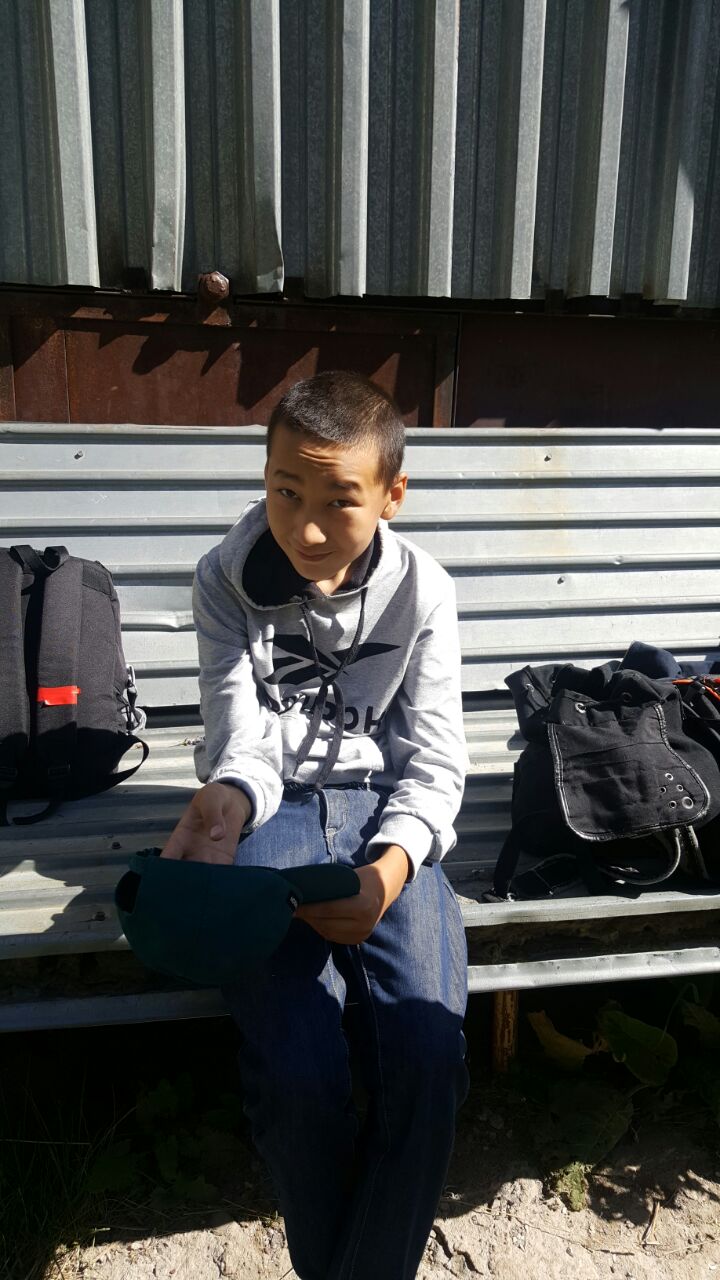
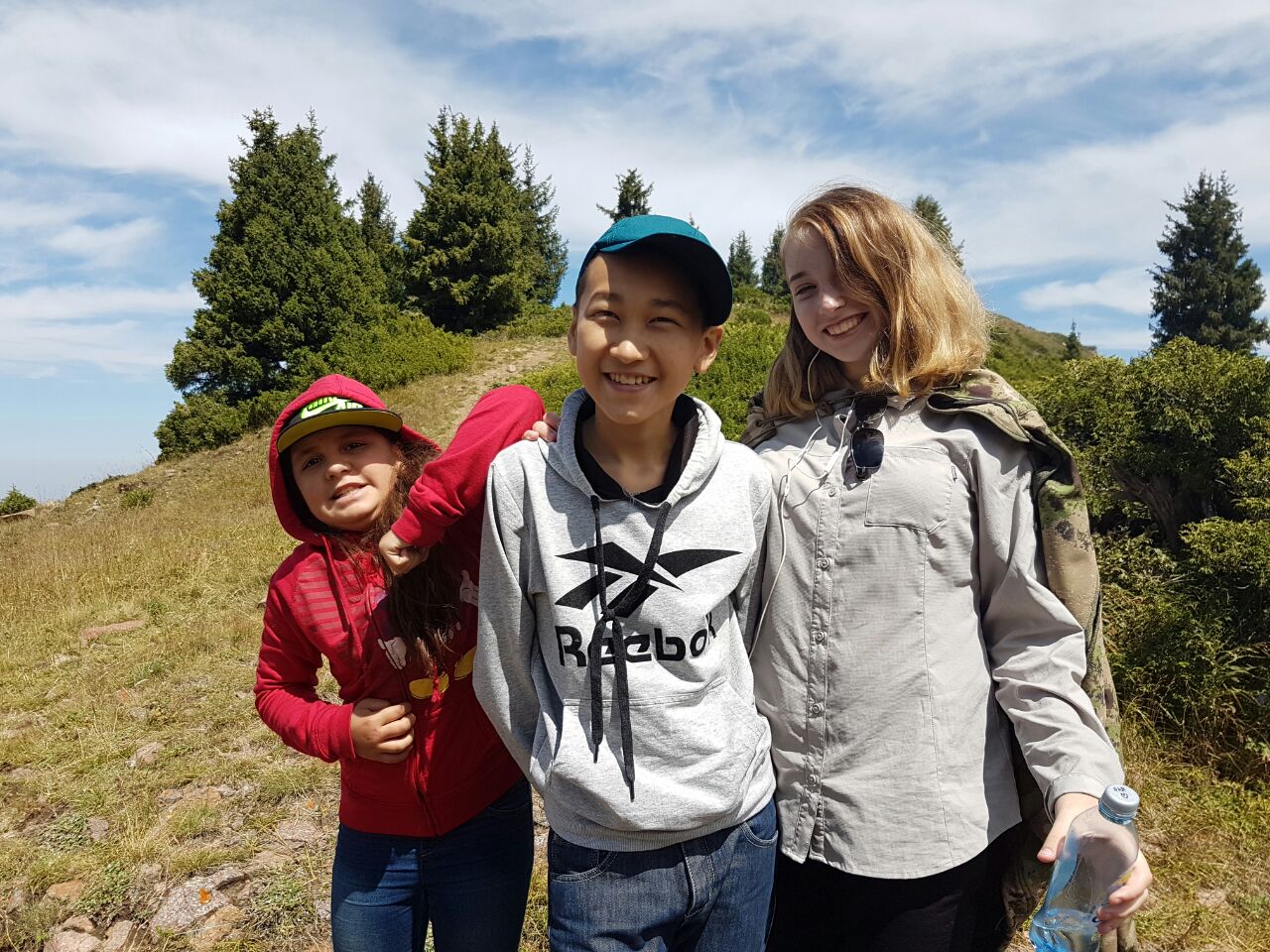
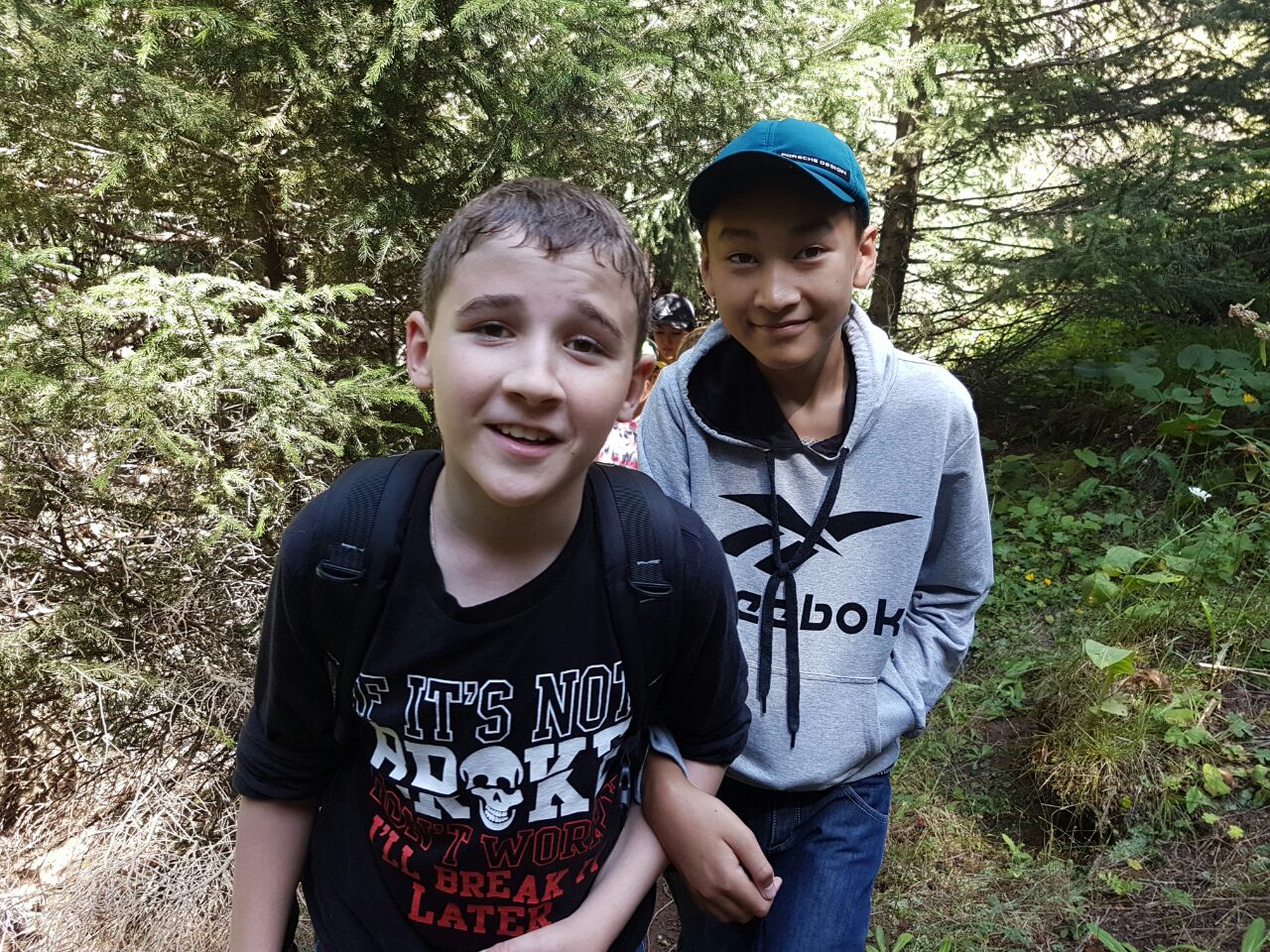 Friendship!
With the activities, nature, trust, responsibility, life with others, acceptance without a defectological or inferiorizing gaze, Tima changed completely in only four or five days.
A truly unimaginable photo on the day of his arrival, when he had interest only in his modeling clay.
And this is one example of success among many others at Pioneer.
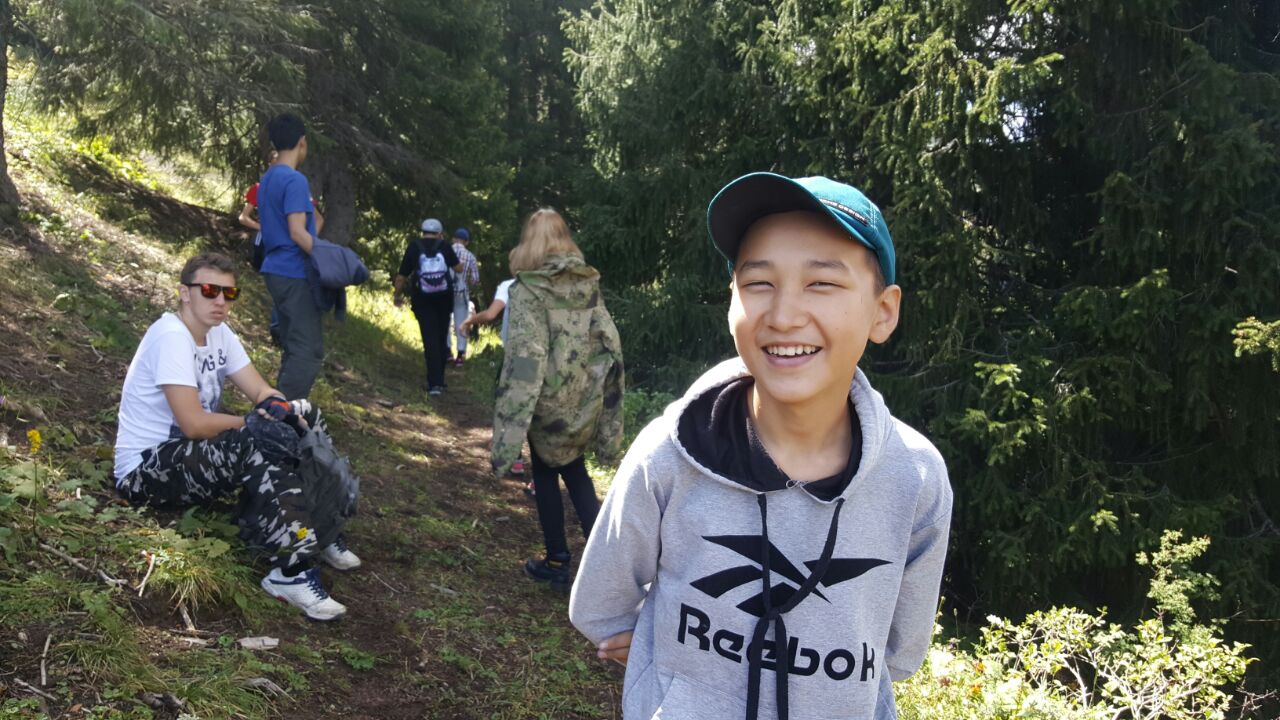
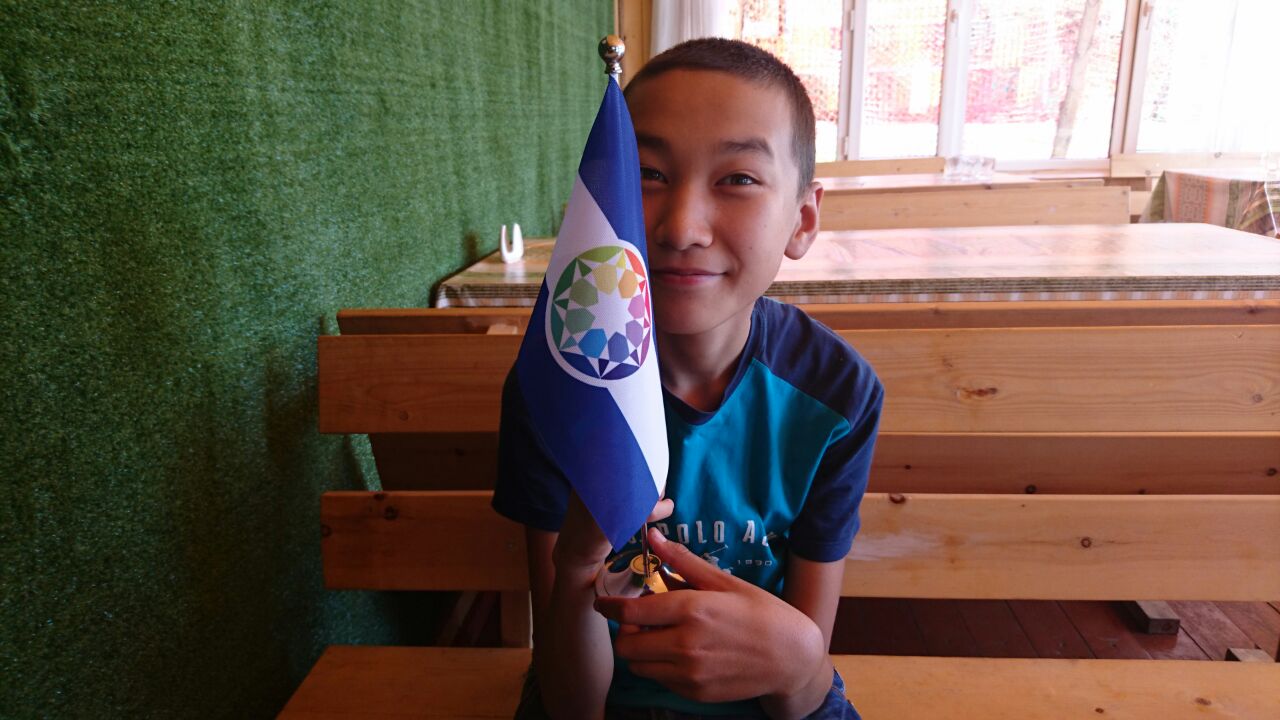 Calm and present.
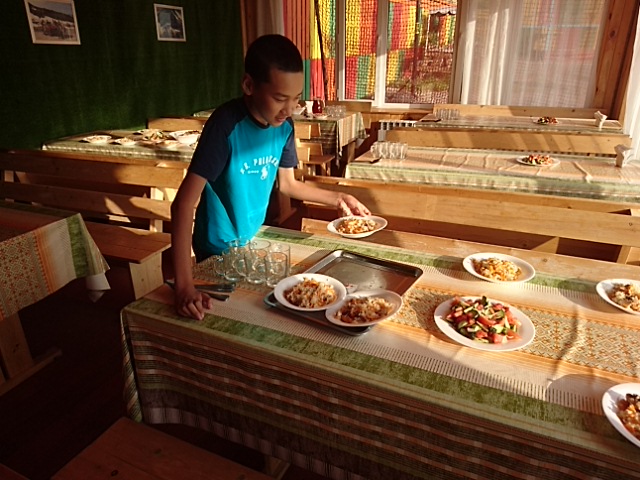
Tima could work in a restaurant.
Autistics must be given opportunities instead of being put under a glass bell.
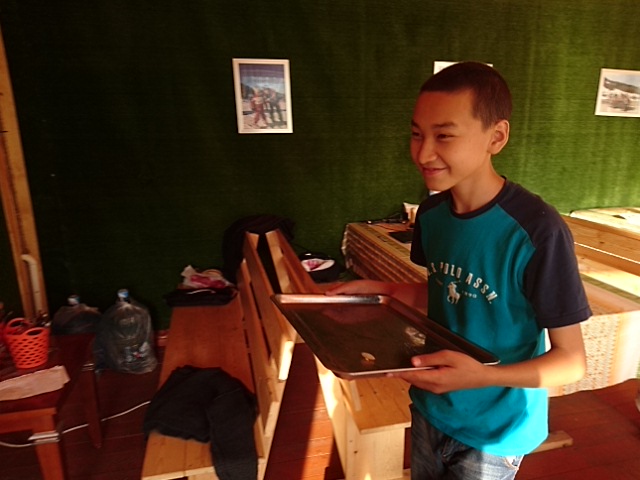
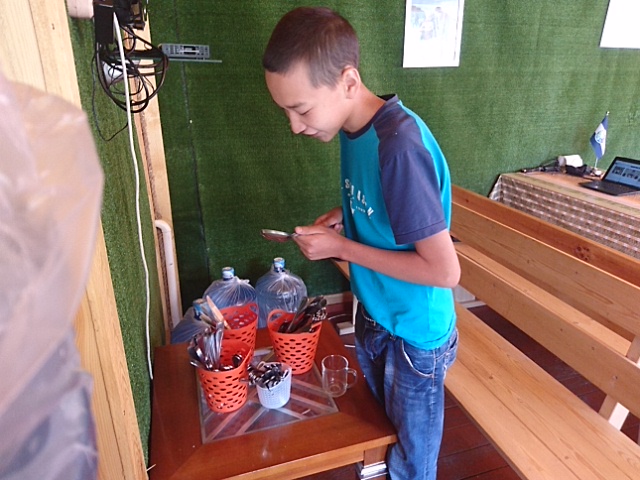
Now he “works” with a smile and confidence, after only five or six days.
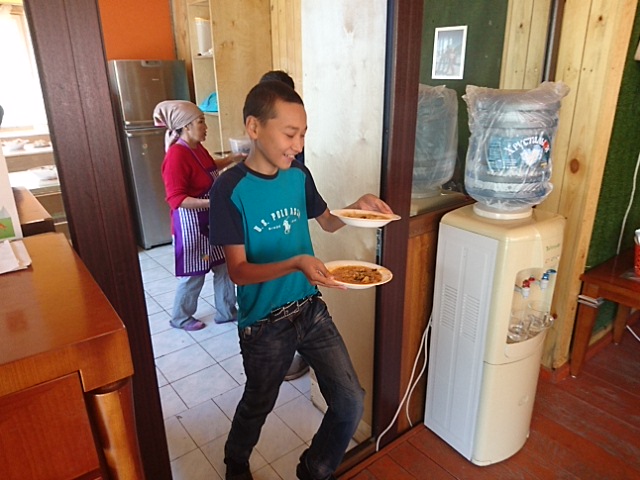
What a contrast with three or four days earlier!
As a reminder:
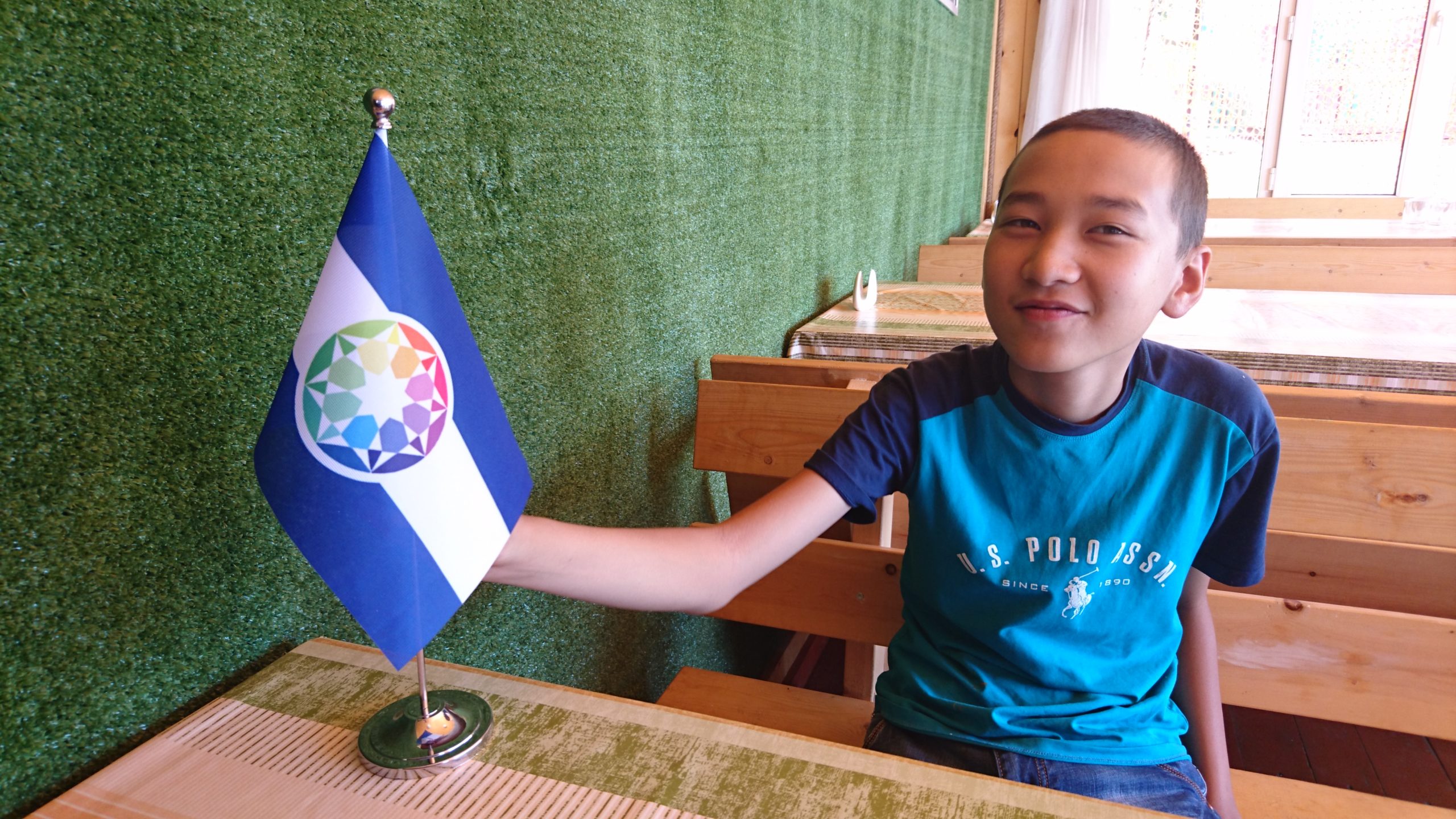
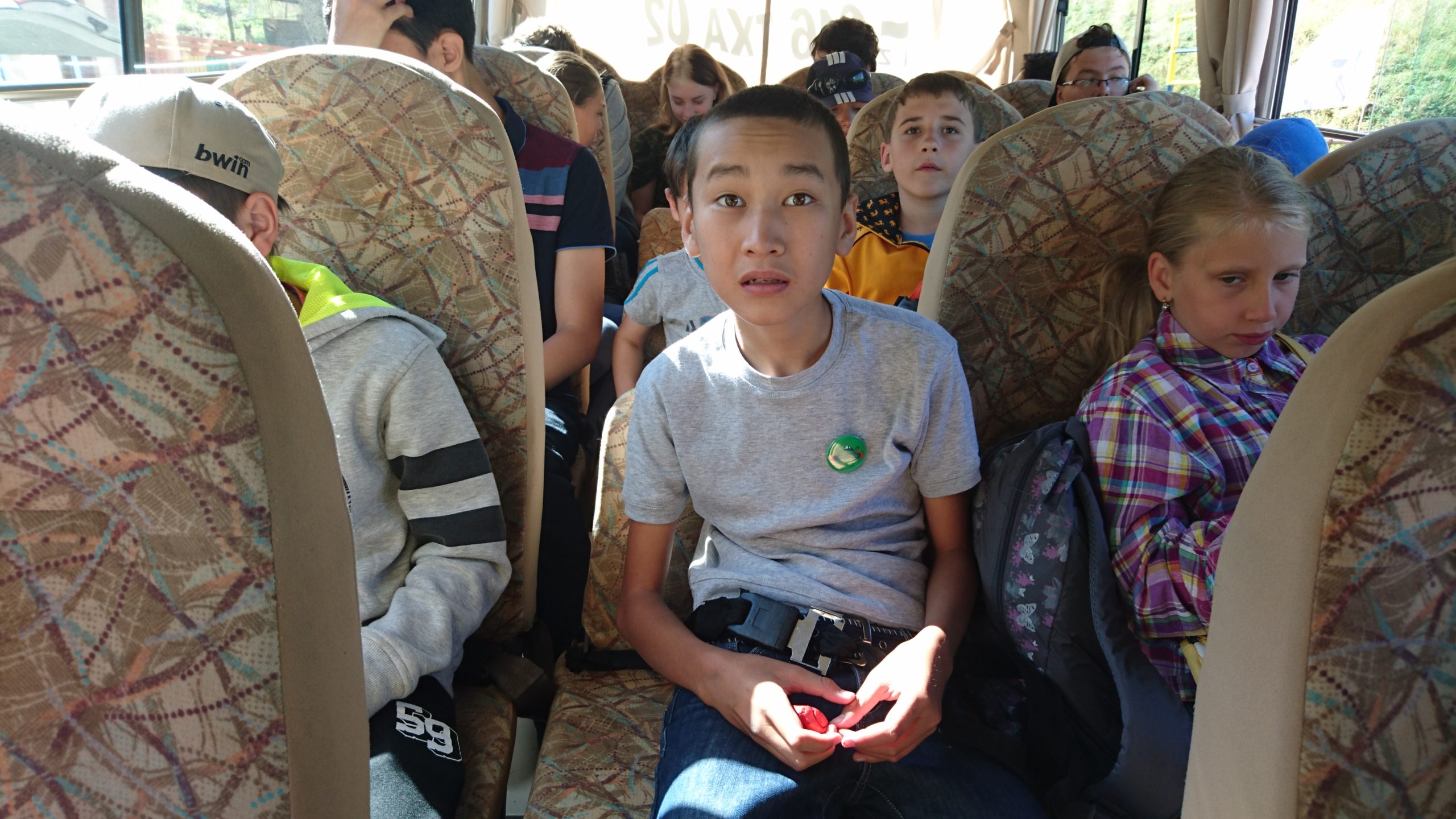
The sadness of leaving Pioneer.
Eloquent photos.
These images are not only memories. They show why Pioneer must be preserved: because a place capable of producing such human transformations cannot be reduced to a simple plot in an administrative file.
Preserving Pioneer means preserving a rare, concrete, and already proven experience of inclusion, accessibility, and progress for autistic children and their families.